
The traditional path to homeownership in Quebec is broken for first-time buyers; success now requires mastering the financial engineering of unconventional housing options.
- Combine government programs like the FHSA and HBP to create a six-figure down payment you didn’t know you had.
- Analyze “last resort” options like mobile homes and rent-to-own as calculated entry points, not compromises.
- Identify future boom towns by tracking infrastructure spending and employer growth before prices explode.
Recommendation: Shift your mindset from passively saving to actively structuring a deal. Your first home is out there, but it won’t be found on a conventional real estate search.
If you’re a first-time home buyer in Quebec, you’ve probably felt the sting of despair. You see home prices climb, interest rates hold firm, and the dream of ownership feels more distant with every passing month. The common advice—”save a bigger down payment” or “just look in cheaper areas”—feels not only unhelpful but completely disconnected from the reality of today’s market. When the median price for a single-family home can feel impossibly high, simply saving more isn’t a strategy; it’s a race you can’t win.
But what if the problem isn’t your budget? What if the problem is the game itself? The conventional approach to real estate is designed for a different era. To succeed today, you can’t just play harder; you have to play smarter. This means shifting your perspective from that of a frustrated saver to a savvy financial strategist. It requires a willingness to explore paths that others dismiss and to see opportunity where most see only risk. The key is not just finding an affordable house, but engineering the finances to make it yours.
This guide is your new playbook. We will move beyond the platitudes and dive deep into the unconventional, often-overlooked strategies that are creating homeowners in Quebec right now. We’ll explore the real math behind rent-to-own agreements, analyze the true cost of mobile homes, and reveal how to stack government programs for maximum impact. Forget what you think you know about buying a home; it’s time to learn the rules of a new game.
This article provides a detailed roadmap, breaking down the specific strategies and financial tools you can use to secure your first home in Quebec. Explore the sections below to build your personalized plan for market entry.
Summary: Your Guide to Finding an Entry-Level Home in Quebec Today
- Rent-to-Own: Is This Path to Homeownership a Scam or a Savior?
- Mobile Homes: The Last Truly Affordable Housing Option in Quebec?
- Why “Handyman Specials” Often Cost More Than Turnkey Homes?
- How to Combine the FHSA and HBP to Maximize Your Down Payment?
- Which Suburbs Offer the Best Price-to-Commute Ratio for First-Time Buyers?
- Prefab vs. Custom Build: Which Pod Strategy Offers the Fastest Payback Period?
- How to Identify the Next Boom Town Before Prices Skyrocket?
- Why You Need to Budget an Extra 3% for Closing Costs in Quebec?
Rent-to-Own: Is This Path to Homeownership a Scam or a Savior?
Rent-to-own (RTO), or “location-achat” in Quebec, carries a mixed reputation, often seen as either a brilliant loophole or a predatory trap. The truth is, it’s neither; it’s a financial instrument that requires careful analysis. In a market where the Quebec mortgage arrears rate remains among Canada’s lowest at 0.19%, lenders aren’t taking big risks, which means qualification standards are high. RTO offers a path for those who can’t meet those standards today but have a clear plan to do so within a few years.
The structure is simple: you rent a property with the option to buy it later at a predetermined price. A portion of your monthly rent, plus an upfront “option fee,” is credited toward your future down payment. The appeal is clear: you lock in a price and build equity while you rent. However, the risks are significant. If you can’t secure a mortgage at the end of the term, you typically forfeit your option fee and all accumulated credits. It’s a high-stakes bet on your future financial health.
The key to making RTO a “savior” instead of a “scam” is to treat it like a business transaction. It’s not just a rental agreement; it’s a private mortgage in waiting. This requires extreme diligence, from vetting the program’s legal standing to calculating the true cost against other savings strategies. You must be confident in your ability to improve your credit and income within the contract’s timeframe. For the disciplined buyer, RTO can be a powerful tool for forced savings and market entry. For the unprepared, it can be a costly lesson.
Your Action Plan: 5 Critical Steps to Evaluate Quebec Rent-to-Own Agreements
- Verify Legitimacy: Confirm the program is registered with Quebec’s housing authorities and review all Civil Code compliance documents with an expert.
- Calculate the True Cost: Tally up the option fee, rent premiums, and final purchase price. Compare this total cost against a strategy of traditional renting plus aggressive saving in an FHSA over the same period.
- Seek Legal Counsel: Before signing anything, have a Quebec notary meticulously review the ‘contrat de location-achat’ to ensure your investment is protected and all terms are compliant with provincial law.
- Check for Program Stacking: Investigate if the property and your situation would qualify for municipal first-time buyer programs, like Montreal’s assistance, upon final purchase.
- Model the End Game: Compare the total cost over the RTO term (e.g., 3 years) against a scenario where you rent traditionally while maximizing contributions to your FHSA and RRSP. Which path yields a larger down payment?
Mobile Homes: The Last Truly Affordable Housing Option in Quebec?
In a province where the median price of single-family homes in Quebec reached $450,000, the idea of buying a home for under $150,000 sounds like a fantasy. Yet, this is the reality in the mobile home market. For too long, mobile homes have been dismissed as a “last resort,” but for a budget-focused buyer, they represent a powerful, calculated entry point into real estate. The key is to look past the stigma and analyze the numbers objectively.
The most significant difference lies in the financing and ownership structure. A mobile home is often financed with a chattel mortgage—a loan on a movable piece of property—rather than a traditional mortgage. These loans typically have higher interest rates and shorter amortization periods. Furthermore, you usually buy the home but rent the land it sits on, creating a monthly lot rent payment. This is where many buyers get scared off. However, a “true cost” analysis often reveals a compelling financial case.
When you compare the total monthly outlay (chattel mortgage + lot rent + taxes) to the cost of a traditional mortgage on a small condo, the mobile home is almost always drastically cheaper. This isn’t just about a lower purchase price; it’s about a fundamentally lower cost of living that can free up thousands of dollars per year. This surplus cash can then be invested, accelerating your journey to your next property. It’s a strategy of using an affordable asset to build capital for a future move.
This comparative table breaks down the financial realities, moving beyond the sticker price to reveal the long-term cost implications of each housing type in Quebec.
| Cost Factor | Mobile Home | Small Condo |
|---|---|---|
| Purchase Price | $80,000-$150,000 | $250,000-$350,000 |
| Monthly Lot Rent | $300-$500 | N/A |
| Property Tax | Minimal | $2,000-$3,500/year |
| Financing Type | Chattel Mortgage | Traditional Mortgage |
| Interest Rate | 7-10% | 5-6% |
| Insurance Cost | Higher premiums | Standard rates |
| 10-Year Total Cost | $160,000-$220,000 | $380,000-$480,000 |
Why “Handyman Specials” Often Cost More Than Turnkey Homes?
The “handyman special” is a classic real estate siren song for first-time buyers: a low purchase price that promises instant equity for those willing to put in some “sweat.” The reality in Quebec, however, is that these properties are often financial quicksand. The low sticker price masks a universe of hidden costs that can quickly eclipse any potential savings. The real challenge isn’t the cosmetic work you can see; it’s the structural, climate-related issues you can’t.
Quebec’s harsh winters, clay-rich soil, and older housing stock create a perfect storm for expensive problems. A “great deal” in the Eastern Townships or Laurentians might have a crumbling foundation from years of freeze-thaw cycles. An older Montreal duplex could be filled with vermiculite insulation containing asbestos. These aren’t simple DIY fixes; they are complex, expensive repairs requiring specialized contractors and often triggering a cascade of other necessary upgrades to meet modern building codes. Suddenly, your “affordable” project costs more than a turnkey home and has taken you out of the market for a year.
This is not to say that a fixer-upper can never be a good investment. However, you must approach it as a professional developer would: with a pessimistic budget and expert inspections. Before you even make an offer, you need quotes from contractors—not just a general inspector. You also need to aggressively leverage financial aid. The true cost of a handyman special isn’t the purchase price plus renovations; it’s the purchase price plus renovations, plus contingency funds, plus your time, minus any grants you can secure. Proactively applying for programs like Quebec’s Rénoclimat for energy efficiency upgrades or checking for municipal heritage grants on older buildings is not optional; it’s essential to making the math work.

As this image reveals, the surface-level issues are rarely the whole story. A small crack can be a sign of significant moisture damage or structural shifting, turning a weekend project into a multi-month, five-figure repair. A successful purchase depends on your ability to accurately diagnose and budget for these hidden liabilities before you commit.
How to Combine the FHSA and HBP to Maximize Your Down Payment?
For a first-time buyer in Quebec, the single most powerful tool is not a real estate agent or a mortgage calculator; it’s a deep understanding of financial engineering using government programs. The introduction of the First Home Savings Account (FHSA) has created an unprecedented opportunity to stack benefits with the existing Home Buyers’ Plan (HBP). Used together, they allow a couple to potentially access a massive, tax-advantaged down payment that can change their purchasing power overnight.
Here’s the core strategy: the FHSA allows you to contribute $8,000 per year up to a lifetime maximum of $40,000. These contributions are tax-deductible (at both federal and provincial levels in Quebec), and withdrawals for a first home are tax-free. The HBP allows you to withdraw up to $60,000 from your RRSP, tax-free, which you must repay over 15 years. The magic happens when you combine them. As a couple, you can each use both programs. This means a potential down payment of $200,000 ($40k FHSA + $60k HBP, per person). For an individual, first-time buyers can access up to $100,000.
This isn’t just about the raw numbers; it’s about the tax strategy. By contributing to an RRSP and then transferring funds to your FHSA (within limits), you can get a tax deduction on the RRSP contribution and then withdraw the money tax-free from the FHSA. This is a level of financial leverage that was previously unimaginable. Understanding these mechanics is the difference between struggling to save a 5% down payment and confidently putting down 20%, avoiding costly mortgage insurance.
The following table illustrates the key differences and synergies between the two cornerstone programs for Quebec residents. Note the crucial distinction in repayment obligations and eligible uses.
| Program Feature | FHSA | HBP |
|---|---|---|
| Maximum Amount | $40,000 | $60,000 |
| Annual Contribution Limit | $8,000 | Based on RRSP limit |
| Tax Deduction (Quebec) | Yes – Federal & Provincial | Yes – on contribution |
| Repayment Required | No | Yes – 15 years |
| Grace Period | N/A | 5 years (until 2025) |
| Can Use for Closing Costs | Yes | No – down payment only |
| Combined Benefit | $100,000 per person ($200,000 per couple) | |
Case Study: A Quebec Couple’s $80,000+ Down Payment Strategy
A young couple in Montreal, both first-time buyers, executed this strategy perfectly. They each opened an FHSA and also maximized their RRSP contributions. For their home purchase, they were able to withdraw their FHSA funds tax-free. In addition, they each utilized the HBP to withdraw $35,000 from their RRSPs. Combined with other incentives like a provincial land transfer tax rebate, they were able to reduce their upfront purchasing costs by over $80,000, allowing them to afford a home in a neighborhood they previously thought was out of reach.
Which Suburbs Offer the Best Price-to-Commute Ratio for First-Time Buyers?
The old real estate mantra was “drive until you qualify,” forcing buyers into long, soul-crushing commutes in exchange for affordability. The modern, strategic approach reframes this trade-off. It’s not about the “price-to-commute ratio” but the “commute-to-equity ratio.” You are not just buying a longer commute; you are investing that travel time into a more affordable asset with, ideally, a higher potential for appreciation. The key is to choose a suburb where infrastructure and quality of life are on the rise.
In the Greater Montreal area, the REM transit network is the single biggest factor redrawing the affordability map. Suburbs that were once isolated are now becoming connected hubs. The strategic buyer looks for areas where the REM is operational or under construction, but where property values have not yet fully priced in the new convenience. This means looking at second-ring suburbs and analyzing the total monthly cost: mortgage, property taxes, and the EXO transit pass for the relevant zone. This holistic calculation often reveals that a home further out, but on a direct transit line, is financially smarter than a closer property that requires expensive car ownership.
Beyond Montreal, entire cities are emerging as havens of affordability. Trois-Rivières, for example, offers an incredible value proposition where it only requires 28.5% of the median household income for mortgage payments. This level of affordability provides significant financial breathing room. When evaluating these areas, a smart buyer looks beyond just the house price and considers factors like daycare availability through Quebec’s centralized system and the presence of English-language services, if required.
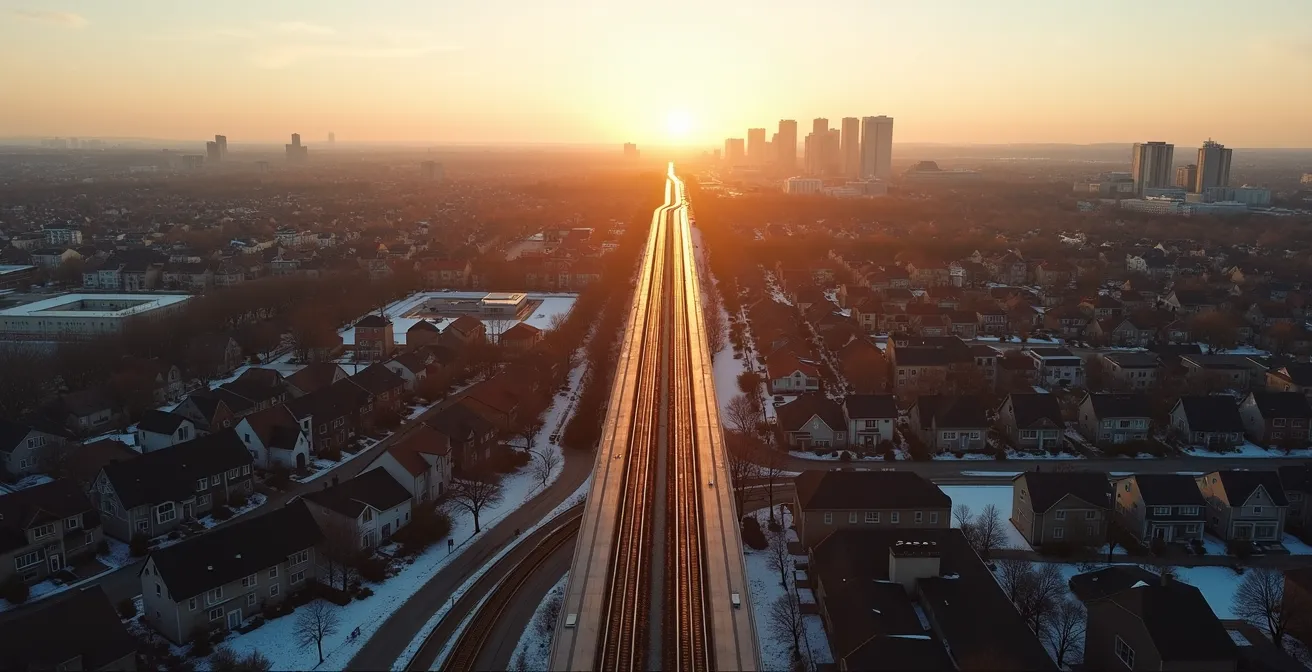
This view showcases the new suburban landscape shaped by transit. The strategic challenge is to identify the neighbourhoods along these corridors that still offer a reasonable “commute-to-equity” balance before they become the next hot market. It’s about buying where the puck is going, not where it is now.
Prefab vs. Custom Build: Which Pod Strategy Offers the Fastest Payback Period?
While often discussed in the context of adding a rental unit (ADU), the underlying principles of prefab and modular construction offer a radical, and increasingly viable, path to first-time homeownership. Instead of buying a finished home, the strategy is to acquire a cheaper plot of land in an emerging area and place a factory-built home on it. This approach can dramatically lower costs and shorten timelines compared to a traditional custom build, but success hinges on navigating municipal zoning and permits.
The game has recently changed in Quebec. To combat the housing crisis, the provincial government has granted municipalities “superpowers” to fast-track housing projects by circumventing their own complex zoning rules. This creates an opportunity for zoning arbitrage, where a savvy buyer can find a municipality eager to approve new, dense, or unconventional housing types like prefabs. This is where companies like Quebec-based Maisons Laprise shine, offering pre-approved designs that can streamline the permit process significantly.
The financial trade-off is clear: a custom-built home allows for more personalization and potentially higher rental income if it’s a multi-unit, but comes with a much longer timeline and higher budget uncertainty. A prefab home offers speed, cost certainty, and a faster path to occupancy. For a first-time buyer, this speed is critical. It means you stop paying rent and start building equity months, or even a year, sooner than with a custom build. This accelerated timeline is the key to a faster payback period, making it a powerful strategy for entering the market.
Case Study: Montreal’s Zoning “Superpowers” in Action
Since early 2024, cities across Quebec have been using new powers to accelerate housing development. In Montreal, several real estate projects that would have been tied up in zoning debates for years have received fast-tracked approval. This legislative shift signals a new willingness from municipalities to embrace innovative housing solutions, including smaller, prefabricated homes on previously unusable lots—a trend a first-time buyer can strategically exploit.
How to Identify the Next Boom Town Before Prices Skyrocket?
The most successful real estate investors don’t follow the market; they anticipate it. For a first-time buyer, adopting this mindset means learning to be an “economic detective.” It’s about identifying the subtle indicators that signal a town is on the cusp of a growth spurt, allowing you to buy in before the price wave hits. You’re not looking for today’s hot spots; you’re looking for tomorrow’s. Quebec City, which recently posted the strongest price growth nationally at 13.5%, is a perfect example of a market that was, not long ago, a quiet and affordable alternative.
So, what are the clues? The first place to look is at large-scale infrastructure projects. Monitor announcements from Transport Quebec for new highway interchanges or transit expansions. These projects are the arteries that bring economic life to smaller communities. Second, track major private investments. The announcement of the Northvolt battery plant in Saint-Basile-le-Grand, for example, instantly put surrounding towns on the map as future employment hubs. Following the jobs is a time-tested strategy.
Demographics and quality-of-life indicators are the final pieces of the puzzle. Use data from the Institut de la statistique du Québec to track inter-provincial and intra-provincial migration patterns. Where are people moving to? Often, the answer is smaller municipalities that are expanding their services. Watch for announcements about fiber internet rollouts in rural areas—a critical enabler for remote work. On a more granular level, even mapping the opening of new microbreweries, artisanal bakeries, and specialty retail shops can serve as a powerful proxy for a town’s growing appeal to a younger, more affluent demographic. These are the leading indicators of a future boom.
Key Takeaways
- Master Financial Engineering: Your greatest asset is not your savings account, but your ability to strategically combine the FHSA and HBP to create a powerful, tax-advantaged down payment.
- Embrace the Unconventional: Options like mobile homes and rent-to-own are not signs of failure. They are calculated entry points that require rigorous financial analysis to become successful first steps on the property ladder.
- Become an Economic Detective: The best deals are found by anticipating market growth. Track infrastructure spending, major employer announcements, and quality-of-life indicators to find the next boom town before everyone else does.
Why You Need to Budget an Extra 3% for Closing Costs in Quebec?
You’ve done it. You’ve navigated the market, engineered your finances, and found your home. But just before you get the keys, you face one final, often underestimated, hurdle: the closing costs. In Quebec, a first-time buyer can be blindsided by a bill that amounts to thousands of dollars they didn’t budget for. As a rule of thumb, you must set aside an additional 1.5% to 3% of the purchase price just to cover these mandatory expenses. Ignoring this can derail your entire purchase at the last minute.
The single largest component of this cost is the “Welcome Tax” (taxe de bienvenue), officially known as the land transfer tax. This tax is calculated on a tiered system based on the home’s price, and the rates in Montreal are higher than in the rest of Quebec. On a $450,000 home, this tax alone can be over $4,000. Next are the notary fees. In Quebec’s civil law system, a notary is legally required to handle the title transfer and mortgage registration. This service typically costs between $1,500 and $2,500.
These two items make up the bulk of the cost, but other expenses add up: property inspection fees, appraisal fees required by the lender, and adjustments for property taxes or condo fees already paid by the seller. The good news is some relief is available. For instance, Montreal offers financial assistance between $5,000 and $15,000 to eligible first-time buyers, which can be used to offset these costs. However, relying on this assistance without budgeting for the full amount is a risky gamble. The 3% rule is your best defense against a final, costly surprise.
This breakdown provides a realistic estimate of the closing costs you can expect at different price points in Quebec, highlighting why a separate budget is non-negotiable.
| Purchase Price | Welcome Tax | Notary Fees | Other Costs | Total (Approx. 3%) |
|---|---|---|---|---|
| $300,000 | $2,250 | $1,500-$2,000 | $1,000 | ~$9,000 |
| $450,000 | $4,250 | $2,000-$2,500 | $1,500 | ~$13,500 |
| $600,000 | $6,750 | $2,500-$3,000 | $2,000 | ~$18,000 |
| Note: Montreal has higher welcome tax brackets than other Quebec regions. | ||||
By shifting your mindset from a passive buyer to an active strategist, you can turn the overwhelming challenge of Quebec’s real estate market into a solvable equation. Start by calculating your maximum potential down payment using the FHSA and HBP stacking strategy and explore which of these unconventional paths aligns with your financial reality and risk tolerance.