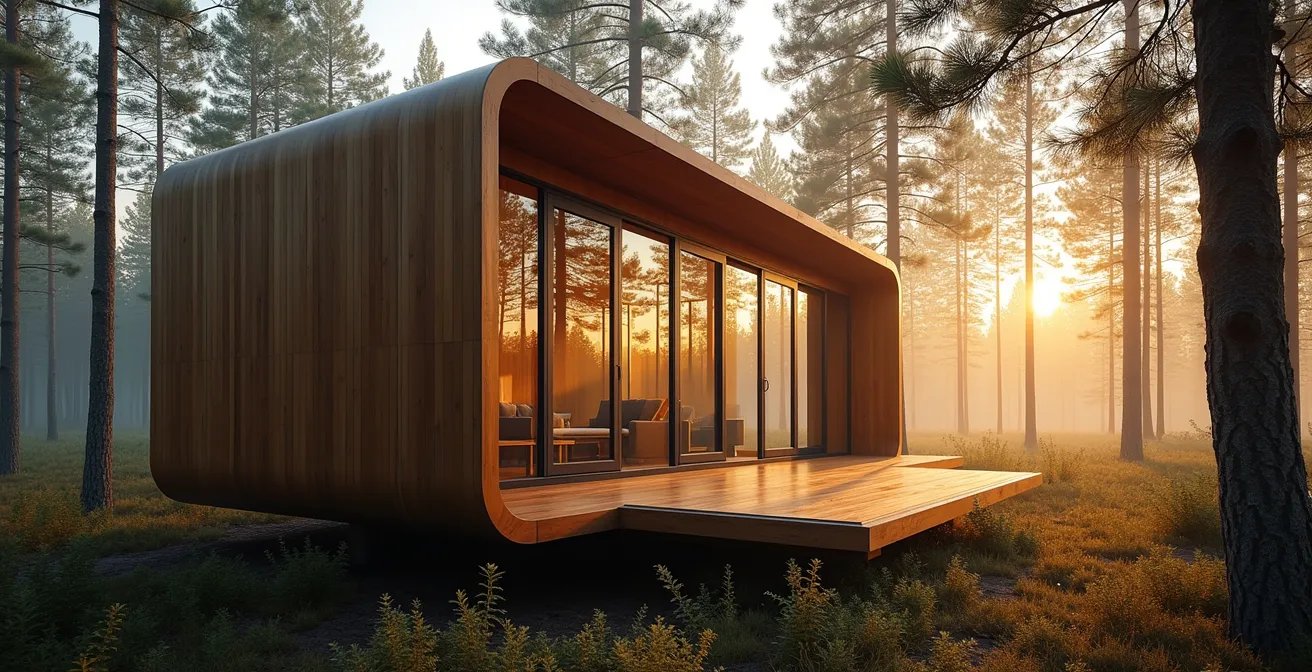
The highest ROI from eco-pods in Canada comes not from their small size, but from their ability to deliver a high-value, sustainable luxury experience that commands premium nightly rates.
- Success hinges on navigating specific Canadian building codes and municipal zoning, which can be a competitive advantage.
- Profitability is directly tied to climate-resilient design, ensuring year-round revenue even in the harshest winters.
Recommendation: Shift your focus from minimizing cost to maximizing the guest experience; this is the key to unlocking a faster and higher return on your land investment.
For the Canadian investor with a plot of land, the question is no longer just “what to build,” but “how to generate the highest return with the lowest impact.” The allure of eco-pods and tiny cabins is obvious, promising a departure from the capital-intensive headache of building a mansion. Many articles praise the minimalist trend and lower initial costs. But this view is dangerously incomplete.
The common advice to “check local bylaws” or “get good insulation” barely scratches the surface. These are not just boxes to tick; they are strategic levers for profitability. The true financial upside of this model isn’t found in simply building smaller. The key to unlocking a high-yield return lies in a more profound approach: treating the eco-pod not as a miniature house, but as a high-performance asset engineered for the luxury hospitality market. It’s about proving that sustainability, when executed with precision, is the most direct path to profitability.
This guide moves beyond the generic to offer a strategic framework for investors. We will demonstrate how mastering Canada’s unique regulatory landscape, embracing off-grid resilience, and designing for extreme climates are not hurdles, but the very cornerstones of a successful, high-ROI wilderness business. We will dissect the costs, the critical technical upgrades, and the design philosophies that turn a 300-square-foot box into a premium, revenue-generating destination.
This article provides a comprehensive roadmap for investors, covering every critical stage from initial legal checks to final business strategy. Explore the sections below to understand how to turn a small piece of land into a highly profitable, sustainable venture.
Summary: A Strategic Guide to Tiny Cabin Investment
- Is It Legal? How to Convince a Municipality to Allow Tiny Home Developments
- Solar and Composting Toilets: The Reality of Managing Off-Grid Rentals
- Prefab vs. Custom Build: Which Pod Strategy Offers the Fastest Payback Period?
- Can a Prefab Pod Really Survive a Saguenay Winter Without Freezing?
- Micro-Living Design: How to Make 300 Sq. Ft. Feel Like a Luxury Suite?
- Glamping vs. Camping: Why Travelers Pay 4x More for a Canvas Tent?
- -40°C Living: What Upgrades Does a Northern Home Absolutely Need?
- Buying a Pourvoirie: The Business of Luxury Wilderness, Not Just a Cottage
Is It Legal? How to Convince a Municipality to Allow Tiny Home Developments
The first and most critical barrier for any tiny home investor in Canada is not cost, but legality. The dream of a profitable eco-pod can be stopped cold by a single zoning bylaw. However, viewing this as a simple “yes/no” question is a mistake. The savvy investor sees it as an opportunity for regulatory arbitrage. The key is to stop asking “if” it’s allowed and start asking “how” it’s classified. Is it a park model home, an accessory dwelling unit (ADU), or a seasonal cottage? Each classification has different rules.
The landscape is shifting favourably. As a case in point, since 2021, Ontario has proactively updated its Planning Act and building codes to encourage alternative housing solutions like tiny homes and modular units. This has led to streamlined approvals and more flexible size requirements. Your mission is to approach the local planning department not with a vague idea, but with a specific, compliant proposal. Having a structure with CSA A277 certification (for factory-built homes) is non-negotiable; it proves your unit meets provincial building codes, separating the structure’s quality from the land’s zoning use.
To convince a municipality, you must present a professional case that highlights the benefits: increased housing diversity, a boost to local tourism, and a low-impact development model. Prepare to distinguish between the provincial building code, which your CSA-certified unit will meet, and municipal bylaws, which dictate how the land can be used. This proactive, well-researched approach transforms you from a hopeful landowner into a credible development partner. According to a guide for Canadian builders, it is essential to verify CSA certification and contact the local planning department before even purchasing land.
Solar and Composting Toilets: The Reality of Managing Off-Grid Rentals
For a rental pod, “off-grid” is not just an environmental statement; it’s a powerful marketing tool that justifies a premium price. It promises guests a true escape and simplifies site selection for investors, opening up cheaper, unserviced lots. However, the operational reality requires careful planning, especially in Canada. The system must be robust enough to handle a cloudy week in November and intuitive enough for a guest who has never used a composting toilet.
The core of a successful off-grid system is a correctly sized solar array and battery bank. This isn’t the place to cut corners. Under-sizing your system will lead to power outages and negative reviews, destroying your ROI. The goal is a four-season power solution, which means panels angled for the low winter sun and a battery bank capable of sustaining the cabin’s modest loads (lighting, fridge, water pump) for several days without sun. This technical reliability is the foundation of off-grid luxury.
This paragraph introduces the challenges and solutions for off-grid systems. The illustration below visualizes a winter-ready solar setup, a key component for any successful Canadian eco-pod investment.
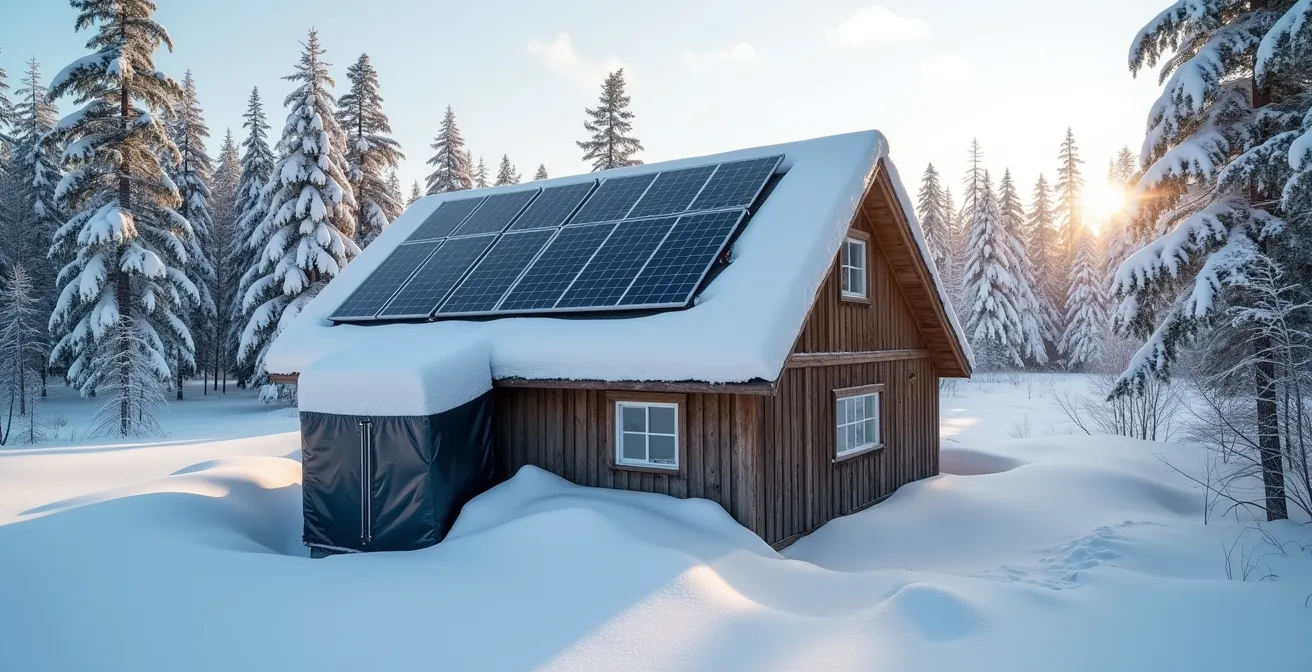
As this image demonstrates, the physical infrastructure must be prepared for harsh conditions. But what about the human element? The success of these systems is proven by real-world experience. A testimonial from an owner highlights the surprising comfort of a well-designed tiny home, even in extreme cold:
Winter heat in the tiny, -27 outside/overnight it was -40. Now, inside the tiny, it is +28, and underneath the tiny is -8. Feeling very cozy, warm and grateful for my Teacup tiny home.
– Real Experience from Teacup Tiny Homes Owner, Teacup Tiny Homes
This level of comfort doesn’t happen by accident. It is the result of meticulous engineering and quality components, proving that off-grid living can be both sustainable and incredibly comfortable, a key factor in commanding higher rental fees.
Prefab vs. Custom Build: Which Pod Strategy Offers the Fastest Payback Period?
Once you have a legal path and an off-grid strategy, the next major decision is your build strategy: prefabricated or custom. This choice directly impacts your upfront capital, timeline, and ultimately, the speed of your return on investment. A custom build offers unparalleled design freedom and the potential for “sweat equity” to lower costs, but it often comes with a longer, more complex timeline of 6 to 12 months and the risk of budget overruns.
For an investor focused on ROI, the prefabricated (prefab) route often presents a more compelling business case. The key advantages are speed and predictability. A CSA-certified prefab unit can be delivered in as little as four months and set up in days, allowing you to start generating revenue almost immediately. This compressed timeline dramatically accelerates your payback period. Furthermore, costs are largely fixed upfront, eliminating the financial uncertainty that plagues many custom projects. While a high-end custom build can reach $200,000 or more, a winter-ready, turnkey prefab pod often falls within a predictable $150,000 to $190,000 range.
The following table breaks down the typical costs and timelines for different build types in Canada, providing a clear financial overview for your investment decision. This data, based on a recent analysis of the Canadian tiny home market, is crucial for calculating your potential payback period.
| Build Type | Price Range (CAD) | Timeline | Key Features |
|---|---|---|---|
| Entry-Level Prefab | $80,000-$100,000 | 4 months delivery + 2 days setup | Container homes, basic THOWs, cabin-style |
| Mid-Range Prefab | $150,000-$190,000 | 4-6 months total | CSA certified, winter-ready, turnkey |
| Custom Build | $90,000-$200,000+ | 6-12 months | Site-specific design, sweat equity option |
| High-End Prefab | $195,000+ | 6 months | Passive house standard, premium finishes |
While the allure of a one-of-a-kind custom design is strong, the speed and cost certainty of a mid-to-high-end prefab model often deliver the fastest path to positive cash flow. This makes it the strategically superior choice for most investors looking to maximize their yield-per-square-foot.
Can a Prefab Pod Really Survive a Saguenay Winter Without Freezing?
The single greatest concern for any northern investor is the brutal Canadian winter. Can a small, prefabricated structure truly withstand -40°C temperatures in a region like the Saguenay without pipes freezing and guests complaining? The answer is an emphatic yes, but only with a non-negotiable commitment to a superior building envelope. This is where climate-resilient ROI becomes a tangible concept: investing more in the shell of the building guarantees year-round revenue and protects the asset itself.
The key lies in the insulation values. Forget standard residential specs. For a tiny home to be viable in Canada’s coldest regions, it must exceed typical requirements. According to the National Building Code of Canada requirements for cold climates, insulation values of R-40 in the walls and R-60 in the roof are considered critical benchmarks. This is often achieved with closed-cell spray foam, which provides a high R-value per inch and an essential air/vapor barrier in one product, preventing the dangerous buildup of interstitial condensation.
This paragraph introduces the crucial role of insulation and window technology in winter survival. The following illustration provides a close-up view of how a high-performance window acts as a thermal barrier against extreme cold.

As the image suggests, the battle against the cold is won at the component level. Beyond insulation, this includes triple-pane windows, meticulous air sealing around every joint and opening, and a properly insulated foundation to stop cold from seeping up from the ground. A prefab pod built to these standards isn’t just surviving winter; it’s creating a cozy, premium refuge that guests will pay more for, turning the harshest season into your most profitable one.
Micro-Living Design: How to Make 300 Sq. Ft. Feel Like a Luxury Suite?
Once you’ve ensured your eco-pod can survive the winter, the next step is to make it a place where people are willing to pay a premium to stay. The challenge of micro-living design is not about cramming in amenities, but about creating a sense of spaciousness, luxury, and connection to the landscape. This is how you generate an experience-driven premium. The goal is to make 300 square feet feel more liberating and luxurious than a 3,000-square-foot suburban home.
The first principle is to erase the boundary between inside and out. Floor-to-ceiling windows are not an optional upgrade; they are a core design feature that frames the Canadian wilderness as “living art.” This visual expansion of the space is the single most effective way to make a small interior feel vast. The interior layout should then be oriented to maximize these views from the bed, the seating area, and even the kitchen.
Luxury in a small space is also defined by the quality of finishes and integrated technology. Modern backyard pods achieve this with features like radiant floor heating, which provides silent, enveloping warmth, and smart thermostats that allow guests to arrive to a perfectly pre-heated cabin. High-quality, multi-functional furniture and sourcing from local Canadian artisans, such as EQ3 furniture or iconic Hudson’s Bay blankets, add a layer of authenticity and comfort that elevates the experience from a simple stay to a memorable retreat. The key is a ruthless focus on quality over quantity, ensuring every object and surface contributes to an atmosphere of refined comfort.
Glamping vs. Camping: Why Travelers Pay 4x More for a Canvas Tent?
To understand the economic model of eco-pod rentals, one must look to the “glamping” (glamorous camping) phenomenon. Why would a traveler pay $400 a night for a well-appointed tent when a standard campsite is $50? The answer lies in the removal of friction and the addition of comfort. Glamping provides the desired outcome of camping—immersion in nature—without the hassles of packing gear, sleeping on the ground, or dealing with the elements. It’s a pure, curated experience.
Your eco-pod investment operates on the exact same principle, but with a hard-sided, four-season advantage. Guests aren’t just paying for a bed; they’re paying for a stress-free, rejuvenating escape. They are buying back the time and effort it would take to achieve that level of comfort and immersion on their own. As a prime Canadian example, Cabinscape has perfected this model with off-grid, solar-powered tiny cabins that offer all modern amenities. They have proven that ecological responsibility, when paired with creature comforts, is a highly marketable and profitable combination.
This model allows entrepreneurs to see a return on investment far faster than with traditional hotel construction. By offering a unique, high-quality accommodation in a desirable natural setting, you tap into a market segment willing to pay a significant premium for the experience. The investment is no longer just in a physical structure, but in the creation of a seamless, luxurious gateway to nature. This is the fundamental economic engine that drives the high ROI of a well-executed eco-pod rental business.
Key Takeaways
- Profitability is driven by creating a premium, year-round guest experience, not by minimizing initial construction costs.
- Navigating Canadian regulations and building codes proactively is a competitive advantage, not just a hurdle.
- Investing in a superior, climate-resilient building envelope (high R-values, triple-pane windows) is the most critical factor for ensuring a high ROI through four-season operation.
-40°C Living: What Upgrades Does a Northern Home Absolutely Need?
For a rental cabin in the Canadian North, “winter-ready” is not a marketing term; it’s a technical specification that determines your business’s viability. Relying on a single heat source or standard insulation is a recipe for disaster. To ensure your asset is protected and your guests are safe and comfortable at -40°C, a series of critical, non-negotiable upgrades is required. This is the practical application of building for a climate-resilient ROI.
First and foremost is the heating system. A primary system like a mini-split heat pump offers excellent efficiency, but it must always be paired with a reliable backup. In a remote location, a power outage during a blizzard is a real possibility. A simple electric baseboard or a direct-vent propane stove can be a business-saver. As one expert on cold climate design states, system reliability is paramount. A Tiny Homes DIY Expert emphasizes in their Cold Climate Tiny Home Design Guide that electrical and heating systems must meet CSA standards, and carbon monoxide detectors are non-negotiable.
Electrical and heating systems must meet Canadian Standards Association (CSA) regulations to ensure reliability in freezing weather. Smoke and carbon monoxide detectors are non-negotiable for my designs, especially with wood stoves in use.
– Tiny Homes DIY Expert, Cold Climate Tiny Home Design Guide
Beyond heating, water is the next critical system. All water supply lines, especially those running underneath the cabin, must be protected with heat trace systems—an electric heating cable that runs along the pipe to prevent freezing. This, combined with proper foundation insulation (skirting), prevents the cold from incapacitating your plumbing and forcing you to shut down for the winter. These upgrades are not expenses; they are investments in year-round operational capacity.
Your Action Plan: Critical Cold Climate Upgrades Checklist
- Insulation: Install closed-cell spray foam insulation to achieve maximum R-values (aim for R-40 walls, R-60 roof) in limited wall thickness.
- Heating Systems: Choose between electric baseboards for simplicity or a mini-split heat pump for efficiency, but ALWAYS install a secondary backup heating system (e.g., propane stove).
- Foundation: Implement robust foundation insulation and skirting to prevent cold from penetrating the floor.
- Plumbing Protection: Install heat trace systems on all exterior or under-floor water supply and drain lines to guarantee they won’t freeze.
- Safety Compliance: Ensure all electrical/heating systems are CSA-certified and that functional smoke and carbon monoxide detectors are installed, especially if using combustion-based heat.
Buying a Pourvoirie: The Business of Luxury Wilderness, Not Just a Cottage
Ultimately, the most successful eco-pod investors in Canada do not think of themselves as landlords or cottage renters. They adopt a more sophisticated mindset: they are operating a micro-hospitality business. The best model for this is the Québec concept of a “pourvoirie” (outfitter)—a business that provides high-quality lodging and curated access to a wilderness experience. Your single eco-pod is a modern, miniaturized version of this proven business model.
Framing your investment this way shifts the entire strategy. You are no longer just providing a roof; you are selling an experience package. This justifies higher prices and encourages longer stays. It means thinking about partnerships with local guides for hiking or fishing, providing high-end amenities like a wood-fired hot tub, or offering a curated selection of local foods and drinks. The pod itself is the comfortable, stylish basecamp for a larger adventure.
This approach aligns perfectly with a growing, high-value market. The potential is significant, as the Canadian prefab tiny home market is already valued at over CAD $200 million annually and is projected to grow substantially. By positioning your offering at the premium end of this market, you capture the most profitable segment. You are not competing with cheap cottage rentals; you are competing with boutique hotels and luxury resorts, but with a fraction of the overhead and a far more unique selling proposition. This is the endgame for maximizing the ROI on your small plot of land—transforming it from a simple property into a destination.
To begin building your own profitable, low-impact hospitality business, the next logical step is to analyze your specific plot of land and local regulations to develop a compliant, site-specific investment plan.