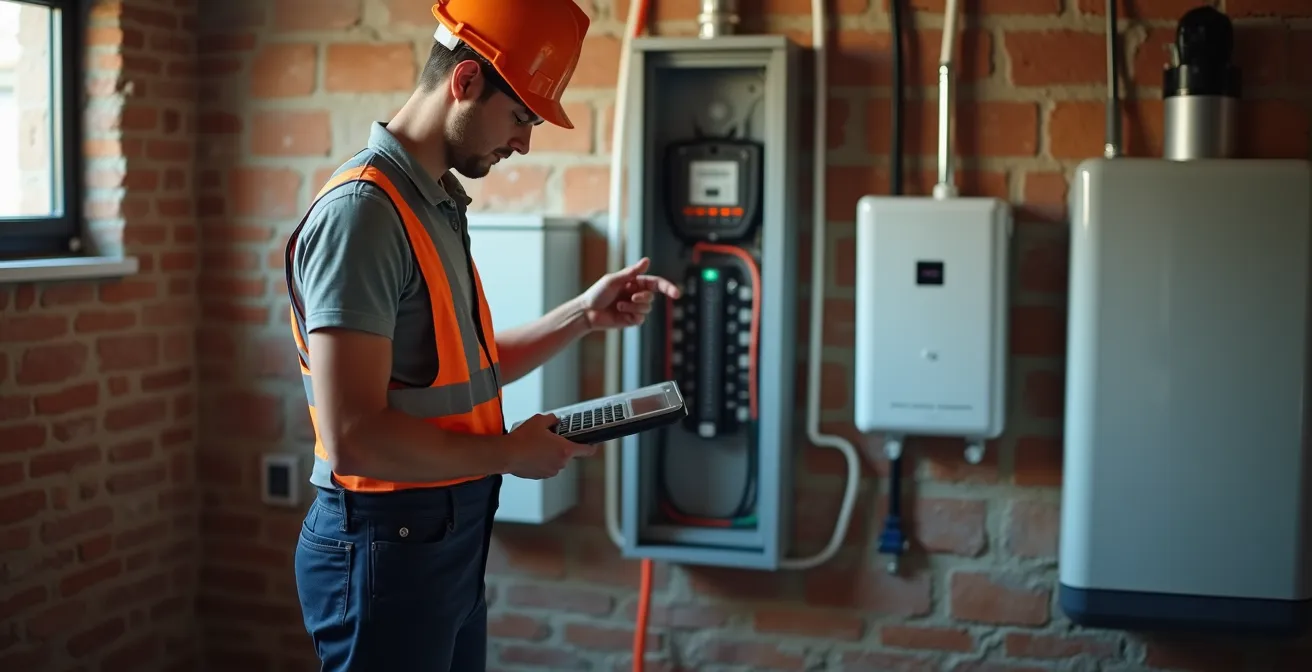
Your 100-amp panel is not just undersized for your new EV or hot tub; it’s a critical safety liability that most Canadian insurance companies will no longer cover.
- Outdated systems like fuse boxes and aluminum wiring present significant fire hazards and are red flags for insurers.
- Upgrading to a 200-amp service is a non-negotiable investment in safety, code compliance, and future-proofing your home’s value.
Recommendation: Immediately engage a licensed Master Electrician (‘maître électricien’ in Quebec) to perform a load calculation and plan a panel upgrade before adding any major new appliance.
You’ve made the decision. The new electric vehicle is on order, or you’re dreaming of a hot tub for those long Canadian winters. Then you hit the wall: the electrician takes one look at your electrical panel and shakes their head. Your 100-amp service, once the standard, is now a roadblock. For a homeowner, this moment is frustrating. For a Master Electrician, it’s a critical safety intervention. The conversation isn’t just about adding more power; it’s about confronting the hidden risks of an electrical system that was never designed for the demands of the 21st century.
Many articles will give you a generic list of power-hungry appliances. But they miss the fundamental point, the one that keeps us up at night: your electrical panel is the heart of your home’s circulatory system. When that heart is strained, it doesn’t just fail to perform; it becomes a critical point of failure. The issue isn’t just about tripping a breaker. It’s about overheating wires, arcing connections, and the very real possibility of an electrical fire. It’s also about a growing financial risk that many homeowners discover too late: uninsurability.
This guide cuts through the noise. From my perspective as a Master Electrician obsessed with safety, we will dissect the real reasons your 100-amp panel is a liability. We’ll move beyond the “what” and into the “why”—why insurers refuse coverage, why new code requirements like AFCI breakers are expensive but essential, and what the specific process for a service upgrade with a utility like Hydro-Québec actually involves. This isn’t about upselling you; it’s about empowering you to make a safe, informed decision that protects your family, your investment, and your future plans.
To navigate this crucial topic, we’ve structured this guide to address every key concern, from insurance and legacy wiring issues to the practical steps for an upgrade and accessing financial aid. Here is a clear roadmap of what we will cover.
Summary: A Homeowner’s Guide to Electrical Panel Safety and Upgrades
- Fuses vs. Breakers: Why Insurance Companies Mandate Panel Upgrades?
- Why Insurance Companies Refuse to Cover Houses Built Before 1950?
- Aluminum Wiring: Do You Need to Rewire the Whole House?
- AFCI Breakers: Why Do New Code Requirements Cost So Much?
- Smart Panels: Is It Worth Spending Extra for Energy Monitoring?
- 200 Amps Upgrade: How to Coordinate with Hydro-Quebec for a Service Change?
- How to Install an EV Charger in a Condo Without Starting a War?
- Energy Efficiency in Quebec: How to Get MaPrimeRénov to Pay for Your Upgrades?
Fuses vs. Breakers: Why Insurance Companies Mandate Panel Upgrades?
The first call a homeowner often makes after being denied insurance is to an electrician, completely bewildered. The reason is frequently a 60-amp or 100-amp fuse panel. From a safety perspective, fuses are a fundamentally archaic technology. Unlike a modern circuit breaker that simply trips and can be reset, a fuse burns out. This leads to a dangerous tendency for homeowners to replace a blown fuse with one of a higher rating—a catastrophic mistake that allows more current than the wires can handle, creating an extreme fire hazard. This single behaviour is why the insurance industry has taken a hard-line stance.
Insurers are in the business of risk management, and a fuse box is an unquantifiable risk. Breakers are calibrated and tamper-resistant; fuses are not. Furthermore, older panels often lack a main shut-off, making it impossible for emergency services to quickly de-energize the house. These factors combined mean that today, most Canadian insurers now refuse coverage for homes with 60-amp service, and many are extending this policy to any home still using a fuse-based panel, regardless of amperage. The message is clear: the system is not just outdated, it’s actively unsafe and financially toxic.
If you’re in this situation, the path forward is not negotiation; it’s remediation. An upgrade to a modern 100-amp or 200-amp breaker panel is the only solution. Once the work is completed by a licensed electrician, you can obtain an electrical safety certificate to prove to the insurer that the risk has been eliminated, finally making your home insurable at a standard rate.
Why Insurance Companies Refuse to Cover Houses Built Before 1950?
Owning a century home in a historic Canadian neighbourhood is a dream for many, but it can quickly become an insurance nightmare. For properties built before 1950, the refusal to insure goes beyond just the panel’s amperage; it’s about a high probability of encountering “knob-and-tube” wiring. This original wiring method, consisting of single insulated copper conductors run through porcelain knobs and tubes, lacks a ground wire—an essential safety feature that protects against electric shock. Over decades, the insulation on these wires becomes brittle and can flake off, creating a severe arcing and fire hazard within your walls.
From an insurer’s perspective, knob-and-tube wiring is an unknown variable. There is no way to visually inspect its condition throughout the house without opening up walls. This, combined with the almost certain presence of an undersized 60-amp fuse panel, makes the property a textbook high-risk case. As a result, most Canadian insurers now refuse to insure homes with 60-amp electrical service, a policy that disproportionately affects these older character homes. They simply will not take on the liability associated with an ungrounded, decaying, and overloaded electrical system.
Case Study: Toronto’s Century Home Insurance Challenge
In older Toronto neighbourhoods like The Annex, homeowners frequently face insurance refusals for their pre-1950 properties. The primary culprits are outdated 60-amp fuse boxes and the presumed presence of knob-and-tube wiring. The standard path to insurability involves commissioning a “four-point inspection” (covering the roof, plumbing, electrical, and HVAC systems), which typically costs between $400 and $600. This inspection almost always mandates a full electrical panel upgrade to a modern 200-amp service, a project costing $3,000 to $5,000, as the non-negotiable first step to securing any insurance coverage.
For owners of these beautiful older homes, the solution is a proactive one. A complete rewire is often the safest long-term option, but at a minimum, the service and panel must be upgraded, and any active knob-and-tube circuits must be professionally decommissioned and replaced to satisfy both the Canadian Electrical Code and any potential insurer.
Aluminum Wiring: Do You Need to Rewire the Whole House?
If your home was built between the mid-1960s and late-1970s in Canada, there’s a strong chance it contains solid single-strand aluminum wiring. Used as a cost-saving measure during a period of high copper prices, this type of wiring has since been identified as a significant safety concern. The problem is not the aluminum itself, but its physical properties. Aluminum expands and contracts more than copper when it heats and cools, and it also oxidizes differently. Over time, this can cause connections at outlets, switches, and the panel to loosen, leading to overheating, sparking, and a serious fire risk—the cascading risk of a single faulty connection.
The thought of this often leads homeowners to the terrifying conclusion that they need a complete, and very expensive, home rewire. While a full copper rewire is the gold-standard solution, it is not the only safe or approved option. The Canadian Electrical Code recognizes specific remediation methods that are far more cost-effective. The most common is “pigtailing,” where a licensed electrician adds a short piece of copper wire to the end of each aluminum wire at every connection point (outlets, switches, fixtures). These connections are made using special CSA-approved connectors, such as purple Marr No. 65 twist-on connectors or AlumiConn lugs, designed to join copper and aluminum safely.
This remediation addresses the point of failure—the connection itself—without the massive disruption and cost of a full rewire. A home properly remediated with approved methods is considered safe and is accepted by insurance companies, provided the work is done by a licensed professional and inspected by the local electrical safety authority (like Ontario’s ESA).
The cost difference is significant and often makes the difference between a homeowner fixing the problem or ignoring it. The following table illustrates the financial options for a typical Canadian home.
| Solution | Cost Range (CAD) | Time Required | Insurance Acceptance |
|---|---|---|---|
| Full Copper Rewire | $15,000 – $25,000+ | 1-2 weeks | 100% acceptance |
| CSA-Approved Pigtailing | $2,500 – $5,000 | 1-2 days | Accepted with ESA certificate |
| AlumiConn Connectors | $3,000 – $6,000 | 2-3 days | Accepted by most insurers |
As one project in a 1970s Toronto home demonstrated, choosing CSA-approved pigtailing can cost 80% less than a full rewire while still meeting all safety and insurance requirements. This makes safety accessible and is the responsible path forward for most homeowners with aluminum wiring.
AFCI Breakers: Why Do New Code Requirements Cost So Much?
When getting a quote for a new panel, many homeowners are shocked by the line item for the breakers themselves. “Why does this one breaker cost $70 when this other one is $10?” The answer is modern safety technology mandated by the Canadian Electrical Code (CEC). The expensive ones are Arc-Fault Circuit Interrupters (AFCIs). While a standard breaker protects against overloads and short circuits (major events), an AFCI breaker is a sophisticated electronic device designed to detect something far more subtle and dangerous: an unintended electrical arc.
An arc fault is a small spark of electricity that can be caused by a damaged extension cord, a wire punctured by a picture-hanging nail, or a loose connection behind an outlet. These low-level arcs may not draw enough current to trip a standard breaker, but they generate intense heat—often exceeding 5,000°C—and are a leading cause of electrical fires. An AFCI breaker constantly “listens” to the electrical signal on the circuit. It recognizes the unique signature of a dangerous arc and cuts the power in milliseconds, long before the arc can ignite surrounding materials. This is a level of protection that simply didn’t exist two decades ago.
This advanced protection comes at a price. The internal electronics of an AFCI are far more complex than a simple thermal-magnetic breaker. The significant cost increase is a direct result of this technology. According to pricing from Canadian contractors, AFCI breakers cost $60-$80 each vs. $10 for standard breakers, which can add over $1,000 to the total cost of a panel upgrade. However, the CEC now requires AFCI protection on almost all circuits in a home for a reason. This isn’t an upsell; it’s the modern standard of care for fire prevention.
Think of it as the difference between having basic seatbelts and having a full airbag system in your car. Both provide protection, but one addresses a far wider and more insidious range of potential dangers. The cost of AFCI breakers is a direct investment in proactive fire prevention and peace of mind.
Smart Panels: Is It Worth Spending Extra for Energy Monitoring?
Once you’ve accepted the need for a panel upgrade, a new question arises: should you install a standard 200-amp panel or invest in a “smart” one? A smart panel is essentially a modern breaker panel with built-in digital technology. It connects to your Wi-Fi and allows you to monitor and control every single circuit in your home from a smartphone app. You can see exactly how much energy your EV charger, heat pump, or even your coffee maker is using in real-time. You can also remotely turn circuits on or off and set schedules for high-load appliances.
Is this just a gimmick for tech enthusiasts? From a safety and management perspective, absolutely not. The primary benefit is unprecedented control. A smart panel can alert you if a circuit is drawing an unusual amount of power, which could indicate a malfunctioning appliance before it fails completely. For homeowners with EVs, it allows for intelligent load management, ensuring the car charges without overloading the system when other major appliances are running. It provides the data needed for a true electrical load calculation, not just a theoretical one.

The financial argument is also compelling, especially in provinces with time-of-use (TOU) electricity rates. A smart panel can automatically schedule high-consumption activities, like charging your EV or running your hot water heater, during off-peak hours when electricity is cheapest. For example, analysis of utility rates shows that smart panels can save Ontario homeowners 15-30% on electricity bills through this automated scheduling. While the upfront cost is higher—typically $1,500 to $3,000 more than a standard panel—it’s an investment that pays for itself over time through energy savings and provides a superior level of control and safety insight.
200 Amps Upgrade: How to Coordinate with Hydro-Quebec for a Service Change?
The panel upgrade itself is only half the job. The new 200-amp panel is useless until the utility provider, like Hydro-Québec, upgrades the “service drop”—the main power line running from the street to your house. This requires careful coordination and is a process many homeowners find opaque and intimidating. Let me be clear: your licensed electrician (a ‘maître électricien’ in Quebec) is your project manager for this process. You do not coordinate with Hydro-Québec directly; they do.
The process follows a set of predictable steps. First, your electrician performs a detailed load calculation to justify the 200-amp request and submits the official service request to Hydro-Québec through their professional portal. Hydro-Québec’s technicians then conduct a technical evaluation, which can take several weeks, to determine if their local infrastructure (like the neighbourhood transformer) can handle the increased load. Once approved, they issue a cost estimate, or ‘devis’, for their portion of the work.
Your electrician then schedules a work window, coordinating their team and the Hydro-Québec crew. On the scheduled day, your electrician installs the new 200-amp meter base, the weather mast, and the panel itself. Then, the Hydro-Québec crew arrives to disconnect the old service drop from the pole and connect the new, larger-capacity line to your new equipment. The final step is a formal inspection by the Régie du bâtiment du Québec (RBQ) to certify the installation, after which the service is fully activated.
Your Action Plan: The Hydro-Québec Service Upgrade Process
- Hire a ‘maître électricien’ licensed by the RBQ (Régie du bâtiment du Québec) to lead the project.
- Your electrician submits a service request via Hydro-Québec’s online portal, including detailed load calculations.
- Await Hydro-Québec’s technical evaluation and cost estimate (‘devis’), which typically takes 2-3 weeks.
- Schedule a work window that coordinates both your electrician’s team and the Hydro-Québec crew’s availability.
- Your electrician completes the “customer-side” work: installing the new mast, meter base, and 200A panel.
Understanding the cost division is critical for budgeting. The homeowner is responsible for all work on the house itself, plus the cost of the final connection from the utility. This table breaks down the typical responsibilities in a Hydro-Québec service upgrade.
| Work Component | Who Pays | Typical Cost (CAD) |
|---|---|---|
| Panel, meter base, mast | Homeowner via electrician | $2,400 – $4,000 |
| Service drop connection | Homeowner to Hydro-Québec | $800 – $1,500 |
| Transformer upgrade (if needed) | Hydro-Québec (may charge) | $0 – $3,000 |
| Permits and inspections | Homeowner | $250 – $500 |
How to Install an EV Charger in a Condo Without Starting a War?
For a condo owner, the desire for an EV charger presents a unique challenge. You don’t just have a technical problem; you have a political one. Your 100-amp panel might be the first hurdle, but the bigger one is often the condo board and a building infrastructure that was never designed for dozens of high-load chargers. Approaching this as an individual request is often a recipe for failure. The key is to reframe the conversation from “my charger” to “our building’s future.”
Your first step is research. Understand your rights under your provincial condominium legislation, such as Ontario’s Condominium Act or BC’s Strata Property Act, which increasingly include “right to charge” provisions. Instead of demanding a hookup, propose that the board commission a building-wide “EV-Ready Assessment” from an engineering firm. This study will analyze the building’s total electrical capacity and provide a strategic plan for adding EV charging infrastructure for all residents over time. This shifts the focus from a single resident’s need to a long-term capital improvement for the entire building.
Bolster your case with data. Presenting evidence from real estate professionals can be incredibly persuasive. As the Canadian Real Estate Association points out, this is an investment that benefits everyone:
Installing EV charging infrastructure increases property value and marketability for all units in the building, not just those with EVs.
– Canadian Real Estate Association, 2024 Condominium Market Trends Report
Finally, propose cost-effective technical solutions. Load-sharing technologies, like those from Quebec-based DCC Electric, allow multiple chargers to share a single circuit, dynamically distributing power without requiring a massive and expensive service upgrade for the entire building. Offering to pilot an installation at your own expense, based on the findings of the EV-Ready Assessment, can be the final step to getting the board’s approval and setting a precedent for the entire community.
Key Takeaways
- An outdated electrical panel (60A/100A, fuse-based) is a major fire hazard and a primary reason for insurance denial in Canada.
- Modern safety standards, like AFCI breakers, significantly increase the cost of a panel upgrade but are non-negotiable for fire prevention.
- Upgrading your service to 200 amps is a coordinated project between your electrician and the local utility, requiring professional management.
Energy Efficiency in Quebec: How to Get MaPrimeRénov to Pay for Your Upgrades?
After outlining the necessary costs for safety and modernization, the final piece of the puzzle is managing the budget. Many Canadian homeowners, particularly in Quebec, look for government programs to help offset these significant expenses. A common point of confusion is “MaPrimeRénov”. Let’s be perfectly clear: MaPrimeRénov is a program for residents of France and is not available in Canada. The equivalent programs Quebec residents should focus on are the federal Canada Greener Homes Grant and provincial programs like Hydro-Québec’s LogisVert.
It’s crucial to understand that these programs do not typically offer a direct rebate for a standalone electrical panel upgrade. The panel is considered an “enabling cost”—a necessary prerequisite for the technologies the programs actually want to incentivize, such as electric heat pumps or solar panel installations. The strategy, therefore, is to bundle the panel upgrade with an eligible energy-efficiency project. This allows you to access the financial incentives to cover a portion of the total project cost.
Case Study: Stacking Federal and Provincial Rebates in Quebec
A Quebec homeowner installing a new heat pump can “stack” rebates. They can apply for the federal Canada Greener Homes Grant, which offers up to $5,000. In parallel, they can apply to Hydro-Québec’s LogisVert program. While the panel upgrade itself isn’t directly rebated, it can be financed through the federal Canada Greener Homes Loan—an interest-free loan of up to $40,000. By classifying the panel upgrade as a necessary enabling cost for the heat pump, its expense can be rolled into this 0% interest loan, significantly easing the financial burden.
The mandatory first step to access any of these programs is a pre-renovation EnerGuide evaluation. You must hire a registered Service Organization to perform this assessment, which costs around $600. This fee, however, is typically reimbursed once your eligible upgrades are completed and a post-renovation evaluation is done. This process ensures that the upgrades meet the program’s energy-saving targets and validates your eligibility for grants and loans.
Now that your home is safe, compliant, and ready for the future, the final step is to ensure it is fully protected. Contact your insurance provider with your electrical safety certificate to confirm your new coverage and enjoy the peace of mind that comes with a professionally upgraded system.
Frequently Asked Questions About Electrical Upgrades and Rebates in Quebec
Is MaPrimeRénov available in Quebec?
No, MaPrimeRénov is a French program. Quebec residents should apply for the Canada Greener Homes Grant and Hydro-Québec’s LogisVert program instead.
Can I get a rebate for my electrical panel upgrade?
Panel upgrades aren’t directly eligible for rebates but may be financed through the federal loan program as an enabling cost for heat pumps or solar installations.
What’s the first step to access these programs?
You must hire a registered Service Organization to perform a pre-renovation EnerGuide evaluation, which costs $600 but is reimbursed upon completion of upgrades.