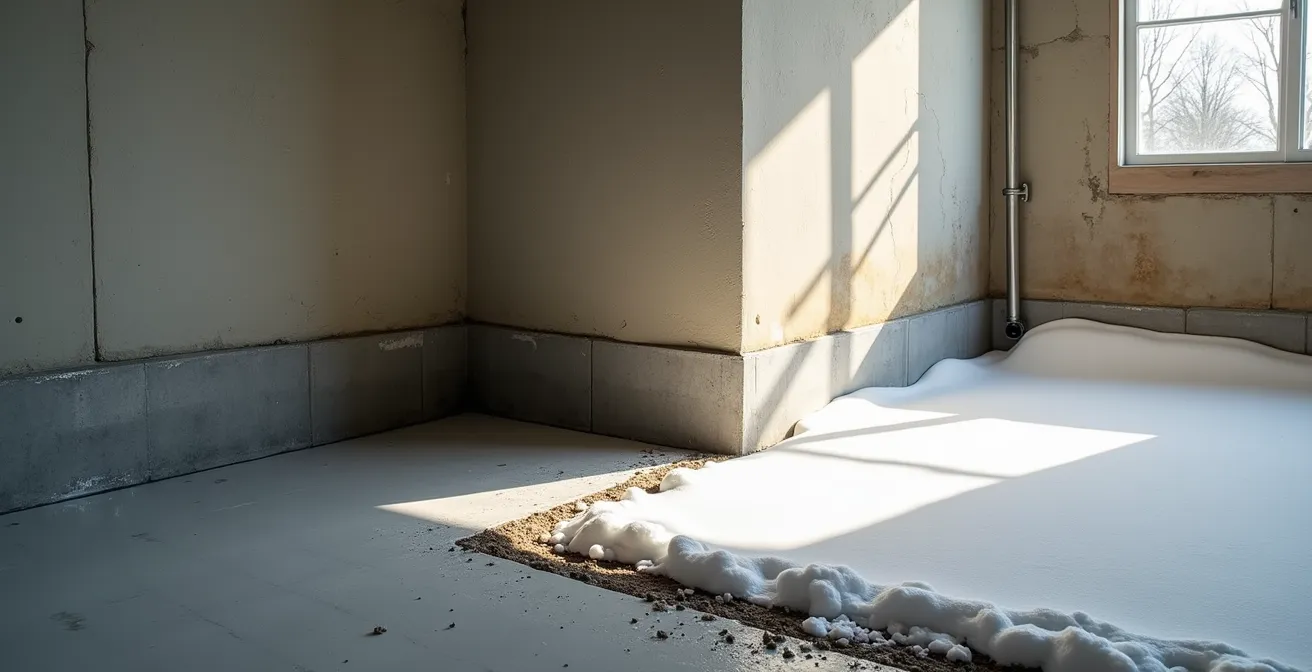
Protecting your foundation from the Canadian spring thaw is a battle against hydrostatic pressure and the freeze-thaw cycle, not just dampness.
- Traditional solutions like tar and basic French drains often fail under the specific pressures of Quebec’s clay soil and frost heave.
- Modern materials like elastomeric membranes and flexible polyurethane injections offer durable, long-term protection by adapting to ground movement.
Recommendation: Shift your focus from superficial, short-term fixes to strategic investments in modern waterproofing technologies that preserve your property’s structural integrity and value.
For any Canadian homeowner, the spring thaw is a double-edged sword. It signals the end of a long winter, but it also marks the beginning of the annual battle against water. As snow and ice melt, the ground becomes saturated, creating immense hydrostatic pressure against your foundation walls. This isn’t just a matter of a damp basement; it’s a direct assault on the structural integrity and value of your most significant asset. Many homeowners believe cleaning gutters and patching visible cracks is enough. While these are good maintenance habits, they are fundamentally surface-level tactics against a subterranean enemy.
The real fight happens below grade, where the freeze-thaw cycle has spent months creating new pathways for water infiltration. In regions like Quebec, with heavy clay soils and deep frost penetration, traditional waterproofing methods like tar coatings and simple drain pipes often prove inadequate. The ground’s movement causes rigid materials to crack and standard drains to clog or collapse. The challenge isn’t just to block water, but to implement a defense system that can withstand the powerful forces of nature unique to our climate.
But what if the key wasn’t simply patching leaks as they appear, but building a resilient, flexible shield around your foundation? This guide moves beyond the usual advice. We will explore the science behind foundation failures in cold climates and delve into the modern materials and technologies designed to offer lasting protection. From diagnosing failing drain systems to understanding the crucial difference between injection materials and identifying uniquely Quebec-based risks like pyrite, this is your strategic manual for winning the war against water and securing your real estate investment.
This article provides a comprehensive overview of the essential strategies and considerations for safeguarding your foundation. Explore the topics below to understand the specific threats and solutions relevant to your property, from drainage and crack repair to the major costs associated with multi-unit buildings.
Summary: A Strategic Guide to Foundation Waterproofing in Canada
- French Drains: How to Know If Your System Is Clogged or Collapsed?
- Epoxy vs. Polyurethane: Which Injection Actually Seals Foundation Cracks?
- Elastomeric Membranes: Why Tar Is No Longer Enough for Waterproofing?
- Pyrite Contamination: How to Test and What It Means for Resale?
- Battery Backup Sump Pumps: Why You Need One Before the Next Power Outage?
- Piles vs. Concrete Foundation: What Holds Up Best in Shifts of Frost?
- Brick, Foundation, and Roof: The Big Three Costs of Plex Ownership
- Renovation Management: How to act as Your Own General Contractor in Quebec?
French Drains: How to Know If Your System Is Clogged or Collapsed?
A French drain, or weeping tile system, is your foundation’s first line of defense against hydrostatic pressure. Its job is to intercept groundwater and channel it away from your foundation footings. However, in the heavy, expansive clay soils common in many parts of Quebec, these systems are highly susceptible to failure. The immense pressure and fine sediment can clog or crush conventional pipes. In fact, some experts find that the average lifespan for Big-O pipe French drains in clay soil can be as short as 2 to 24 months.
Recognizing a failing system early is critical. The most obvious signs include water seeping into your basement at the floor-wall joint, persistent damp spots on the floor, or visible white, powdery efflorescence on the concrete. Outside, look for perpetually soggy areas of your lawn near the foundation, even days after a rainstorm, or localized depressions in the ground that suggest the drain trench has collapsed. An ineffective French drain doesn’t just lead to a wet basement; it means the full force of groundwater pressure is being exerted on your walls, which can lead to cracking and structural damage over time.
The cause of failure dictates the solution. A simple clog might be cleared with high-pressure water jetting. However, a collapsed or improperly installed system, especially one using materials ill-suited for cold climates, requires full excavation and replacement. A Michigan-based contractor with extensive experience in cold climates notes that rigid PVC pipes often crack from frost heave, while flexible corrugated pipes are more resilient. Diagnosing the problem correctly is the first step toward a lasting solution.
Action Plan: Diagnosing Your French Drain’s Health
- Lawn Saturation Check: Identify and mark areas of your lawn that remain saturated for several days after the spring thaw or heavy rain, indicating poor subsurface drainage.
- Foundation Perimeter Inspection: Walk the perimeter of your home, looking for any localized sinking or depressions in the ground along the foundation line, which can signal a collapsed drain.
- Frost Heave Analysis: Look for starburst or map-like crack patterns on your foundation walls. Differentiate these from simple settlement cracks to identify potential structural stress from a failed drainage system.
- Heavy Rain Monitoring: During a downpour, observe if water pools near your foundation instead of being channeled away. This is a direct indicator of system failure.
- Professional Confirmation: If signs are present, schedule a professional camera inspection or dye test to pinpoint the exact location and nature of the blockage or collapse.
Epoxy vs. Polyurethane: Which Injection Actually Seals Foundation Cracks?
When you discover a crack in your foundation, the immediate goal is to seal it. For decades, homeowners have used hydraulic cement or tar, but these are merely temporary patches. They are rigid, brittle, and will quickly fail as the foundation continues to shift with the freeze-thaw cycle. The professional standard for crack repair is injection, but the choice between epoxy and polyurethane is critical and depends entirely on the nature of the crack. It’s not a one-size-fits-all solution.
Epoxy injection is a structural repair. When cured, it forms a bond that is often stronger than the concrete itself. This makes it the ideal choice for repairing wide, structural cracks in a stable, dry foundation. It essentially “glues” the concrete back together. However, its rigidity is also its weakness in a wet, active environment. Epoxy does not expand and can re-crack if the foundation experiences further movement from frost heave—a near certainty in Canada. Its success rate is low in damp conditions as water can interfere with the curing process.
Polyurethane injection, on the other hand, is a waterproofing solution. It is a flexible foam that, upon contact with water, rapidly expands to up to 20 times its volume, filling the entire depth and width of the crack and any voids behind it. This flexibility is its greatest asset. It can accommodate the natural expansion and contraction of the concrete during freeze-thaw cycles without losing its seal. As Montreal’s Akton Injection specialists point out, this makes it the superior choice for active leaks and for foundations in the humid, variable Canadian climate.
Polyurethane is flexible and can withstand freeze and thaw cycles, as well as future movement… it’s most effective in areas with high humidity.
– Akton Injection specialists, Foundation crack repair expertise in Montreal
The following table, based on data from Quebec foundation experts, breaks down the key differences to help you determine the right approach for your specific problem.
| Characteristic | Epoxy | Polyurethane |
|---|---|---|
| Best Use | Structural cracks requiring bonding | Active leaks & freeze-thaw movement |
| Flexibility | Rigid when cured | Remains flexible, handles movement |
| Cold Climate Performance | Can crack with freeze-thaw cycles | Withstands temperature fluctuations |
| Expansion Rate | No expansion | Expands 20x volume |
| Cost Range | $500-$2,500 professional | $500-$1,500 professional |
| DIY Success Rate | Low in damp/cold basements | Moderate with proper conditions |
Elastomeric Membranes: Why Tar Is No Longer Enough for Waterproofing?
For decades, applying a thick layer of black tar (asphalt coating) to the exterior of a foundation was the standard for “waterproofing.” This method is outdated, inefficient, and fundamentally flawed for a cold climate. Tar becomes brittle in low temperatures and cracks as the foundation and surrounding soil shift during the freeze-thaw cycle. These hairline cracks are all water needs to penetrate the concrete, leading to the very problems you sought to prevent. The consequences of such failures are significant, with the average cost of basement seepage damage in Canada exceeding $40,000 after a major spring melt.
The modern, superior solution is an elastomeric waterproofing membrane. Unlike tar, these are highly flexible, rubber-based coatings or self-adhering sheets that are designed to stretch and move with the foundation. They maintain their flexibility even in extreme cold, bridging new cracks that may form over time and providing a continuous, seamless barrier against hydrostatic pressure. The difference in performance is stark, as a modern membrane remains pliable while a tar coating becomes a fractured, useless shell.

As the image clearly demonstrates, the material science is simply better. Companies specializing in these systems in Quebec, like RESISTO, have developed specific installation protocols for our climate. Their process involves vertically applying self-adhered membranes, using reinforcement pieces at corners, and sealing the critical footing-wall junction with elastomeric sealant. The system is then mechanically fastened at the top. This creates a robust, integrated shield that is vastly superior to a simple layer of tar. Choosing an elastomeric membrane is choosing a long-term defense over a short-term, and ultimately failed, barrier.
Pyrite Contamination: How to Test and What It Means for Resale?
Beyond water infiltration, some Quebec homeowners face a hidden and destructive geological problem: pyrite. This iron sulfide mineral, when present in the crushed stone backfill used for foundations and garage slabs, can oxidize in the presence of humidity and air. This chemical reaction creates sulfuric acid and gypsum, causing the backfill to swell with incredible force. The result is catastrophic: heaved and cracked garage floors, damaged partition walls, and even lifted foundations. The problem is particularly concentrated in certain areas like the Montérégie and Montreal’s South Shore.
Because the damage is slow, progressive, and can mimic other foundation issues, professional testing is the only way to confirm its presence. A positive pyrite test has serious implications for a property’s resale value, insurance eligibility, and mortgage financing. Canadian banks are often hesitant to finance properties with significant, unremediated pyrite damage. Therefore, understanding the testing process is not just about diagnosis; it’s about managing a major financial liability.
The standardized test in Quebec is the Petrographic Swelling Potential Index (PSPI), or IPPG in French. This laboratory analysis measures the potential of the backfill to cause damage, with results categorized from negligible (IPPG below 10) to extremely high (IPPG over 100). If you suspect pyrite, or are buying a home in a known hotspot, following a rigorous testing protocol is non-negotiable. It provides the definitive data needed for remediation estimates and legal disclosures in any real estate transaction.
Action Plan: The Pyrite Testing and Disclosure Process
- Conduct a Visual Inspection: Begin by looking for tell-tale signs: long, intersecting cracks on the garage slab, a visible bulge in the center of the floor, or white powder (efflorescence) pushing through cracks.
- Arrange for Professional Core Sampling: Hire a certified firm to take core samples from the concrete slab and, more importantly, the stone backfill underneath.
- Submit for Certified Laboratory Analysis: Ensure the samples are sent to a lab accredited for PSPI/IPPG analysis in Quebec to get a standardized, legally recognized result.
- Review the PSPI/IPPG Report: Understand your risk level. A negligible result provides peace of mind, while a moderate to high result necessitates a plan for remediation.
- Obtain Remediation Estimates and Disclose: If the test is positive, get detailed quotes from specialized contractors for the removal of the contaminated backfill and slab replacement. This report must be disclosed in any promise to purchase.
Battery Backup Sump Pumps: Why You Need One Before the Next Power Outage?
Your sump pump is the heart of your basement’s water management system, working tirelessly during the spring thaw to eject the water collected by your French drain. But what happens when the power goes out during a torrential spring rainstorm? A standard sump pump becomes useless, leaving your basement completely vulnerable to flooding. Given that Canada’s rapid spring melting can overload drainage systems within just a few days, a power outage at this critical time is a recipe for disaster.
This is why a backup sump pump system is not a luxury, but an essential piece of equipment for any home with a basement in a cold climate. There are two primary types of backup systems: battery-powered and water-powered. Each has distinct advantages and disadvantages, particularly in the context of a cold Canadian basement.
A battery backup system uses a deep-cycle marine battery to power a secondary pump when the main power fails. These systems are powerful and can often be equipped with smart features, like WiFi alerts sent to your phone. Their main limitation is runtime—typically 8-12 hours of continuous use—and the fact that battery performance can degrade in the cold. A water-powered backup uses your home’s municipal water pressure to create a siphon that sucks water out of the sump pit. Its major advantage is an unlimited runtime as long as you have water pressure. However, they are generally less powerful than battery backups and use a significant amount of municipal water (often 1 gallon used for every 2 gallons pumped out), which can be a concern.
For most Canadian homeowners, the reliability and power of a battery backup system make it the preferred choice, provided the battery is properly maintained and replaced every 3-5 years.
The following table provides a clear comparison to help you choose the right failsafe for your home.
| Feature | Battery Backup | Water-Powered |
|---|---|---|
| Power Source | Deep-cycle marine battery | Municipal water pressure |
| Runtime During Outage | 8-12 hours continuous | Unlimited if water pressure maintained |
| Cold Basement Performance | Battery life reduced in cold | No temperature sensitivity |
| Installation Cost | $300-$800 | $200-$500 |
| Water Usage | None | Uses 1 gallon to pump 2 gallons |
| Smart Features Available | Yes – WiFi alerts common | Limited options |
Piles vs. Concrete Foundation: What Holds Up Best in Shifts of Frost?
For most homes, the foundation is a standard poured concrete structure resting on footings. This design works well in stable soil, but in regions with deep frost penetration and expansive soils, it can be vulnerable. Frost heave is the upward swelling of soil during freezing conditions, caused by an increasing presence of ice. This force is powerful enough to lift and crack roads, and it can do the same to a shallow concrete foundation, causing uneven settlement, structural cracks, and significant damage over time.
An alternative and often superior solution for unstable soil conditions is a foundation built on piles, particularly helical screw piles. These are, in essence, giant steel screws that are drilled deep into the ground, past the frost line (which can be 1.5 meters or more in parts of Quebec) and into stable, load-bearing soil. The structure of the house then rests on these piles, effectively bypassing the volatile, frost-susceptible upper layers of soil. The foundation is anchored to a stable stratum that does not move.
The key advantage of a piled foundation is its stability. While a traditional concrete foundation “floats” on the soil and is subject to its every movement, a piled foundation is locked into the stable earth below. This prevents the cyclical lifting and settling that causes cracks and structural stress. While more common in new construction on problematic lots, underpinning an existing, failing foundation with piles is also a proven, albeit expensive, method of permanent stabilization.
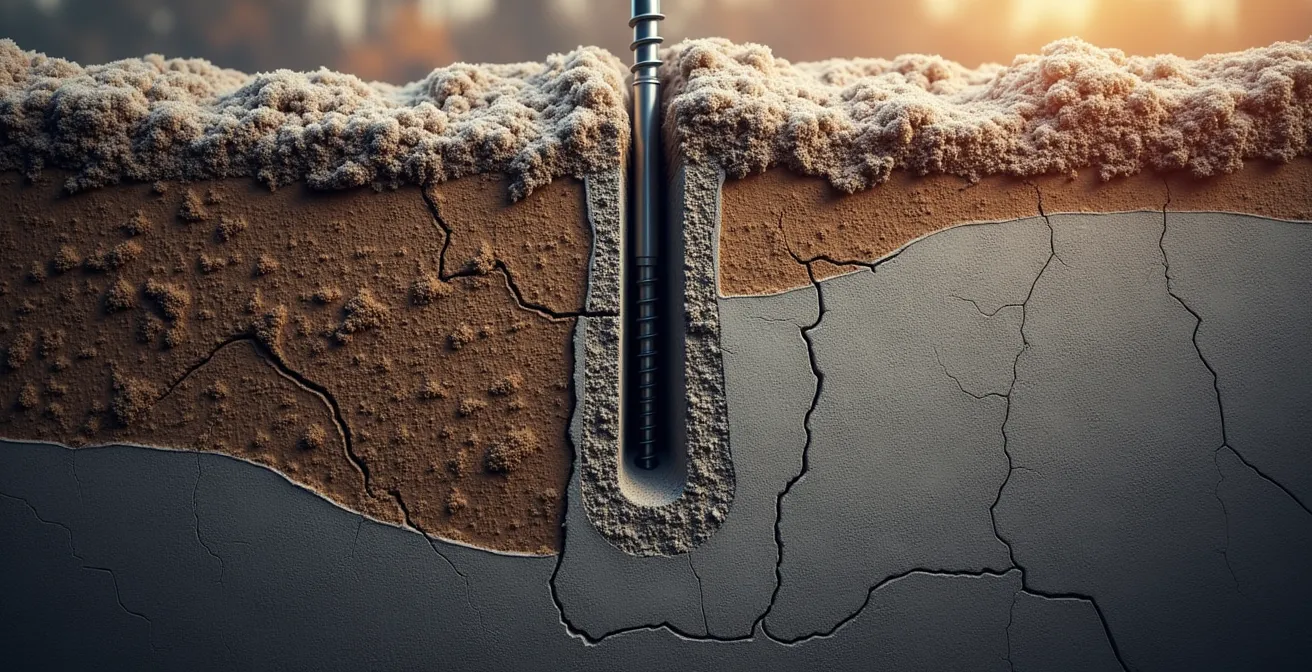
As illustrated, the screw pile transfers the building’s load to a depth unaffected by surface freezing. This makes it an incredibly resilient choice for construction in Canada’s most challenging soil conditions. For homeowners dealing with recurring structural issues caused by soil movement, understanding the benefits of a piled system is essential for finding a permanent solution rather than endlessly patching the symptoms.
Key Takeaways
- The Canadian spring thaw creates intense hydrostatic pressure that outdated waterproofing methods like tar cannot handle.
- Flexible, modern materials such as polyurethane for crack injections and elastomeric membranes for exterior walls are essential to withstand the freeze-thaw cycle.
- Beyond water, Quebec-specific issues like pyrite contamination and strict RBQ contractor regulations require specialized knowledge to protect your investment.
Brick, Foundation, and Roof: The Big Three Costs of Plex Ownership
Owning a duplex, triplex, or any multi-unit residential building (“plex”) in Quebec is a fantastic investment, but it comes with a unique set of financial responsibilities. Beyond the day-to-day maintenance, the long-term capital expenditures are dominated by what can be called “The Big Three”: the roof, the brick facade, and the foundation. Failure in any one of these systems can lead to cascading damage affecting multiple units, tenant disputes, and massive, unbudgeted repair bills. Proactive management of these three assets is the cornerstone of profitable plex ownership.
The roof is the building’s primary shield against precipitation. An aging, leaking roof won’t just damage the top-floor apartment; water can travel through walls and floors, causing mould, rot, and electrical hazards in units below. The brick facade, especially on older buildings, requires periodic repointing. Mortar joints are the weak link, and when they deteriorate, they allow water to seep into the wall assembly, leading to spalling bricks from frost damage and interior water issues. Finally, the foundation carries the entire load. All the problems discussed in this guide—from cracks and leaks to pyrite—are magnified in a plex, where the repair costs and logistical disruptions are multiplied by the number of units.
A strategic approach involves phased renovations and a dedicated sinking fund. Address the most critical issue first: an active roof leak takes priority over foundation seepage. Budgeting for these large expenses should not be an afterthought. A common rule of thumb is to set aside 2-3% of the property’s total annual rental income into a capital expenditure fund. As Jean-François Lupien of Huntsman Building Solutions notes, investing in modern, high-performance systems is a smart financial move.
Investing in polyurethane and polyurea systems is a smart choice for builders looking to future-proof their commercial projects. These materials offer superior protection and provide a return on investment that traditional waterproofing methods cannot match.
– Jean-François Lupien, Global Director of Product Management at Huntsman Building Solutions
This mindset applies equally to plex owners. Using advanced polyurethane spray foam for foundation waterproofing, for example, not only solves water issues but can also improve energy efficiency, providing a tangible return for you and your tenants.
Renovation Management: How to act as Your Own General Contractor in Quebec?
For a determined and organized homeowner, taking on the role of a general contractor for your foundation renovation can seem like a way to save money. In Quebec, this is possible for non-structural work on your own primary residence. However, the regulatory landscape is strict, and the risks are high. The Régie du bâtiment du Québec (RBQ) mandates that any structural foundation work must be performed by a contractor holding the appropriate subclass license (e.g., subclass 2.6 for foundation repair). Attempting this work yourself or hiring an unlicensed individual is illegal and voids any potential for insurance claims related to the work.
Even for non-structural repairs, acting as your own GC means you are responsible for hiring and coordinating subcontractors, sourcing materials, managing the budget, and ensuring all work meets code. Your first and most important job is to thoroughly vet any professional you hire. This means checking their RBQ license status online, asking for proof of liability insurance, and verifying their reputation with organizations like the APCHQ or ACQ. Furthermore, you should check for any past complaints with the Office de la protection du consommateur. A professional contractor will offer a substantial written warranty—often 10 years and transferable—for work like polyurethane injections. A DIY job or one done by an unlicensed friend comes with zero protection.
Managing the finances also goes beyond paying invoices. You must meticulously track all Goods and Services Tax (GST/TPS) and Quebec Sales Tax (QST/TVQ) paid on materials and labor. If the renovation is for a rental property, you may be eligible for Input Tax Credits/Refunds, but this requires proper business registration and flawless documentation. If your project includes energy-efficiency upgrades (like exterior insulation during a waterproofing job), you might qualify for rebates through programs like RénoClimat, but this requires energy audits before and after the work. Acting as your own GC in Quebec is less about swinging a hammer and more about being a meticulous project and compliance manager.
Protecting your foundation is not a one-time fix; it’s an ongoing strategy. By understanding the specific forces at play in our Canadian climate and investing in the right modern technologies, you are not just preventing a wet basement—you are preserving the structural integrity and financial value of your home. It’s the smartest investment you can make in your property.
Frequently Asked Questions About Foundation Issues in Quebec
What is the Petrographic Swelling Potential Index (PSPI/IPPG)?
The PSPI is a standardized test specific to Quebec that measures the potential for foundation damage from pyrite-containing backfill. Results range from negligible to extremely high risk levels, informing homeowners and buyers about the likelihood of future structural problems.
Which regions in Quebec are most affected by pyrite issues?
The Montérégie region and parts of Montreal’s South Shore are known historical hotspots for pyrite contamination in residential backfill. Testing is considered an essential part of due diligence for any property transaction in these areas.
How does pyrite affect mortgage and insurance eligibility?
A positive pyrite test indicating a moderate to high risk can create significant difficulties in securing mortgages from major Canadian banks. It may also limit or void home insurance coverage for any foundation-related damage, making remediation a near necessity for financial security.
What foundation work requires an RBQ licensed contractor?
In Quebec, any work that touches the structure of a foundation, such as repairing major cracks, underpinning, or replacing sections, legally requires a contractor with the appropriate RBQ license (e.g., subclass 2.6). Homeowners are only permitted to perform minor, non-structural repairs on their own primary residence.
How do I verify a contractor’s credentials in Quebec?
You should always verify a contractor’s license number on the RBQ’s online registry. Additionally, check for their membership in good standing with professional associations like the APCHQ or ACQ, and search for any complaints filed against them with the Office de la protection du consommateur (Consumer Protection Office).
What warranty should I expect for foundation crack repairs?
Reputable, professional foundation repair contractors in Quebec typically offer a 10-year transferable written warranty for polyurethane injection repairs. This warranty is a mark of quality and a valuable asset when selling the property. DIY repairs or work done by unlicensed individuals carry no warranty protection.