
A “four-season” label means nothing until its core systems are stress-tested against a -30°C Canadian reality; true year-round value lies in resilience, not just accessibility.
- Access is more than a plowed road; it’s about grade, drainage, and private maintenance contracts that won’t leave you stranded.
- A chalet’s heating and water systems must have built-in redundancy to survive power outages and deep freezes, a common failure point for converted summer homes.
Recommendation: Before buying, conduct a “resilience audit” by verifying insulation, foundation, and system integrity, focusing on how they perform under worst-case winter scenarios, not just on a sunny afternoon.
The vision is captivating: a cozy chalet, snow falling outside, a fire crackling within. It’s the Canadian dream, a retreat for both summer swims and winter ski trips. Many properties are listed as “four-season,” a promise of year-round enjoyment. But this label can be dangerously misleading. The market is filled with summer cottages given a superficial winter-ready makeover—a seasonal trap waiting for an unsuspecting buyer. Families are drawn in by the waterfront view in August, only to discover a frozen nightmare in January when the plumbing fails and the driveway becomes an ice rink.
Standard advice often revolves around checking insulation R-values or asking if the road is plowed. This is surface-level. It doesn’t prepare you for the systemic failures that occur when a property designed for mild weather is pushed to its limits by a harsh Canadian winter. The real challenge isn’t just keeping a cottage warm; it’s ensuring its fundamental systems—water, access, heat, and structure—have the integrity to function reliably when the temperature plummets to -30°C and the power goes out.
This guide moves beyond the brochure. We are not just looking at features; we are conducting a resilience audit. Instead of simply asking *if* a chalet is winterized, we will uncover *how well* it performs under stress. This is the perspective of an inspector who knows that insulation matters more than the view. We’ll dissect the critical systems that distinguish a truly resilient four-season home from a summer cottage in disguise, giving you the framework to make a smart, secure investment.
This article provides a detailed audit of the essential systems that define a true four-season property. Follow this guide to learn how to identify potential failure points and ensure your dream chalet is a sanctuary in all seasons.
Summary: A Buyer’s Audit for Year-Round Canadian Chalets
- Will Your SUV Make It? Checking Steep Driveways Before Buying a Chalet
- Well vs. Lake Intake: Which Water Source Won’t Freeze in January?
- Wood Stove vs. Electric Baseboards: What Keeps a Chalet Warm at -30°C?
- Why Is Insuring a Secondary Residence More Expensive Than Your Main Home?
- Satellite vs. Fiber: Can You Really Work Remotely from the Woods?
- -40°C Living: What Upgrades Does a Northern Home Absolutely Need?
- Can a Prefab Pod Really Survive a Saguenay Winter Without Freezing?
- The Classic Cottage: Is a Three-Season Property a Smart Buy in Quebec?
Will Your SUV Make It? Checking Steep Driveways Before Buying a Chalet
Year-round access is the first pillar of a four-season property, and it begins and ends with the driveway. A beautiful chalet is useless if you can’t reach it safely from November to April. Many buyers look for a “plowed road,” but this is dangerously simplistic. The critical factors are the driveway’s grade, its legal status, and its maintenance reality. A steep, winding driveway that is charming in the summer can become a terrifying, impassable luge track in the winter, even for a capable SUV. Furthermore, many rural or cottage roads are private, meaning snow removal isn’t a municipal service but a shared cost and responsibility among neighbours—a detail that can lead to disputes and unreliable service.
A proper resilience audit of the driveway involves more than a visual inspection. It’s about investigating the logistics. Does a local snow removal contractor even service the property? Some refuse clients with excessively steep or long driveways. What about the “mud season” in spring? Poor drainage can turn a dirt driveway into an impassable bog, effectively isolating you. According to Royal LePage ProAlliance Realty, year-round access is the second-most important factor for new cottage buyers, as they want to maximize the use of their expensive investment. Forgetting to vet the access is one of the most common ways to fall into a seasonal trap.
Your Driveway Resilience Audit Checklist
- Contractor Confirmation: Verify if local snow removal contractors will accept the property by contacting the previous owner’s contractor for confirmation of serviceability.
- Legal Road Status: Check the legal status of the access road to determine if it is municipally maintained or a private road with shared maintenance costs and agreements.
- Grade and Design Assessment: Evaluate the driveway’s grade and design, assessing if switchbacks or a straight incline present a greater risk for winter safety and vehicle traction.
- Drainage System Test: Inspect drainage systems like French drains and grading during the spring thaw to ensure the property won’t be isolated by mud season.
- Annual Cost Calculation: Calculate annual maintenance costs, factoring in plowing services which can average $300-$600 per season for private driveways in many Canadian regions.
Well vs. Lake Intake: Which Water Source Won’t Freeze in January?
A functioning water supply at -30°C is non-negotiable, and it is a common failure point in poorly converted cottages. The two primary sources, a drilled well or a lake intake system, each present unique winter challenges. The core principle is keeping every part of the system below the frost line—the depth to which the ground freezes. In Southern Ontario this might be 4-5 feet, but in Northern Quebec or Alberta, it can be 8 feet or more. A water line buried too shallow is a guaranteed burst pipe waiting to happen.
Lake intake systems are particularly vulnerable. The intake pipe itself must be deep enough to avoid freezing, but it also faces the threat of frazil ice—slushy ice crystals that can form in turbulent water and completely clog the intake screen. Drilled wells are generally more resilient, as the water source is deep underground. However, the pressure tank and associated plumbing are often placed in an unheated crawlspace or shed, creating a major vulnerability. Without adequate insulation and a reliable, low-level heat source, these components will freeze and fail.
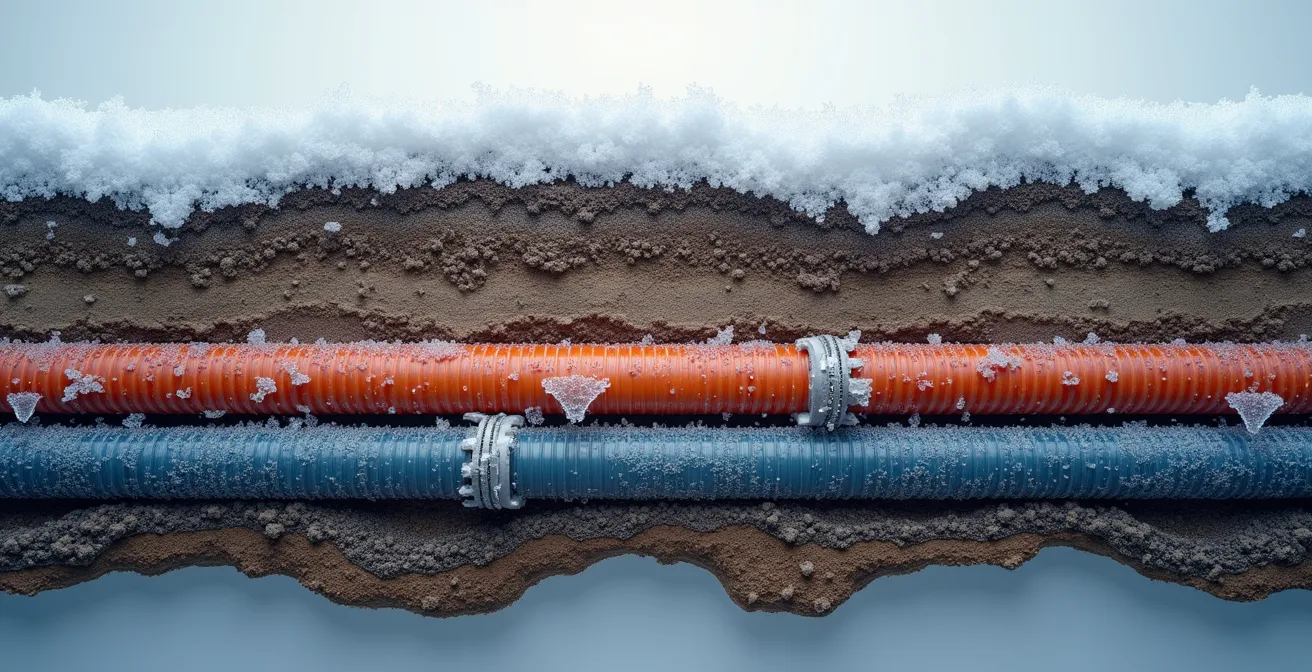
As this cross-section shows, protecting your water supply is about depth and insulation. Many local building codes now specify minimum burial depths and may require remedial solutions like heat tracing—an electrical cable that runs along the pipe to prevent freezing. Below is a summary of how these requirements can vary, underscoring the need to check local regulations.
The following table provides a general overview of water system requirements and common issues across different Canadian regions. For specific details, consulting a provincial breakdown of requirements and local building codes is essential.
| Province/Region | Frost Line Depth | Code Requirements | Common Issues |
|---|---|---|---|
| Southern Ontario | 4-5 feet | Heat tracing as remedial solution per Canadian Electrical Code | Lake turnover affecting water quality |
| Northern Quebec/Alberta | 8+ feet | Deeper burial requirements for water lines | Frazil ice clogging intake points |
| Muskoka Region | 5-6 feet | WETT certification required for supplemental heat | Pressure tank placement in unheated spaces |
Wood Stove vs. Electric Baseboards: What Keeps a Chalet Warm at -30°C?
Heating a chalet in the dead of winter is about two things: power and resilience. Electric baseboards are common, but they are entirely dependent on a stable power grid—a luxury not always available during a Canadian ice storm. A power outage at -20°C can quickly turn a dream retreat into a dangerous situation with a high risk of burst pipes. This is why a secondary, non-electric heat source is not a luxury, but a core component of a true four-season property.
A wood stove is the classic solution, providing powerful radiant heat completely independent of the electrical grid. However, it comes with its own critical requirements. For insurance and safety, any wood-burning appliance MUST have a WETT (Wood Energy Technology Transfer) certification. An uncertified stove is a major fire hazard and will make getting insurance nearly impossible. Propane or gas furnaces are another option, but their blowers still require electricity, making a battery or generator backup essential for true resilience.
Many owners of seasonal properties make the critical mistake of turning off all heat to save money when they leave. However, insurance experts advise against this. According to one major Quebec insurer, keeping the temperature between 5 and 10°C prevents pipes from freezing and bursting while still saving money. This low-level heat is the first line of defense, with the wood stove acting as the robust backup for extreme cold and power outages.
Why Is Insuring a Secondary Residence More Expensive Than Your Main Home?
One of the first financial surprises for new chalet owners is the cost of insurance. A secondary residence is almost always more expensive to insure than your primary home, for one simple reason: increased risk due to vacancy. When a pipe bursts or a tree falls on the roof, the damage is exponentially worse if no one is there to notice it for days or weeks. Insurers see an empty property as a higher liability for everything from water damage and theft to wildlife intrusions.
This increased risk is reflected in both the price and the type of coverage offered. While policies vary, a Canadian cottage owner can expect an average cottage insurance cost of $960 per year, but this can climb significantly based on factors like wood stove certification, distance from a fire station, and the type of water system. It’s also vital to understand the “vacancy clause” in your policy. Many standard home insurance policies limit or void coverage if a property is left unoccupied for more than 30 days, which is why a specific seasonal or secondary residence policy is required.
The type of policy you choose is also a critical decision. A basic “Named Perils” policy is cheaper but only covers the specific risks listed in the contract (like fire). A “Comprehensive” policy covers all risks unless they are specifically excluded, offering much broader protection for a valuable four-season investment.
| Coverage Type | What’s Covered | Common Exclusions | Best For |
|---|---|---|---|
| Named Perils | Fire, explosion, smoke, specific water damage | Wildlife damage, certain water issues | Basic seasonal cottages |
| Comprehensive | All risks except specific exclusions | Gradual deterioration, flooding | Four-season investment properties |
Satellite vs. Fiber: Can You Really Work Remotely from the Woods?
In today’s world, a “four-season” chalet often implies the ability to work remotely. This makes internet connectivity not just a convenience, but a critical piece of infrastructure. The idyllic vision of Zoom calls with a forest backdrop quickly shatters when faced with the reality of rural internet. While some lucky areas are getting fiber optic cable, most cottage country relies on satellite, wireless hubs, or cellular data, each with significant limitations.
Satellite internet, like that offered by Starlink or Xplornet, has been a game-changer for many, but it’s not without flaws. It can be affected by “rain fade” during heavy storms, requires a clear view of the sky, and is dependent on power. Cellular and mobile hub solutions can be surprisingly fast, but often come with punishingly low monthly data caps (e.g., 100GB) that a family can burn through in a week of streaming and video calls. Relying on your phone’s data plan is often costly and impractical for anything beyond basic email.
A true remote-work resilience audit for a chalet’s internet involves several key checks. It is not enough to simply run a speed test on a clear day. You must investigate the system’s weak points to ensure you stay connected when it matters most.
- Upload Speed Verification: Before buying, test the upload speeds. A minimum of 5 Mbps is required for stable video calls.
- Data Cap Investigation: Confirm monthly data caps with all potential providers to avoid surprise overage fees.
- Power Backup Planning: Install an Uninterruptible Power Supply (UPS) for your modem and router to handle short power flickers, and have a generator plan for extended outages.
- Weather Impact Research: Ask neighbours about service reliability during heavy snow or rainstorms, as this is a known issue for satellite connections.
-40°C Living: What Upgrades Does a Northern Home Absolutely Need?
Living comfortably when the external temperature hits -40°C requires more than just a good furnace. It demands a holistic system where the building envelope itself is engineered to retain heat and manage moisture. This is where many converted three-season cottages fail catastrophically. The three absolute must-have upgrades for a true northern home are superior insulation, airtightness paired with ventilation, and a frost-protected foundation.
First, insulation is key. While batt insulation is common, closed-cell spray foam is far superior for chalets. It not only provides a higher R-value per inch but also acts as an air and vapour barrier, preventing heat loss through drafts and stopping moisture from getting into the wall cavities, where it can condense, freeze, and cause rot. Second, an airtight home needs mechanical ventilation. A Heat Recovery Ventilator (HRV) is essential. It continuously exchanges stale, humid indoor air with fresh outdoor air while transferring the heat from the outgoing air to the incoming air. This prevents heat loss and, critically, controls indoor humidity to stop window condensation and mould growth—a huge problem in small, well-sealed spaces.

Finally, the foundation must be robust. A cottage built on surface blocks will heave and shift as the ground freezes and thaws, causing structural damage. A four-season home requires a foundation that goes below the frost line. Concrete footings (sonotubes) or, increasingly, helical screw piles are the standard, providing a stable base that is immune to frost heave and ensuring the structural integrity of the home year after year.
Can a Prefab Pod Really Survive a Saguenay Winter Without Freezing?
The rise of modern, minimalist prefab pods and cabins is an exciting trend in recreational real estate. They offer sleek design and quick construction. But can a small, factory-built structure truly withstand the brutal winters of a region like Saguenay, Quebec? The answer is a definitive yes—but only if it’s ordered with the right specifications. A standard prefab model is often just a three-season shell; surviving a deep freeze requires a dedicated “winter package.”
This package isn’t just one item; it’s a series of systemic upgrades that work together. The most critical is insulation. A winter-ready pod will upgrade from standard batt insulation to high-density spray foam (R-40 or higher) and swap double-pane windows for triple-pane, low-E coated units. Ventilation is also key. The high-efficiency HRV system becomes mandatory to manage the moisture generated in a small, airtight space. Without it, condensation would be rampant.
The foundation and water systems are also beefed up significantly. The pod must be anchored on screw piles drilled deep below the frost line. The water tanks and plumbing must be internally located within the insulated envelope or be fully wrapped in industrial-grade heat tracing. These upgrades come at a significant cost, but they are the difference between a functional winter home and a frozen, damaged box.
| Feature | Standard Model | Winter Package | Additional Cost |
|---|---|---|---|
| Insulation | Batt insulation R-20 | Spray foam R-40+ | $8,000-12,000 |
| Windows | Double-pane | Triple-pane low-E | $5,000-8,000 |
| Ventilation | Basic exhaust fans | HRV system | $3,000-5,000 |
| Foundation | Surface blocks | Screw piles below frost | $10,000-15,000 |
| Water System | Basic plumbing | Heated/insulated tanks | $3,000-4,000 |
Key Takeaways
- A “four-season” label is a marketing term; a true year-round chalet is defined by the resilience of its interdependent systems (access, water, heat, structure).
- Resilience is proven by stress-testing against worst-case scenarios like a -30°C cold snap with a power outage, not by a summer viewing.
- The most expensive mistakes come from underestimating the cost and complexity of upgrading a three-season property, especially its foundation and insulation.
The Classic Cottage: Is a Three-Season Property a Smart Buy in Quebec?
It can be tempting to see a charming, rustic three-season cottage for a lower price and think, “I can just upgrade it.” This is perhaps the biggest and most costly seasonal trap of all. While technically possible, converting a classic Quebec cottage built on blocks with minimal insulation into a true four-season residence is a massive undertaking, often costing as much as building new. The financial and logistical hurdles are substantial.
The process involves far more than just adding insulation. The entire structure must typically be lifted to install a proper, frost-proof foundation of sonotubes or screw piles. The walls may need to be rebuilt to accommodate thicker, more effective insulation. The windows and doors must be replaced with high-performance units. The plumbing and septic systems, designed for seasonal use, often need a complete and costly overhaul to function in freezing temperatures. In many cases, a total conversion cost often exceeding $100,000 is a realistic estimate.
Even more critically, municipal zoning can be an insurmountable barrier. Many waterfront areas in the Laurentians and other parts of Quebec are zoned specifically as ‘seasonal residential.’ This legal designation can prohibit year-round occupancy, even if the cottage is physically winterized. Before even considering a conversion, a thorough check of the property’s `certificat de localisation` and local bylaws is non-negotiable. Buying a three-season cottage can be a smart lifestyle investment for summer use, but viewing it as a cheap backdoor to a four-season home is a path fraught with financial risk and regulatory roadblocks.
Your search for the perfect chalet should be guided by this resilience audit. Use these checkpoints as your guide during viewings and ask pointed questions that go beyond the surface to truly understand the property’s capabilities. A true four-season home provides peace of mind, and that is an investment that always pays off.