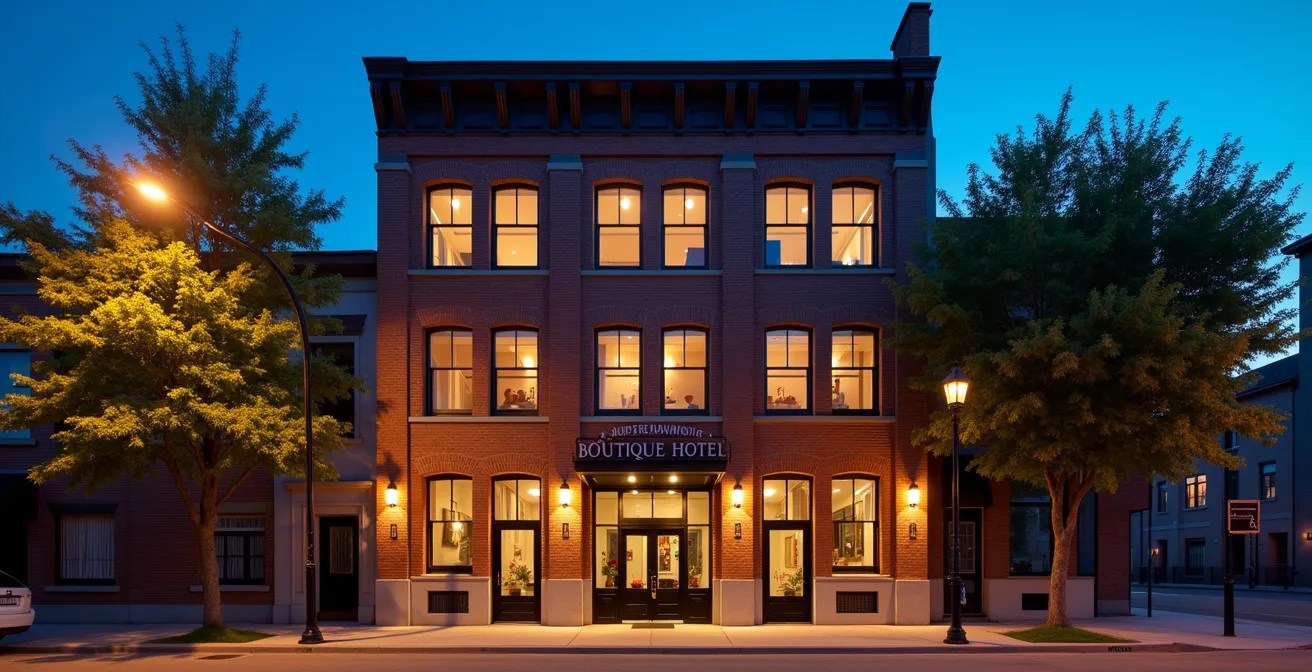
Converting a Canadian multiplex into a boutique hotel is less about design and more about ruthless financial engineering.
- Zoning battles and non-negotiable code upgrades, particularly for sprinklers and fire exits, are the primary budget killers that must be solved before any other step.
- The choice between full independence, a major franchise, or a “soft brand” has a direct, calculable impact on your Revenue Per Available Room (RevPAR) and operational freedom.
Recommendation: Your first step is not a design brief, but a viability study focused on building code compliance and a lean operational model to forecast true profitability.
For any investor holding a well-located multiplex in a Canadian city, the allure is undeniable: transform a residential asset into a high-yield commercial hospitality operation. The vision of a chic boutique hotel, buzzing with creative-class travelers and generating premium nightly rates, is a powerful motivator. You see the exposed brick, the local art, the bustling lobby-café—a vibrant hub in a neighborhood you already know well. This dream seems like a straightforward path to maximizing asset value.
However, the common advice often glosses over the brutal realities. You’ll hear generic tips about “checking local bylaws” or “creating a unique brand.” While true, this surface-level guidance fails to address the critical points where these projects actually fail. The path from a residential plex to a licensed hotel is not a design challenge; it is a gauntlet of regulatory hurdles and unyielding financial pressures. Success isn’t determined by the choice of furniture, but by a cold, hard analysis of structural and operational costs from day one.
This is where our perspective shifts. Instead of focusing on the aesthetics, we will dissect the conversion as an exercise in financial engineering. The real key to profitability lies not in the Instagram-worthy décor, but in mastering the unglamorous trio of zoning law, building code compliance, and operational leverage. We will explore the deal-breaker costs that sink most conversions, analyze the strategic choice between brand affiliation and independence, and identify the technologies that genuinely reduce payroll in a tight labor market.
This guide provides a developer’s-eye view of the entire process. We will walk through the critical decision points, from the initial rezoning application to marketing your finished product, equipping you with the framework to determine if this ambitious conversion is a sound investment or a financial trap.
Summary: The Roadmap from Residential Plex to Commercial Hotel
- Zoning Change: The Process of Turning Residential into Commercial Hospitality
- Sprinklers and Exits: The Code Upgrades That Kill Boutique Hotel Conversions
- Independent vs. Franchise: Should You Flag Your Boutique Hotel?
- Front Desk vs. Digital Key: Reducing Payroll in Small Hotels
- How to Market an Industrial-Chic Hotel to the Creative Class?
- Can You Still Legally AirBnb Your Loft in the Old Port?
- Converting a Heritage Home into a Bed & Breakfast: Is It Still Profitable?
- Hospitality in Quebec: Why Experience-Based Stays Are Outperforming Standard Hotels?
Zoning Change: The Process of Turning Residential into Commercial Hospitality
The first and most significant hurdle in converting a multiplex is not construction, but paperwork. You cannot lay a single new floorboard for a commercial hotel in a zone designated residential. The process of rezoning is a complex, costly, and time-consuming battle that requires strategic navigation. In many Canadian cities, the political climate favors preserving residential housing stock, creating an uphill battle for would-be hoteliers. For instance, in Toronto, around 70% of residential land is zoned exclusively for detached single-family homes, illustrating the regulatory rigidity you’ll face.
Successfully petitioning for a zoning by-law amendment involves a formal, multi-stage process that varies by municipality but generally follows a clear path. You aren’t just asking for permission; you are building a legal and public case for why your project benefits the community.
- Preliminary Consultation: The first step is always to meet with municipal planning staff. This is where you test the feasibility of your plan and get crucial, informal feedback.
- Formal Application: You must complete an official application with exhaustive details about the project, accompanied by a significant fee that can run into thousands of dollars.
- Public Consultation: Your project will be subject to public meetings. This is where community opposition can mobilize, so having a strong case for local economic benefits is crucial.
- Council Decision & Appeal: The municipal council will vote on your application. If they refuse or fail to make a decision within a specific timeframe (typically 90-120 days in Ontario), you have the right to appeal to a provincial body like the Ontario Land Tribunal (OLT).
Case Study: The ReHousing the Yellowbelt Initiative
Change is possible. The “ReHousing the Yellowbelt” project in Toronto demonstrates the power of proactive engagement. By developing over 50 prototype plans for converting single-family homes into multiplexes, the research team provided city planners with practical, actionable tools. This work was instrumental in influencing Toronto’s 2023 zoning changes that now permit multiplexes in all residential areas, showing that well-researched proposals can shift municipal policy.
This process demands patience and a significant upfront investment in consultants, lawyers, and architects to make your case. Success here is the true foundation of your project.
Sprinklers and Exits: The Code Upgrades That Kill Boutique Hotel Conversions
Once you’ve conquered zoning, you face the second great filter: the National Building Code of Canada. A residential multiplex is built to a fundamentally different safety standard than a commercial hotel. The required upgrades, especially regarding fire safety and egress, are often so extensive and expensive that they become the deal-breaker costs that render a project financially unviable. This isn’t about simple renovations; it’s about a complete overhaul of your building’s core safety systems.
The two most significant upgrades are fire suppression systems and means of egress. Commercial hospitality requires comprehensive, automated sprinkler systems throughout the entire building, including every guest room, hallway, and common area. Retrofitting these into an existing structure, especially a heritage building, is an invasive and costly process.

Equally critical are the requirements for exits. The number, location, and fire-rating of stairwells and exit doors are far more stringent for a hotel. This can involve demolishing existing walls, reconfiguring entire floor plans to create protected corridors, and potentially sacrificing rentable square footage to meet code. These are not optional upgrades; they are non-negotiable life-safety requirements that building inspectors will enforce without compromise. While these costs are daunting, overcoming them unlocks significant value, as research from JLL’s Hotels & Hospitality Group reveals that successfully converted hotel properties can command a 25% to 35% value premium.
Independent vs. Franchise: Should You Flag Your Boutique Hotel?
With the legal and structural hurdles cleared, the next critical decision is your operational and brand strategy. Do you operate as a fiercely independent hotel, join a major franchise like Marriott or Hilton, or explore the increasingly popular “soft brand” option? This choice is not merely aesthetic; it’s a financial decision that directly impacts your initial investment, ongoing costs, and potential revenue. Each path offers a different balance of support, flexibility, and profitability.
A major franchise offers immediate brand recognition, access to a global distribution system (GDS), and a powerful loyalty program. However, this comes at a high cost: significant initial franchise fees, ongoing royalty payments (often 4-12% of revenue), and a mandatory Property Improvement Plan (PIP) to meet strict brand standards. Independence, on the other hand, offers complete creative freedom and no brand-related fees, but places the entire burden of marketing, distribution, and reputation-building on your shoulders.
A third way has emerged that offers a compelling compromise for boutique properties. As EHL Insights explains in its analysis of hotel ownership, “Soft brands have emerged as a ‘third option’ between franchising and total independence… allowing independent hotels to retain much of their unique identity while benefiting from a franchise network.” This model gives you access to the parent company’s reservation system and loyalty program while allowing for much greater flexibility in design and operations. The following table breaks down the key financial and operational differences.
| Aspect | Franchised Hotel | Independent Hotel | Soft Brand |
|---|---|---|---|
| RevPAR Premium | 10%+ over independents | Baseline | 5-8% over independents |
| Initial Investment | High (franchise fees + PIP) | Lower (no brand fees) | Moderate |
| Marketing Support | Global distribution & loyalty programs | Self-reliant, local focus | Access to reservation systems |
| Operational Flexibility | Strict brand standards | Complete flexibility | Greater flexibility than core brands |
| Guest Loyalty Access | Full program benefits | Must build own | Partial program access |
For the Canadian market, the independent route is showing strong potential. While major brands dominate, market analysis indicates that independent hotels in Canada are projected to achieve a 5.36% compound annual growth rate through 2030, suggesting a healthy appetite for unique, non-branded experiences.
Front Desk vs. Digital Key: Reducing Payroll in Small Hotels
In a small hotel operation, payroll is the single largest operating expense. The traditional model of a 24/7 staffed front desk can cripple the profitability of a boutique hotel with a limited number of rooms. In today’s tight labor market, achieving operational leverage through technology isn’t a luxury; it’s a survival strategy. The North American hospitality industry is facing a severe labor crisis, with AHLA survey data showing 76% of U.S. hotels reporting staffing shortages, a trend mirrored across Canada.
The solution lies in automating the check-in process and guest communication. Implementing digital key technology, where guests receive their room key directly on their smartphone, can virtually eliminate the need for a physical front desk. This allows you to reallocate staff to more value-added guest experience roles or to significantly reduce overall headcount. This isn’t about replacing human touch entirely, but about focusing it where it matters most, rather than on the transactional process of handing over a key.
Case Study: Miami Beach Digital Transformation
A 42-room boutique hotel in Miami Beach provides a powerful example. By implementing keyless digital locks and a contactless check-in platform, the hotel was able to streamline its front-of-house operations dramatically. The initial technology investment was fully recovered within just six months through direct labor cost savings, all while seeing an improvement in guest satisfaction scores due to the convenience and efficiency of the digital experience.
Adopting a tech-forward operational model requires careful planning and execution. It’s a strategic shift that impacts your team, your guests, and your bottom line. A phased and well-managed approach is key to a successful transition.
Your Action Plan: Implementing a Digital Key Strategy
- Start Small: Introduce mobile check-in or smart room controls in a select few rooms first to monitor guest feedback and calculate the real return on investment before a full rollout.
- Empower Your Team: Ensure your staff are fully trained not just to use the new systems, but to troubleshoot and explain the benefits to guests, turning them into technology advocates.
- Ensure Security Compliance: Protecting guest data is paramount. Work with a vendor that provides robust encryption and meets all relevant privacy standards, such as PIPEDA in Canada.
- Integrate with Your PMS: The new technology must integrate seamlessly with your existing Property Management System (PMS) to avoid creating data silos and operational friction.
- Monitor Key Metrics: Continuously track the impact on labor cost savings, guest satisfaction scores (especially regarding the check-in experience), and any increases in ancillary revenue.
How to Market an Industrial-Chic Hotel to the Creative Class?
Your hotel is built, licensed, and operationally lean. Now, you need to attract the right clientele. For an industrial-chic boutique hotel born from a multiplex, your target market is the “creative class”: travelers who value authenticity, design, and local experience over cookie-cutter corporate loyalty programs. Marketing to this demographic isn’t about expensive ad campaigns; it’s about storytelling and creating a powerful sense of place. The aesthetic itself—exposed brick, reclaimed wood, minimalist furniture—is a core part of the product.
The key is to embed your hotel in the fabric of the neighborhood. This goes beyond a list of nearby restaurants. It means forging genuine partnerships with local artists, designers, coffee roasters, and craft brewers. Your lobby should function as a gallery for local art, your café should serve locally sourced products, and your concierge’s recommendations should be for hidden gems, not tourist traps. You are selling an curated, insider experience of the city, with your hotel as the stylish and comfortable home base.

This strategy resonates deeply with modern travelers, particularly Millennials and Gen Z. As industry analysts at Mordor Intelligence note, the boutique hotel segment’s “agility allows operators to pivot quickly toward thematic décor, hyper-local food sourcing, and neighborhood storytelling, which resonate with millennial and Gen Z travelers.” Your marketing materials—especially your social media presence on platforms like Instagram—should be a visual celebration of this local ecosystem. It’s about showcasing the lifestyle that your hotel enables, not just the rooms you’re selling. This creates “authenticity at scale,” a brand that feels personal and unique, justifying a premium price point.
Can You Still Legally AirBnb Your Loft in the Old Port?
For any property owner in a prime urban location like Montreal’s Old Port or Toronto’s King West, the temptation to use short-term rental (STR) platforms like Airbnb or Vrbo is strong. The potential for high nightly rates without the regulatory burden of a licensed hotel seems like a golden ticket. However, that window of opportunity is closing rapidly across Canada. Municipalities, under pressure from residents and the hotel lobby, have enacted a wave of restrictive regulations designed to curb the “ghost hotel” phenomenon and return housing units to the long-term rental market.
Operating an STR business is no longer a casual undertaking. It has become a complex legal landscape that requires careful navigation. Simply listing your units is a recipe for hefty fines and legal trouble. The dream of running a quasi-hotel through Airbnb is increasingly being replaced by the reality of stringent licensing and operational constraints.
If you’re considering the STR route, you must undertake rigorous due diligence. The rules are hyper-local and constantly changing, but several key themes have emerged in major Canadian cities:
- Municipal Bylaws are King: Each city has its own set of rules. You must research and comply with local registration requirements, zoning restrictions, and density limits.
- Principal Residence Requirements: Cities like Vancouver and Toronto have implemented rules that largely restrict STRs to an owner’s principal residence, making it illegal to operate a dedicated, multi-unit STR business in a residential building.
- Provincial Registration Systems: In Quebec, all tourist accommodations, including STRs, must be registered with the Corporation de l’industrie touristique du Québec (CITQ) and display a registration number on all listings. British Columbia is launching a similar provincial registry.
- The Licensed Alternative: The increasing regulatory burden on STRs makes the path of converting to a fully licensed hotel or bed & breakfast more attractive. It involves higher upfront costs but offers long-term stability and freedom from the ever-changing whims of STR regulations. This is a form of regulatory arbitrage—choosing the more stable, predictable legal framework for your business.
The bottom line is clear: the easy money in unregulated STRs is a thing of the past. The path forward is either strict compliance with complex rules or committing to a fully licensed commercial operation.
Converting a Heritage Home into a Bed & Breakfast: Is It Still Profitable?
Converting a designated heritage home presents a unique set of challenges and opportunities. The appeal is obvious: these properties possess a character, history, and architectural detail that new builds can’t replicate. This inherent uniqueness can be a powerful market differentiator, allowing you to command premium rates as a high-end bed & breakfast or boutique inn. Guests are not just paying for a room; they are paying to inhabit a piece of local history. However, profitability hinges on your ability to balance preservation with modernization.
The primary challenge is navigating the restrictions imposed by heritage preservation acts. Renovations, especially to the exterior and significant interior features, will be subject to intense scrutiny and approval from local heritage committees. This can limit your ability to make changes needed for operational efficiency or to meet building codes for commercial use. The process is often slower and more expensive than a standard renovation, requiring specialized tradespeople and materials.
Despite these hurdles, the rewards can be substantial when the conversion is executed thoughtfully. The key is to make the heritage of the building the centerpiece of the guest experience. This is not about creating a museum; it’s about weaving the building’s story into a modern, luxury hospitality offering. The most successful conversions celebrate the historical narrative while seamlessly integrating contemporary comforts.
Case Study: Drake Devonshire Inn, Wellington, Ontario
The Drake Devonshire is a prime example of a profitable heritage conversion. This 19th-century foundry in Prince Edward County was transformed into a stunning 21st-century “farmhouse hotel.” The developers preserved the building’s industrial bones and historical identity while introducing contemporary artworks, modern design, and high-end amenities. By leveraging the building’s authentic story, the Drake Devonshire has become a destination in itself, demonstrating that the perceived constraints of a heritage property can be its greatest marketing asset and a driver of premium revenue.
Ultimately, profitability in a heritage conversion is a function of authenticity. If you can successfully preserve the soul of the building while delivering a flawless guest experience, the market will reward you for it. It’s a high-stakes, high-reward niche within the adaptive reuse space.
Key Takeaways
- Success in hotel conversion is determined by solving non-negotiable costs (zoning, fire code) before focusing on design.
- The “soft brand” model offers a powerful middle ground, providing brand distribution without sacrificing the unique identity of your boutique hotel.
- Automating check-in with digital keys is a critical strategy to reduce payroll, the largest operational expense in a small hotel.
Hospitality in Quebec: Why Experience-Based Stays Are Outperforming Standard Hotels?
The final and most crucial element for long-term success is understanding the fundamental shift in traveler expectations. Nowhere is this more evident than in Quebec, a market that has masterfully capitalized on experience-based tourism. Today’s travelers, especially those willing to pay a premium, are not just buying a place to sleep. They are buying a story, an immersion into local culture, and a unique experience. Standardized hotels offering little more than a clean room and a generic breakfast are being consistently outperformed by properties that deliver an authentic sense of place.
This trend is driven by both consumer demand and market realities. As Destination Canada highlights, modern “travelers now stay longer and spend more on experiential activities, which benefits boutique and independent properties that showcase local culture.” Simultaneously, the industry faces immense operational pressures. With industry reports showing 170,000 unfilled positions in the Canadian hospitality sector and labor contracts in cities like Vancouver granting massive pay hikes, the old model of relying on a large staff is becoming unsustainable. The properties that succeed are those that create a high-value experience that justifies a higher room rate, allowing them to afford top talent and still maintain profitability.
Case Study: Auberge Saint-Antoine, Quebec City
The Auberge Saint-Antoine in Quebec City’s Old Port is the quintessential example of the Quebec experience model. Built on a major archaeological site, the hotel didn’t just build over its history—it incorporated it. Artifacts from the French and British colonial eras are beautifully displayed throughout the facility, turning hallways and common areas into a living museum. This deep integration of historical narrative with five-star luxury amenities creates an unparalleled guest experience that allows the hotel to command some of the highest rates in the market. Guests leave with a memorable story, not just a receipt.
For an investor converting a multiplex, this is the ultimate lesson. Your property’s unique history, its neighborhood context, and its architectural quirks are not liabilities; they are your most valuable assets. By building your entire concept around an authentic, experience-rich theme, you move beyond competing on price and start competing on story—a far more profitable and sustainable position in the modern Canadian hospitality market.
The next step isn’t hiring an architect; it’s commissioning a detailed feasibility study that models code compliance costs and operational leverage against your target RevPAR. This is how you turn a promising property into a profitable hospitality asset.