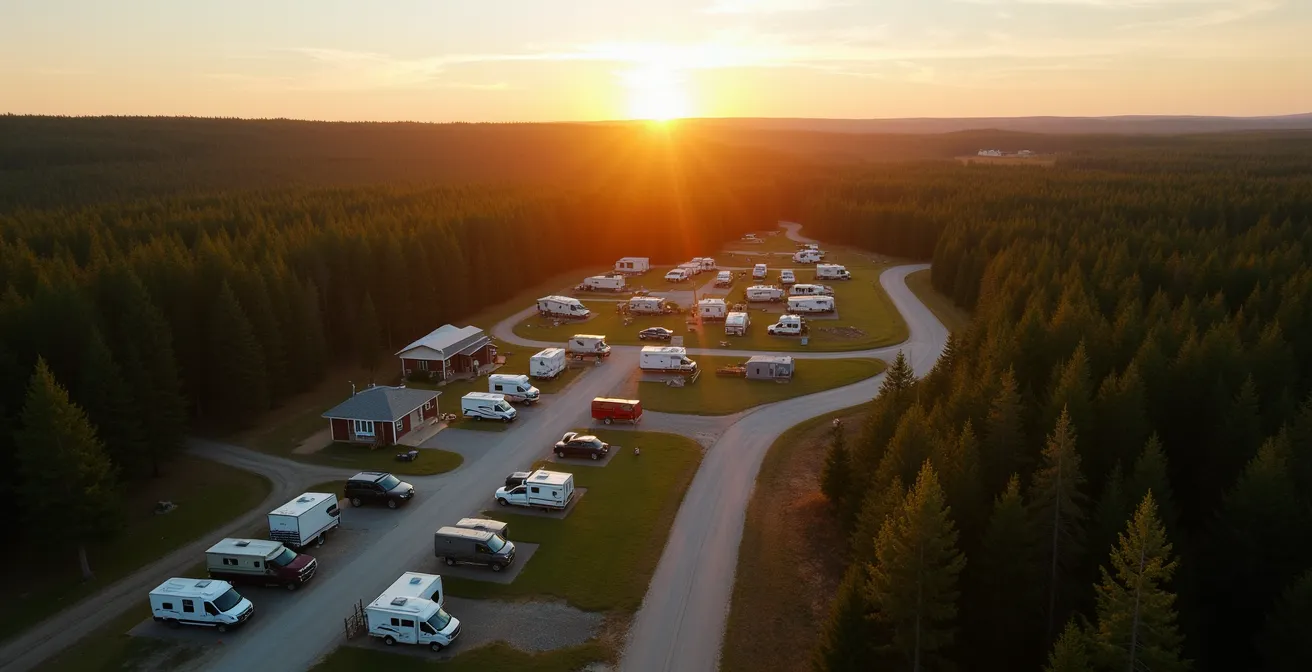
Despite the picturesque setting, a campground is not a passive land investment; it’s a high-touch service business where profitability is dictated by infrastructure management, not just location.
- Your biggest financial risk isn’t market fluctuation, but the failure of unseen systems like septic and electrical grids.
- Sustainable cash flow comes from engineering the right mix of seasonal, transient, and off-season revenue, not just high summer occupancy.
Recommendation: Before you even consider making an offer, your first call should be to an engineer to assess the septic system and a lawyer to verify its compliance with provincial regulations.
You see it for sale driving through cottage country: a sprawling property on a pristine lake, dotted with RVs and happy families. The sign reads “Campground For Sale,” and your mind immediately jumps to a idyllic life of collecting fees while your land asset appreciates. It seems like the perfect real estate play—a tangible asset that generates income. This is the dream. The reality, however, often involves a frantic call at 10 p.m. because a septic alarm is blaring in Site 23, or a family is demanding a refund because the Wi-Fi is too slow for their kids to stream movies.
Many investors look at a campground and see the land. A veteran owner sees a small, complex municipality. You are not just a landlord; you are the mayor, the public works director, the head of tourism, and the chief of sanitation. The belief that you are buying a simple real estate asset is the single most expensive mistake a new investor can make. The real value—and the most significant risk—lies not in the scenic views but in the hidden infrastructure buried underground.
This guide peels back the curtain on campground ownership in Canada. We will move past the romantic notions and dive into the operational realities that determine success or failure. From the capital expenditure time bombs lurking in aging septic fields to the strategic decisions about revenue streams and amenity ROI, you will learn to evaluate a campground as the complex service business it truly is.
To help you assess a potential campground investment with the critical eye of an operator, not just an investor, this article breaks down the essential business components you must understand. The following sections will guide you through the core operational pillars that truly define a campground’s profitability and long-term viability.
Summary: Investing in Campgrounds: A Real Estate Play or a Service Business?
- Septic and Electrical: The Hidden CapEx Time Bomb in Old Campgrounds
- Seasonal vs. Transient: Finding the Right Mix for Cash Flow
- Water Parks and Wi-Fi: Which Upgrades Justify Raising Nightly Rates?
- Shoreline Protection: Managing Camping Sites Near Lakes and Rivers
- Winter Revenue: Utilizing Empty Campgrounds for RV and Boat Storage
- Generators and Float Planes: The Heavy Equipment Costs of Fly-In Lodges
- Septic Tanks and Wells: The Hidden Costs of Country-Style Detached Living
- Buying a Pourvoirie: The Business of Luxury Wilderness, Not Just a Cottage
Septic and Electrical: The Hidden CapEx Time Bomb in Old Campgrounds
Before you calculate potential nightly revenue, you must first become an expert in wastewater and power grids. Many older Canadian campgrounds were built in the 60s and 70s with systems designed for a fraction of today’s demand. An aging septic system isn’t a minor repair; it’s a multi-thousand-dollar liability waiting to happen. If a property sale triggers a mandatory upgrade under provincial regulations, you could be facing a complete system replacement before you even welcome your first guest. This is the definition of a Capital Expenditure (CapEx) time bomb.
The costs are not trivial. In provinces like Ontario, a conventional system installation can easily cost between $7,500 to $10,000 for a conventional septic system installation, and that’s for a standard residential size. A commercial-scale system for a campground is a far larger investment. Similarly, an electrical grid with outdated 15-amp service will not support modern RVs, which require 30- or 50-amp hookups. A full electrical upgrade is a massive undertaking, involving trenching, new wiring, and new pedestals at every site. Ignoring this is like trying to run a modern hotel with outlets that only support flip phones.
These infrastructure components are the bedrock of your business. A failing septic system can lead to environmental fines, closure orders, and a ruined reputation. An inadequate electrical grid means you cannot attract high-value RV clients. As an investor, your due diligence must focus here first. The “bones” of the campground are far more important than its surface-level appeal.
Your Septic System Due Diligence Checklist
- Soil Testing: Before any acquisition, commission independent soil percolation tests to verify the ground’s absorption capacity and determine what type of system is even possible.
- Regulatory Compliance: Verify with the local municipality and provincial authority if the property sale will void any “grandfathered” status and trigger a mandatory, immediate upgrade to current building codes (e.g., Ontario’s Part 8 regulations).
- Capacity Calculation: Calculate the required daily flow based on the maximum number of sites, washrooms, and other facilities. This will determine the necessary tank size (e.g., minimum 3,600L for dual-chamber systems) and the scale of the leaching bed.
- Operational Budgeting: Factor in non-negotiable operational costs, such as mandatory septic inspections (often every 3 years) and tank pumping (every 3-5 years, depending on usage).
- New Build Factoring: If building new or replacing entirely, budget for startup costs that can range from $15,000 to $50,000 or more for the complete septic infrastructure, depending on soil conditions and system complexity.
Seasonal vs. Transient: Finding the Right Mix for Cash Flow
Once you’ve secured the basic infrastructure, your focus shifts to “cash flow engineering.” A common mistake is to fixate on nightly rates and maximizing summer occupancy. A seasoned operator knows that the key to stable, year-round revenue is balancing two very different types of customers: seasonal and transient campers. Seasonal campers, who rent a site for the entire season, are your financial bedrock. They provide a guaranteed, predictable income stream before the season even begins, covering your fixed costs like taxes, insurance, and base salaries.
Transient campers—the weekend warriors and vacationing families—are your profit margin. They pay a higher nightly rate and spend more on-site at your store or on rentals. However, they are far less predictable, being highly dependent on weather, gas prices, and economic trends. Relying solely on them is a high-risk gamble. The sweet spot is a carefully calculated mix. Many successful Canadian campgrounds allocate 60-70% of their sites to seasonal campers to ensure financial stability, leaving the remaining 30-40% for high-margin transient guests.

This strategy also shapes the entire culture of your park. Seasonal campers build a community. They organize potlucks, look out for each other’s property, and become ambassadors for your brand. This reduces marketing costs and creates a welcoming atmosphere that attracts new guests. Neglecting your seasonal base in pursuit of a few extra dollars from transient campers can quickly erode the community feel and long-term stability of your business.
The following table illustrates the different financial characteristics of these core customer groups, highlighting why a blended strategy is often the most resilient.
| Customer Type | Average Stay | Rate Range | Occupancy Stability |
|---|---|---|---|
| Seasonal (Snowbirds) | 3-6 months | $500-800/month | Guaranteed 100% |
| Transient (Tourists) | 1-7 nights | $25-80/night | Variable 40-90% |
| Industrial Workers | 2-4 weeks | $35-50/night | Predictable contracts |
Water Parks and Wi-Fi: Which Upgrades Justify Raising Nightly Rates?
With your financial base secured by seasonal campers, the next question is how to grow your high-margin transient revenue. The temptation is to add flashy amenities like a swimming pool, splash pad, or even a water slide. While these can be powerful draws, they are also immense capital investments with high operational and liability costs. The key is not to ask “What amenities are popular?” but rather “What amenities will deliver a measurable Return on Investment (ROI)?”
In the modern camping world, one amenity has shifted from a luxury to a utility: reliable Wi-Fi. With a staggering 88% of campers bringing mobile devices, stable internet is often ranked as the top desired feature. Families want to stay connected, and remote workers are increasingly taking their jobs on the road. Investing in a robust, park-wide Wi-Fi network can directly justify a rate increase and attract a wider demographic. It’s an investment in the core user experience, not just a frill.
Beyond Wi-Fi, the most successful upgrades often lean into unique, local experiences rather than generic ones. Instead of a standard pool that can be found anywhere, consider amenities that resonate with a Canadian identity: a wood-fired sauna, canoe or kayak rentals for the lake, or a well-equipped fish cleaning station. These reinforce the sense of place and often have lower maintenance and liability costs. For example, in Ontario, a water slide requires expensive and rigorous TSSA (Technical Standards and Safety Authority) certifications, a cost many new owners overlook. In contrast, a fleet of kayaks has minimal overhead and can generate direct rental revenue, paying for itself in a season or two.
Shoreline Protection: Managing Camping Sites Near Lakes and Rivers
The “prime” real estate in any campground is almost always the waterfront sites. They command the highest rates and are booked first. However, this proximity to water introduces a significant layer of regulatory complexity and environmental responsibility. As the operator of your “mini-municipality,” you are the steward of that shoreline, and provincial authorities will hold you accountable for its protection. This is particularly critical when it comes to the placement and function of your septic systems.
Provincial regulations, such as the Ontario Building Code, are extremely strict about the distance between septic systems and water sources. A leaching bed must be a minimum of 100 feet (approximately 30 metres) from wells and water sources to prevent contamination. If you’re looking at an older park where sites and systems were placed before these rules were enforced, you may be sitting on a non-compliant and environmentally hazardous situation. A system failure near the water is a catastrophic event, both for the ecosystem and your business.
As the Ontario Building Code guidelines bluntly state, the consequences of a poorly sited system are severe. The risk is not theoretical; it is a clear and present danger to the very asset you are buying.
Septic systems that are installed in unsuitable soils usually malfunction by leaking raw, untreated sewage to the surface of the ground or a roadside ditch, or by contaminating the groundwater.
– Ontario Building Code Guidelines, Builders Ontario Septic Systems Guide
Your management plan must include shoreline erosion control, designated access paths to prevent habitat destruction, and rigorous septic maintenance schedules for any system near the water. This isn’t just good practice; it’s a legal and financial necessity. The premium you earn on those waterfront sites must be weighed against the heightened cost of compliance and the immense risk they represent if mismanaged.
Winter Revenue: Utilizing Empty Campgrounds for RV and Boat Storage
For most Canadian campgrounds, the season ends with the Thanksgiving long weekend. The gates close, and the property sits empty and unproductive for six months, while fixed costs like property taxes continue to accumulate. The smart operator sees this downtime not as a liability, but as an opportunity for off-season revenue generation. The most common and effective strategy is converting your empty park into a secure storage facility for RVs, boats, and trailers.
Your existing infrastructure is perfectly suited for this purpose. You have a fenced, secure property with defined sites that can easily accommodate large vehicles. By offering winter storage, you create an entirely new, low-effort revenue stream. The labour involved is minimal—checking customers in during the fall and out in the spring—and it requires almost no additional capital investment. This income can be the difference between breaking even and turning a healthy profit for the year, helping to cover your property taxes and insurance during the winter months.
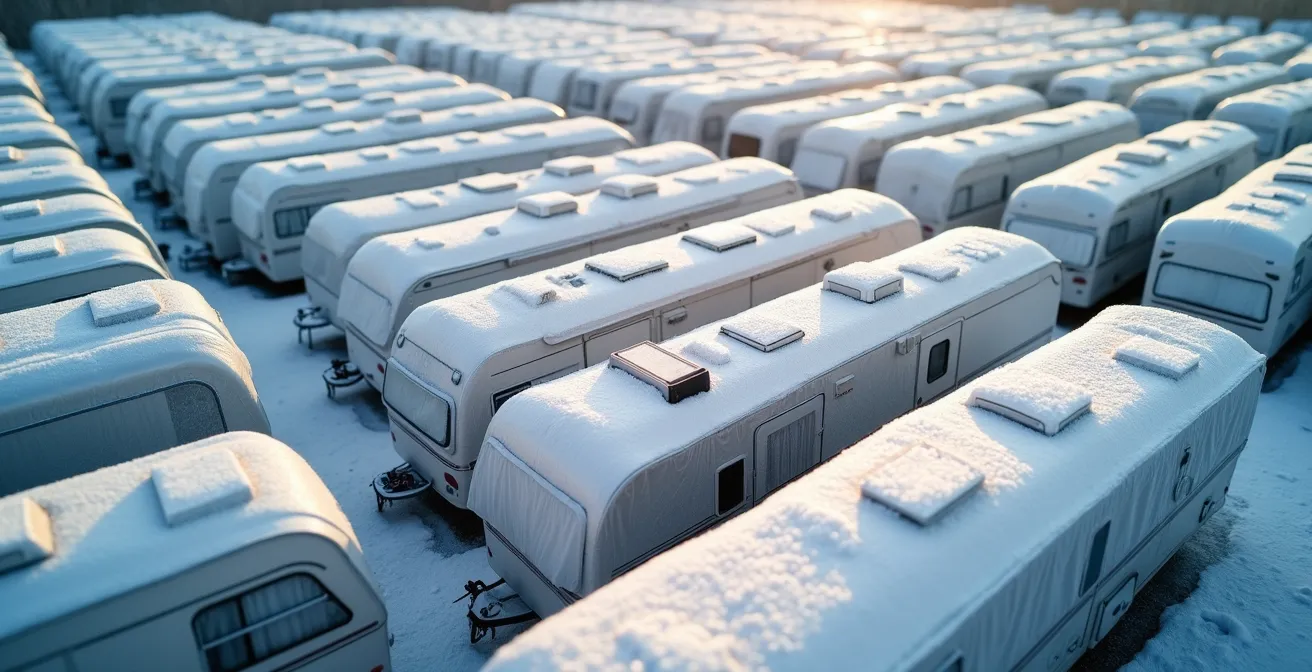
This model provides another key benefit: it keeps your seasonal customers tethered to your business year-round. By storing their RV on-site, they are far more likely to renew their seasonal lease for the following year, reducing your marketing churn and administrative workload. This strategy proved its worth for many operators, such as an Alberta campground that secured solid future revenue by pivoting to seasonal rentals and storage when other activities were restricted. It transforms a seasonal business into a 12-month operation, maximizing the earning potential of your land asset.
Generators and Float Planes: The Heavy Equipment Costs of Fly-In Lodges
While most campground investments fall within a certain range, moving into the world of remote, fly-in lodges in Canada represents a quantum leap in operational complexity and cost. These are not simply campgrounds with a more rugged address; they are entirely self-sufficient outposts that require a staggering level of investment in heavy equipment and logistics. Here, the concept of running a “mini-municipality” becomes literal. You are responsible for generating your own power, treating your own water, and managing your own transportation network.
The initial investment for a standard drive-to campground can be significant, often in the $1 million to $4 million range according to KOA data. For a fly-in lodge, this is merely the starting point. You must budget for industrial-sized diesel generators (often in pairs for redundancy), extensive fuel storage tanks, and sophisticated water treatment systems. Every single nail, food item, and piece of equipment has to be flown in, adding an enormous transportation premium to your operational costs.
Furthermore, if your lodge relies on float planes for access, you are entering the realm of federal aviation regulation. This involves licensing your water aerodrome with Transport Canada, maintaining docks and fueling facilities to specific standards, and carrying substantial liability insurance. The cost and maintenance of the planes themselves, or the contracts with air charter services, become one of your largest line items. This is the ultimate service business, where the “luxury wilderness” experience for guests is directly supported by a highly complex and expensive backstage operation.
Septic Tanks and Wells: The Hidden Costs of Country-Style Detached Living
We’ve discussed the risk of aging infrastructure, but it’s crucial for an investor to understand the concrete numbers involved when that risk materializes. When a septic system fails in a rural setting, you don’t have the option of simply connecting to a municipal sewer line. You are entirely responsible for its replacement, and the cost is dictated by the specific conditions of your property. The phrase “country-style living” often masks a set of significant, non-negotiable infrastructure costs.
The type of system you can install—and its price tag—depends entirely on your soil’s ability to absorb wastewater. As illustrated by Ontario’s guidelines, well-drained, loamy soil might allow for a less expensive conventional system. However, many beautiful waterfront or wooded properties have shallow soil, clay, or a high water table, requiring far more complex and costly modified or advanced treatment systems. A problem that might be a $10,000 fix on one property could be a $30,000 crisis on another, just a few kilometres away.
The table below breaks down the typical options and associated costs in a province like Ontario. This demonstrates how a detailed soil analysis during your due diligence period is not optional—it is a critical step in accurately forecasting your potential capital expenditures.
| System Type | Suitable Soil | Installation Cost | Maintenance Frequency |
|---|---|---|---|
| Conventional Septic | Loamy, well-drained | $7,500-$10,000 | Pump every 3-5 years |
| Modified System | Wet or shallow | $12,000-$18,000 | Annual inspection required |
| Advanced Treatment | Poor percolation | $20,000-$30,000 | Quarterly maintenance |
This same principle applies to your water source. A well requires regular testing and a robust filtration and treatment system to be compliant for public use. These systems add another layer of cost and maintenance responsibility. Failing to budget for the complete lifecycle of these essential services is a direct path to financial distress.
Key takeaways
- A campground is an active operational business, not a passive real estate holding. Treat it as such.
- The condition of “hidden infrastructure” like septic, water, and electrical systems is your single greatest financial risk and should be the primary focus of due diligence.
- Profitability hinges on smart cash flow engineering—balancing stable seasonal revenue with high-margin transient income and finding creative off-season uses for the property.
Buying a Pourvoirie: The Business of Luxury Wilderness, Not Just a Cottage
At the intersection of campground operation and luxury hospitality lies the classic Canadian `pourvoirie`, or outfitter. Buying one of these is the ultimate expression of the “service business” model. An investor who sees a pourvoirie as simply a large cottage with extra cabins is fundamentally misreading the entire business. You are not selling accommodation; you are selling a highly curated, all-inclusive wilderness experience. The cabins are just one small part of a complex package that includes guided fishing or hunting, boat rentals, meal plans, and expert local knowledge.
The operational intensity is immense. Your staff includes not just cleaners and front-desk clerks, but professional guides, boat mechanics, and chefs. Your asset list isn’t just land and buildings, but a fleet of boats, motors, and fishing gear that require constant maintenance. Because of this high-touch, high-service model, the potential returns can be attractive, with industry benchmarks suggesting a typical ROI range of 10% to 30% for well-run parks. However, this return is directly earned through intense, hands-on management.
The profitability is also sensitive to factors beyond your control. As one analysis on park model profitability noted, even historically high-return investments like rental cabins have seen their ROI drop from over 40% to around 25% in recent years due to rising material costs. This highlights that even with a perfect operational plan, you are still part of a larger economic ecosystem. Your success is a function of managing a thousand small details, from the sharpness of the filleting knives to the reliability of the boat motors. It is the furthest thing from a passive investment.
If you have meticulously inspected the infrastructure, engineered a resilient revenue mix, and fully embraced the reality that you are entering the service industry, then a campground can be a rewarding and profitable venture. Your next step, however, is not to look at sales brochures. It is to get your boots muddy. The most critical part of your due diligence will be done standing over a septic tank lid with an engineer, not sitting in a boardroom. Evaluate the business for what it is, and you will be positioned for success.