Success in Canadian resource town real estate hinges on treating it as a strategic service for industrial workforces, not a speculative commodity play.
- High yields are driven by intense, predictable demand from Fly-in/Fly-out (FIFO) workers and permanent operational staff, creating a captive tenant base.
- Risk is concentrated in single-industry dependency and financing constraints, requiring a rigorous due diligence process that assesses a town’s economic diversification and resilience.
Recommendation: Shift your analysis from macro commodity forecasts to a micro-level assessment of tenant segmentation, employer housing competition, and specialized financing vehicles like CMHC’s MLI Select program.
For the bold investor, the allure of Canadian resource towns is undeniable: the promise of double-digit cash flow and rapid appreciation during boom cycles. These industrial hubs, from the oil sands of Alberta to the mining communities of Northern Quebec, present a compelling mathematical case for investment. The conventional wisdom focuses almost exclusively on the macro picture—tracking global commodity prices and timing the market to perfection. This approach treats real estate as a passive derivative of the resource it services.
However, this high-level view misses the critical operational realities on the ground. It ignores the granular dynamics of workforce housing, the nuances of tenant turnover, and the structural risks baked into the financial and economic fabric of these communities. Relying solely on a commodity boom is not an investment strategy; it’s a gamble. The real key to unlocking sustainable returns in this niche doesn’t lie in predicting the next price surge, but in understanding the underlying mechanics of the housing demand itself.
What if the most resilient portfolio wasn’t built on market timing, but on becoming an indispensable service provider to a captive workforce? This guide reframes the investment thesis. We will move beyond the boom-bust narrative to dissect the operational drivers of success, analyze the specific risk factors that trip up unprepared investors, and uncover the strategic levers—from tenant management to specialized financing—that create long-term value in Canada’s industrial heartlands.
This article provides a portfolio manager’s framework for evaluating these unique markets. Below is a summary of the core strategic considerations we will explore, from identifying your core tenant base to navigating the specific financial landscape of these high-risk, high-reward environments.
Summary: A Strategic Framework for Resource Town Investing
- Who Are Your Tenants in a Mining Town: Families or Fly-in/Fly-out Workers?
- How to Manage High Tenant Turnover in Seasonal Industry Towns?
- Can You Compete with Employer-Provided Housing in Remote Areas?
- Why Betting on a Single-Industry Town Is a Dangerous Game for Your Portfolio?
- Why Banks Require Higher Down Payments for Properties in Remote Zones?
- The Risk of Buying in a ‘One-Company Town’ When the Mill Closes
- Staffing the Whale Boats: The Critical Shortage of Housing for Seasonal Pilots
- Quebec Rental Market: Why Immigration and Low Supply Are Driving Investment?
Who Are Your Tenants in a Mining Town: Families or Fly-in/Fly-out Workers?
The first principle of successful resource town investing is rigorous tenant segmentation. Viewing your potential renters as a monolithic group is a critical error. The demand is not singular; it’s a complex ecosystem of distinct groups with divergent needs, timelines, and financial profiles. The most visible and cyclical demand comes from Fly-in/Fly-out (FIFO) workers. This group requires maximum flexibility, often seeking furnished units with short-term or rotating lease structures that align with their 14-on/14-off schedules. Their housing decisions are transient and purely functional.
In contrast, long-term operational staff and their families are the bedrock of a stable rental portfolio. These are the engineers, managers, and senior technicians who commit to the community for multi-year periods. They seek unfurnished, family-friendly housing—single-family homes or larger townhouses with access to schools and community amenities. Their presence acts as a stabilizing force against the volatility of FIFO demand. A third, often overlooked segment, is the ancillary service sector. These are the nurses, teachers, and small business owners who support the town’s infrastructure. Their income is not directly tied to commodity prices, providing a crucial layer of economic diversification to your tenant base.
Understanding this mix is essential for asset selection and marketing. A portfolio heavily skewed towards FIFO workers will experience higher yields during booms but also face extreme vacancy risk during downturns. Conversely, focusing on housing for permanent staff and service workers may offer lower peak rents but provides a more resilient and predictable cash flow stream through the cycle. The strategic question is not *if* you can find tenants, but *which* tenants you are equipped to serve effectively.
How to Manage High Tenant Turnover in Seasonal Industry Towns?
High tenant turnover is not a bug in resource town investing; it’s a feature. For seasonal industries like fishing, tourism, or specific phases of construction, turnover is an operational constant that must be managed, not avoided. The key is to transform this challenge into a competitive advantage through specialized management and strategic asset positioning. Traditional annual leases are often unworkable. The solution lies in creating a flexible, service-oriented offering that commands a premium.
This includes offering fully furnished units, all-inclusive pricing (utilities, internet), and seamless digital booking and payment systems. By minimizing friction for incoming workers, you become the default choice for employers and contractors needing to place staff for 3-to-6-month terms. Furthermore, building direct B2B relationships with major employers can create a pipeline of pre-vetted tenants. A master lease agreement, where a company rents a block of units for its workforce, can eliminate vacancy risk entirely for a defined period, albeit sometimes at a slightly discounted rate.
This operational intensity is what separates successful investors from those who are overwhelmed by constant tenant sourcing and unit preparation. Market dynamics, even in these volatile towns, can shift rapidly. For instance, an analysis of Fort McMurray’s market showed a sharp transition to seller’s conditions post-Christmas 2024. While lower-priced units faced pressure from foreclosures, the middle and move-up markets tightened significantly, demonstrating that even within a high-turnover environment, specific segments can exhibit strong demand. An investor who understands these micro-trends can pivot their strategy to meet the most acute need, whether it’s premium short-term rentals or stable family housing.

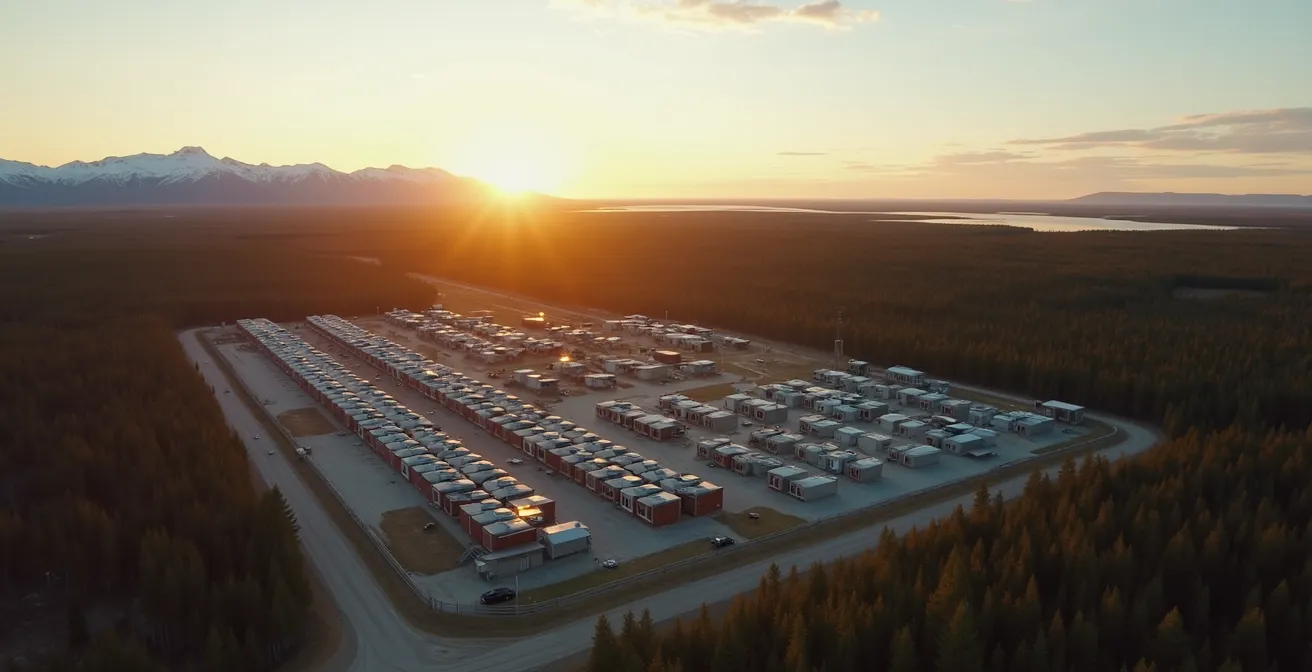
The repetitive nature of modular worker housing complexes, as seen above, visually represents the cycle of tenant turnover. Yet, the warm lights from within each unit symbolize the consistent need for a temporary “home,” which is the core service an investor provides. Effectively managing this flow requires a system, not just a property.
Can You Compete with Employer-Provided Housing in Remote Areas?
In many of Canada’s most remote resource projects, the primary competition for a private investor is not another landlord, but the operating company itself. Large mining and energy firms often build and manage their own work camps or staff housing complexes. Attempting to compete with these on price or proximity is often a losing battle. However, these large-scale, one-size-fits-all solutions create significant gaps in the market that a savvy investor can exploit.
Employer-provided housing is typically utilitarian and standardized, designed for a transient workforce. It rarely caters to the needs of management-level employees, couples, or staff with families who may be relocating for longer-term roles. This is your primary niche. By offering a superior product—such as a higher standard of finishes, more spacious layouts, private yards, or pet-friendly policies—you can attract the talent that companies are desperate to retain but ill-equipped to house. Your value proposition is not just shelter, but a better quality of life.
Another key strategy is to focus on flexibility. Corporate housing often comes with restrictive rules and may be tied directly to employment, creating a sense of being “on the clock” 24/7. A private rental offers a psychological and physical separation from the worksite. You can also cater to the burgeoning class of specialized contractors and consultants who service the main industry but are not direct employees. These individuals or small firms are often overlooked by corporate housing programs and represent a high-value tenant segment willing to pay a premium for comfortable, independent living arrangements during their project-based assignments.
Why Betting on a Single-Industry Town Is a Dangerous Game for Your Portfolio?
Investing in a town dominated by a single mine, mill, or oil project is the equivalent of holding a single, highly volatile stock in your portfolio. The concentration of risk is absolute. When the primary employer thrives, property values and rental demand soar. But when commodity prices collapse, or the resource is depleted, the town’s economic engine seizes up. The resulting exodus of workers triggers a catastrophic collapse in the housing market, leaving investors with vacant properties and plummeting asset values.
The cautionary tales are written across Canada’s landscape. A prime example is the volatility seen in markets like Fort McMurray, where at the bottom of the cycle, there have been reports of condo apartments priced as low as $35,000—a fraction of their peak value. This is the stark reality of single-industry dependency. The high yields of the boom years can be wiped out in a single bust cycle. Therefore, a core part of due diligence is not just analyzing the property, but conducting a macro-analysis of the town’s economic resilience.
A portfolio manager must develop a scorecard to gauge this resilience. Is the town’s economy supported by one large mine or several smaller, independent operations? Is there a significant public sector presence, such as a hospital, college, or regional government office, that provides a stable employment base? Proximity to major transportation corridors and the emergence of secondary economies like tourism or local services are also critical indicators of an “economic moat.” Ignoring these factors and focusing only on the projected lifespan of the primary resource is a profound analytical failure.
Your Municipal Resilience Scorecard
- Employer Concentration: Assess the number of major employers. Is it a single mine or multiple, independent operations?
- Public Sector Anchors: Check for stabilizing employment from hospitals, colleges, or government offices.
- Logistical Importance: Evaluate the town’s proximity to major transport corridors (highways, rail, ports).
- Secondary Economies: Identify any developing non-resource economies, such as tourism, technology, or regional services.
- Political Headwinds: Monitor for political or regulatory sentiment changes that could impact the primary industry.
- Commodity Price Sensitivity: Track long-term price trends for the specific commodity the town depends on.
Why Banks Require Higher Down Payments for Properties in Remote Zones?
Securing financing for property in a resource town presents a distinct set of challenges, primarily manifested in higher down payment requirements from lenders. This is not arbitrary; it is a calculated risk mitigation strategy. Banks and other lending institutions view these markets as having a much higher volatility coefficient than major urban centres. Their underwriting models account for the boom-bust nature of these economies, and they demand a larger equity cushion from the investor to offset the increased risk of default during a downturn.
A key structural factor is the role of the Canada Mortgage and Housing Corporation (CMHC). Standard high-ratio mortgage insurance, which allows buyers to purchase with as little as 5% down, is often unavailable or has stricter criteria for properties in designated remote or high-risk zones. Furthermore, a critical national lending restriction is that properties valued over $1 million are ineligible for CMHC insurance, automatically requiring a minimum 20% down payment. In a hot resource town market where prices can spike, this can quickly become a barrier for even modest single-family homes.
However, sophisticated investors should not view this as just a hurdle, but as a filter. The higher barrier to entry weeds out less capitalized, speculative buyers. Moreover, there are specialized financing tools designed for these scenarios. CMHC’s MLI Select program, for example, is a powerful instrument for investors in multi-unit properties. By focusing on projects that meet specific criteria for affordability, accessibility, and energy efficiency, investors can access favourable terms, including higher loan-to-value ratios and extended amortization periods. The key is to present a professional underwriting case to the lender, demonstrating stable income potential through strategies like master lease agreements with corporate tenants and providing clear evidence of the community’s long-term economic plan.
The Risk of Buying in a ‘One-Company Town’ When the Mill Closes
The ultimate stress test for a resource town investment is the closure of its primary employer. In a “one-company town,” this event is not a downturn; it’s an economic apocalypse. The immediate and cascading effects are devastating. The direct workforce is laid off, leading to a mass exodus as families leave to find work elsewhere. This population collapse instantly evaporates rental demand. Vacancy rates don’t just rise; they can approach 50% or more, rendering rental properties virtually worthless as income-generating assets.
Simultaneously, the for-sale market is flooded with inventory as departing homeowners desperately try to sell. With no buyers, property values plummet. The market seizes, and even significant price cuts fail to attract offers. This is where the true risk of high-leverage investing is exposed. An investor who is over-leveraged will find themselves with negative cash flow and an asset worth far less than the outstanding mortgage. As Melanie Galea, a Fort McMurray real estate professional, noted about market bottoms when speaking with CBC News, the price destruction can be immense, though it can also create generational buying opportunities for the most risk-tolerant investors:
We’re seeing some prices as low as $35,000 for a condo apartment. That becomes appealing for investors.
– Melanie Galea, CBC News Edmonton
For a portfolio manager, the lesson is clear: due diligence must extend to the long-term viability of the core industry and the specific company operating it. This involves monitoring the company’s capital reinvestment in the facility, tracking labour relations, staying ahead of new environmental regulations that could threaten operations, and analyzing the company’s position on the global cost curve. If the town’s primary employer is a high-cost producer, it will be the first to shut down when commodity prices fall. Buying in a one-company town is a bet on that single company’s perpetual success—a bet that few prudent investors should be willing to make without extreme risk mitigation.
Staffing the Whale Boats: The Critical Shortage of Housing for Seasonal Pilots
The housing crisis in resource towns is not limited to mining and forestry. It’s a critical operational headwind in seasonal tourism economies as well. Consider a town like Tofino, British Columbia, or Tadoussac, Quebec, where the entire economy revolves around a few intense months of whale watching, fishing charters, or other outdoor activities. These businesses need to attract highly skilled, certified staff—like boat captains, pilots, and wilderness guides—for short, high-stakes seasons. The primary bottleneck to their growth is often not a lack of customers, but a severe shortage of suitable staff housing.
This creates a unique and lucrative opportunity for real estate investors. The demand is not for standard annual rentals, but for specialized, high-turnover housing solutions that cater directly to the needs of these seasonal professionals. These tenants have different priorities: proximity to the docks or airport, secure storage for personal gear, and flexible lease terms that align with the tourist season. They are often less price-sensitive than long-term residents, as their housing cost is factored into their high seasonal earning potential. For an investor, this translates into the ability to generate a full year’s worth of revenue in just five to seven months.
Different models can be deployed to capture this demand. The table below illustrates how purpose-built solutions can outperform traditional rentals by a significant margin. A “Staff House” model, with B2B contracts directly with tour operators, or a premium “Co-living” space for independent professionals can generate substantially higher revenue by offering a product perfectly tailored to the market’s needs.

The intricate growth rings in wood grain, much like the economic cycles of these towns, show periods of rapid expansion followed by slower, more stable phases. Understanding these natural patterns is key to building a resilient investment. By providing a crucial service—housing—you become an integral part of the town’s economic infrastructure, weathering the seasons of boom and bust. The following table, based on market analysis, shows the potential of different models.
| Housing Model | Target Occupancy | Average Monthly Revenue | Key Features |
|---|---|---|---|
| Premium Co-living | 85-95% | $2,359+ per unit | Private bedrooms, shared premium amenities |
| Staff Houses | 90-100% | $1,800-2,500 per unit | Purpose-built storage, B2B contracts |
| Traditional Rentals | 65-75% | $1,200-1,800 per unit | Standard amenities, individual leases |
Key takeaways
- Shift from Speculator to Service Provider: Frame your investment as a B2B service providing essential housing to an industrial workforce, not a speculative bet on commodity prices.
- Segment Your Demand: Differentiate between transient FIFO workers, long-term operational staff, and the ancillary service sector to build a resilient and diversified tenant base.
- Analyze Municipal Resilience: Use a scorecard to assess a town’s economic diversification, moving beyond single-industry dependency to identify communities with a durable economic moat.
- Master Specialized Financing: Leverage tools like CMHC’s MLI Select program and build relationships with local credit unions to overcome the higher equity requirements in remote zones.
Quebec Rental Market: Why Immigration and Low Supply Are Driving Investment?
While many resource town investment theses are built on volatile commodity cycles, the Quebec market introduces a unique set of stabilizing factors. Here, the investment case is powerfully augmented by two macro trends: strong, sustained immigration and a chronic undersupply of rental housing, particularly in regions supporting major industrial projects. This creates a compelling floor for rental demand that is less correlated with the price of any single commodity.
Furthermore, Quebec’s distinct rental framework, governed by the Tribunal administratif du logement (TAL), offers a paradoxical advantage for the long-term investor. While often perceived as “tenant-friendly,” the system’s rules around automatic lease renewals and regulated rent increases provide something invaluable in a resource town: predictability. This legal structure reduces casual turnover and creates highly stable, forecastable income streams, a feature that institutional lenders value. It mitigates the “ghost town” risk seen in more transient markets.
The result is a market where fundamental demand drivers are exceptionally strong. Across Canada’s major centres, CMHC data shows that only 1-2% of rental units affordable to lower-income households were vacant, a statistic that highlights the intense pressure on supply. In Quebec’s resource regions, this pressure is amplified. Provincial bodies like Investissement Québec and the Société d’habitation du Québec actively support the development of northern housing to facilitate major resource extraction projects, offering another layer of public-private partnership potential for savvy investors. This combination of demographic tailwinds and a stable regulatory environment makes Quebec’s resource towns a uniquely compelling case within the Canadian landscape.
Ultimately, investing in Canada’s resource towns is a specialist’s game. It demands a level of due diligence that transcends typical real estate analysis. By shifting your focus from commodity speculation to operational excellence—by becoming a strategic provider of a critical service—you can build a portfolio that not only generates exceptional yields but also exhibits a resilience that passive investors can only dream of. The next logical step is to apply this framework to a specific target community, beginning the rigorous process of on-the-ground analysis.