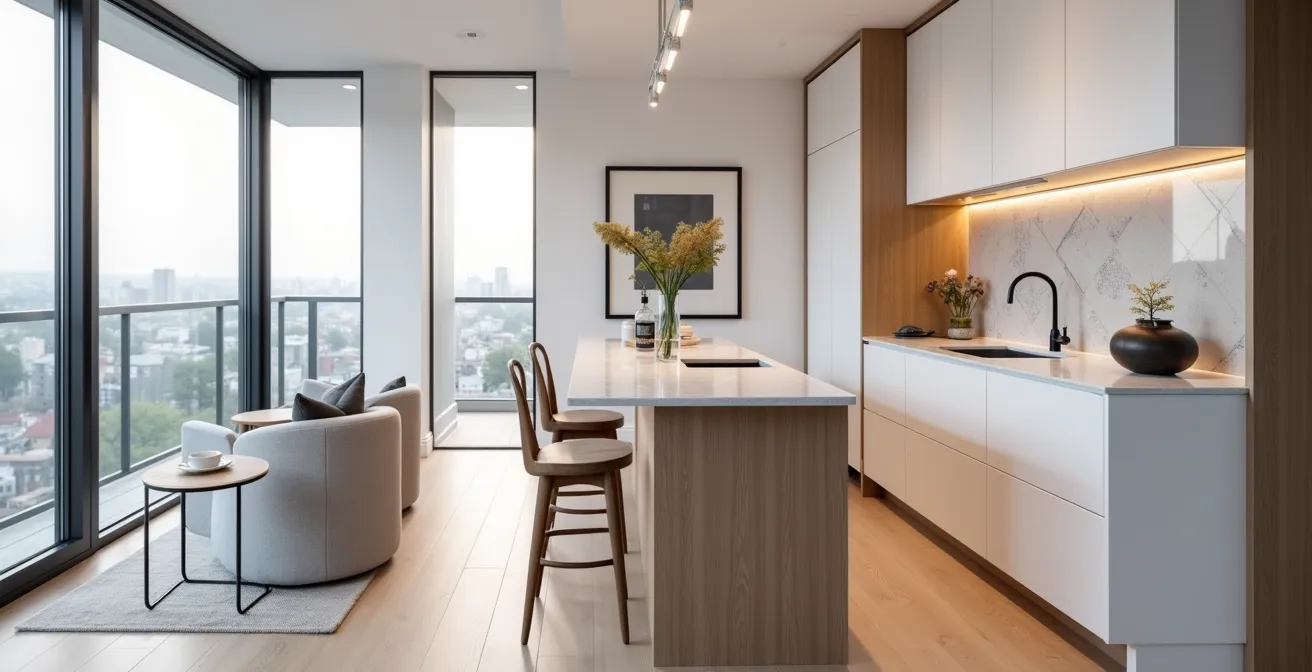
In summary:
- Ditch the outdated “work triangle” for modern, ergonomic “work zones” tailored to your cooking style.
- Invest strategically in high-touch surfaces and hardware; save on elements that don’t impact daily workflow.
- Master layered lighting to eliminate shadows and create a functional, inviting culinary workspace.
- Understand your Canadian condo’s structural and administrative limitations before planning any layout changes.
- A well-designed kitchen is the single best renovation for maximizing your property’s resale value.
The dream of a chef’s kitchen—a space of seamless workflow and culinary creativity—often feels at odds with the reality of a 500-square-foot Canadian condo. For many owners of galley or L-shaped kitchens, the daily experience is one of compromise: cramped counters, poor lighting, and a layout that works against you. The common advice often misses the mark, suggesting you simply “paint it white” to feel bigger or sacrifice appliance performance for a smaller footprint. This approach addresses the symptom (lack of space) but ignores the core desire: a kitchen that performs like a professional one, regardless of its size.
As a certified kitchen designer with a focus on ergonomics, I see this frustration constantly. The secret to unlocking a small kitchen’s potential isn’t about making it look bigger; it’s about making it work bigger. This requires a shift in thinking from purely aesthetic choices to an engineering mindset focused on workflow, performance density, and sensory ergonomics. It’s about understanding that the quality of your prep surface, the precision of your task lighting, and the logic of your storage are what truly define a chef’s kitchen.
This guide moves beyond generic tips to provide a strategic framework for your condo kitchen renovation. We will deconstruct the key decisions you’ll face, from layout principles and material selection to budget allocation and navigating the unique constraints of condo living in Canada. By focusing on ergonomic principles, you can create a space that not only maximizes every inch but also elevates your daily cooking experience from a chore to a joy.
This detailed guide will walk you through the essential considerations for transforming your compact space. Explore the sections below to build a kitchen that is efficient, valuable, and perfectly suited to your culinary ambitions.
Summary: Designing the Ultimate Condo Chef’s Kitchen
- The Work Triangle: Is It Still Relevant in Modern Open-Concept Kitchens?
- Quartz vs. Granite vs. Dekton: Which Surface Survives Red Wine Spills?
- IKEA vs. Custom Cabinetry: Where Should You Spend Your Budget?
- Layered Lighting: How to Avoid Shadows on Your Prep Counter?
- Moving the Sink: The Cost Reality of Drilling Through Concrete Slabs
- Kitchen Remodel: How to Spend $20k to Add $40k to Your Home Value?
- How to Furnish a 500 sq. ft. Condo to Maximize Resale Appeal
- Resale Value: Which Renovations Actually Pay Off in the Quebec Market?
The Work Triangle: Is It Still Relevant in Modern Open-Concept Kitchens?
The classic “work triangle”—the conceptual line connecting the sink, refrigerator, and stove—has been a kitchen design staple for decades. Its purpose was to ensure efficiency in a closed-off kitchen. However, in the open-concept, often linear layouts of modern Canadian condos, this rigid model is largely obsolete. A far more effective approach for a small, high-performance kitchen is ergonomic zoning. Instead of a triangle, we design dedicated zones for specific tasks: prepping, cooking, cleaning, and storage.
This method focuses on workflow and minimizing unnecessary movement. The Prep Zone should be the largest counter space, ideally located between the sink and the cooktop, with easy access to knives and waste disposal. The Cooking Zone surrounds your range or cooktop, with spices, oils, and cooking utensils within immediate reach. The Cleaning Zone centralizes the sink, dishwasher, and waste/recycling bins to contain messes. Finally, a well-organized Storage Zone, using full-extension drawers for pantry items, keeps you from having to dig through deep cabinets.
This zoning philosophy is championed by experts in small-space living. For example, Articulated Design Studio in Vancouver, a firm recognized for its innovative work in dense urban centres, specializes in optimizing these workflows for compact condo kitchens. By focusing on how you actually cook, you create an environment that is intuitive and efficient, turning a small footprint into a powerhouse of productivity. The goal is a kitchen that supports your culinary process, not one that forces you into a geometric formula.
Quartz vs. Granite vs. Dekton: Which Surface Survives Red Wine Spills?
The countertop is the workhorse of a chef’s kitchen. It’s a high-impact visual element and, more importantly, a functional surface that must withstand heat, scratches, and stains. In a small kitchen, this single choice defines the space. The debate between quartz, granite, and ultra-compact surfaces like Dekton comes down to a balance of aesthetics, durability, and budget, especially within the Canadian market.
Granite is a natural stone, meaning every slab is unique. It offers excellent heat resistance, allowing you to place hot pans directly on it. However, its porous nature requires annual sealing to prevent staining from culprits like red wine or oil. Quartz, on the other hand, is an engineered product composed of crushed quartz, resins, and pigments. This makes it non-porous and highly resistant to stains and scratches without any need for sealing. Its main drawback is moderate heat resistance; a trivet is always recommended for hot pots. Dekton is a newer, premium ultra-compact surface created under extreme heat and pressure. It boasts superior resistance to heat, scratches, and UV rays, making it virtually indestructible, but it comes at a higher price point.
For most condo owners seeking a balance of beauty and low maintenance, quartz is the leading choice. It offers the high-end look of stone with superior practicality for a busy cooking environment. The cost for a typical condo kitchen renovation often involves a total material and installation cost of $2,000 to $4,000, making it a predictable and valuable investment.
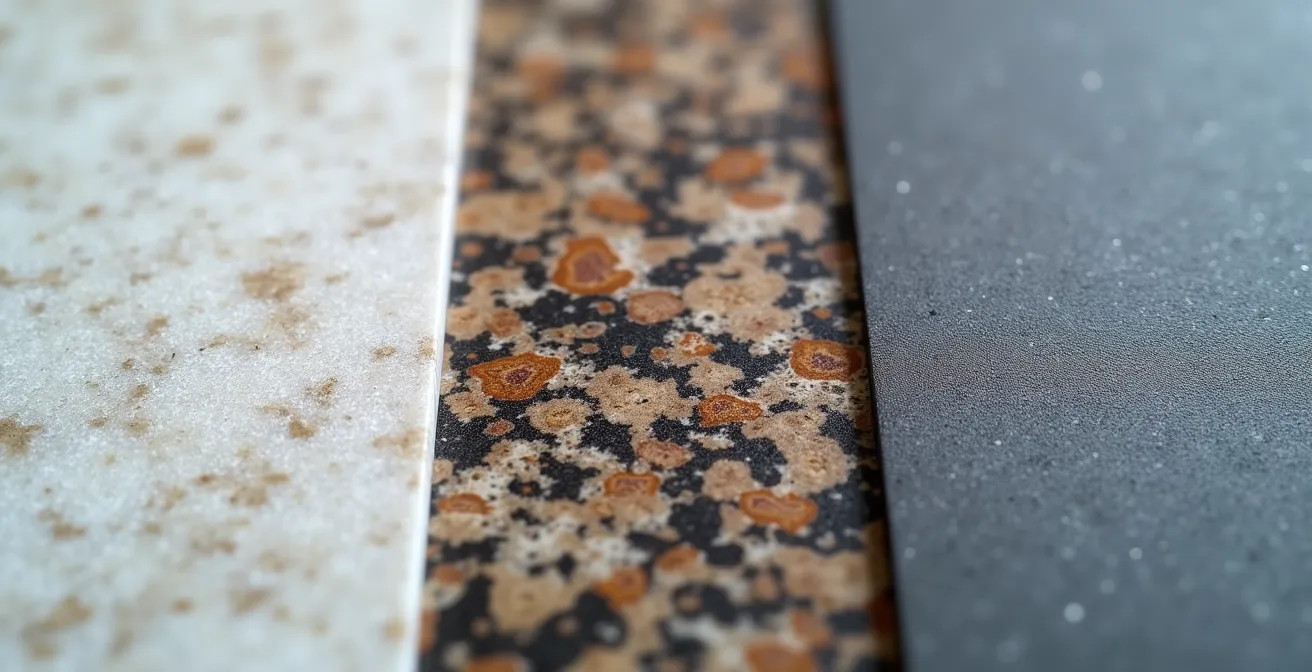
This detailed view highlights the non-porous, consistent surface of quartz versus the more varied, crystalline structure of natural granite. For a chef, this translates directly to ease of cleaning and long-term durability against stains. The following table breaks down the costs and features for the Canadian market.
| Material | Price per sq ft (CAD) | Maintenance Required | Heat Resistance |
|---|---|---|---|
| Quartz | $40-$100 | None | Moderate |
| Granite | $40-$100 | Annual sealing | Excellent |
| Dekton | Higher than quartz/granite | None | Excellent |
IKEA vs. Custom Cabinetry: Where Should You Spend Your Budget?
Cabinetry is the largest single expense in a kitchen renovation, and in a small condo, it dictates the entire functionality of the space. The choice between off-the-shelf solutions like IKEA and fully custom cabinetry is a critical one. The most intelligent approach for a high-performance condo kitchen is often a hybrid strategy: leveraging the affordability of standard boxes while investing strategically in custom fronts and high-quality hardware.
IKEA’s SEKTION system offers a robust and modular foundation at an unbeatable price. Where you elevate the system is by focusing on the elements you see and touch every day. Investing in full-extension, soft-close drawer hardware from a quality distributor like Canada’s Richelieu is a non-negotiable for an ergonomic kitchen. It allows you to see and access everything in your drawers, eliminating “dead” space at the back. Secondly, upgrading the cabinet fronts through a Canadian company like Kitch or a local cabinetmaker can give you a completely custom, high-end look without the cost of full custom boxes.
A case in point is the popular strategy of cabinet refacing. A dated Toronto condo kitchen can be completely transformed with new Shaker-style fronts in a modern finish. This strategy delivers maximum visual impact for a fraction of the cost of a full tear-out. The key is to allocate your budget where it most affects your workflow: prioritize lower cabinet organization systems (drawers over doors) and splurge on custom solutions only for truly awkward corners or non-standard dimensions that are common in condo layouts.
Action Plan: Smart Budget Allocation for Canadian Condo Kitchens
- Allocate 20-35% of your total budget to labour costs, reflecting current rates in major markets like Toronto or Vancouver.
- Invest in premium, full-extension soft-close drawer hardware from a reputable supplier like Richelieu.
- Use standard cabinet boxes (like IKEA SEKTION) and upgrade the fronts with a specialized Canadian company for a custom look.
- Prioritize custom cabinetry solutions only for awkward condo corners and non-standard dimensions where off-the-shelf won’t fit.
- Save on extensive upper cabinets but splurge on high-function lower cabinet organization systems like pull-out drawers.
Layered Lighting: How to Avoid Shadows on Your Prep Counter?
Lighting is arguably the most overlooked element in amateur kitchen design, yet it is fundamental to creating a functional and safe chef’s kitchen. A single, central ceiling fixture is the enemy of a good workspace. It casts shadows on your countertops exactly where you need to see, as your own body blocks the light. The solution is a layered lighting plan, combining three distinct types of light: ambient, task, and accent.
Ambient lighting provides the overall illumination for the room. In a condo with a concrete ceiling where installing new pot lights is difficult or impossible, this can be achieved with stylish surface-mounted track lighting. Task lighting is the most critical layer for a chef. It provides bright, focused light directly onto your work surfaces. As experts at Canadian Home Style note, “Under-cabinet lighting is perfect for providing extra light on countertops.” Using slim LED strips under your upper cabinets completely eliminates shadows on your prep area. For an island or peninsula, a series of pendant lights provides both task and ambient light.
Finally, accent lighting adds depth and character. This could be lighting inside glass-front cabinets or a spotlight on a piece of art. The magic is in how these layers work together. With smart bulbs, you can create different “scenes”: bright, cool light for intensive food prep, and warm, dim light for enjoying a meal or a glass of wine. This control over sensory ergonomics transforms the kitchen from a purely utilitarian space into the heart of the home.

As this image demonstrates, a well-lit prep area is completely free of shadows, allowing for safe and precise work, while ambient light creates a warm, inviting atmosphere in the rest of the space. This is the power of a layered approach.
Moving the Sink: The Cost Reality of Drilling Through Concrete Slabs
In the quest for the perfect layout, many condo owners dream of moving plumbing fixtures—relocating a sink to a new island, for instance. However, in the context of a Canadian concrete high-rise, this is one of the most complex and expensive undertakings in a renovation. The “structural reality” of your building is a primary design constraint that must be respected from day one.
Unlike a wood-frame house, a condo’s floors are thick slabs of reinforced concrete containing a web of steel rebar, post-tension cables, and conduits for your neighbours’ utilities. Moving a drain line requires core drilling through this slab, a process fraught with risk and expense. Before any work can begin, you must submit a formal application to your condo board or strata council. This typically requires a structural engineering report to verify the safety of the proposed drilling. The board will also mandate X-ray scanning of the slab to precisely locate rebar and conduits, ensuring you don’t compromise the building’s structural integrity or sever a critical service line.
The costs add up quickly. Beyond the plumber and engineer, you face administrative hurdles. For example, navigating Toronto condo renovation requirements could involve permit fees from $0 to $5,000 depending on the project’s scope. You will also need to secure significant liability insurance and coordinate all work within the building’s strict construction hours. In most cases, the astronomical cost and complexity make moving plumbing unfeasible. The most ergonomic and budget-conscious strategy is to design your new kitchen layout around the existing plumbing stacks. Working with these fixed points is the mark of a savvy condo renovation.
Kitchen Remodel: How to Spend $20k to Add $40k to Your Home Value?
A kitchen renovation is not just an upgrade for your lifestyle; it’s a significant financial investment in your property. Among all home improvements, a well-executed kitchen remodel consistently offers one of the highest returns. In fact, the Appraisal Institute of Canada assesses the return on investment (ROI) for a kitchen renovation at 75 to 100 percent. This means that nearly every dollar you spend can be added back to your home’s value. The key is spending it wisely.
The idea of spending $20,000 to add $40,000 in value isn’t about magic; it’s about perceived value and strategic allocation. A full gut renovation in a city like Toronto can easily range from $70,000 to $150,000. However, a more targeted, high-impact renovation can create the *perception* of a complete overhaul for a fraction of that price. The secret lies in focusing on the “Big Three” of perceived value: countertops, cabinets, and appliances.
With a $20,000 budget, you could allocate funds to create a dramatic transformation. For example: spend $4,000 on new quartz countertops, $8,000 on a hybrid cabinet solution (IKEA boxes with custom fronts), $5,000 on a new suite of panel-ready or stainless-steel appliances, and the remaining $3,000 on new lighting, a quality faucet, and a stylish backsplash. This combination completely changes the look and feel of the kitchen, making it appear brand new and high-end to a prospective buyer. It’s the visual and functional transformation that commands a higher resale price, effectively doubling your initial investment.
How to Furnish a 500 sq. ft. Condo to Maximize Resale Appeal
In an open-concept 500 sq. ft. condo, the kitchen is not a separate room; it’s the anchor of the entire living space. Furnishing and styling this integrated area to maximize resale appeal requires a minimalist, high-function approach. The goal is to create a sense of spaciousness, sophistication, and seamless flow between the kitchen and living zones. This is where the concept of the “disappearing kitchen” becomes a powerful tool.
As the design experts at renoWOW! in Toronto suggest, this technique creates an uncluttered, expansive feel.
The ‘Disappearing Kitchen’ technique uses handleless flat-panel cabinets and integrated appliances to make the entire 500 sq. ft. unit feel larger.
– renoWOW! Toronto, Small Condo Kitchen Renovation Ideas
This aesthetic is achieved with handleless, flat-panel cabinets in a neutral colour that blends with the walls. Panel-ready appliances that accept a custom cabinet front are essential, hiding the dishwasher and refrigerator from view. This creates a clean, architectural look that feels less like a kitchen and more like custom millwork.
To complete the look for resale, styling should be ruthlessly minimal. Keep counters completely clear, except for one or two high-impact “lifestyle” items, such as a high-end espresso machine or a single beautiful bowl of fresh fruit. In the living area, choose multi-functional furniture from Canadian brands known for their condo-scale designs, like a Gus* Modern sofa or an expandable dining table. Use a single large area rug to define the living zone, creating a visual separation from the kitchen without a physical wall. This curated, minimalist approach signals a sophisticated, low-maintenance lifestyle that is highly appealing to potential buyers.
Key Takeaways
- Effective condo kitchen design prioritizes ergonomic work zones over the traditional work triangle for superior workflow.
- Strategic investment in high-touch, high-performance elements like countertops and hardware yields a greater return than spreading the budget evenly.
- A layered lighting plan is non-negotiable for creating a functional, shadow-free workspace that also feels warm and inviting.
Resale Value: Which Renovations Actually Pay Off in the Quebec Market?
While the principle that kitchen renovations offer a high ROI holds true across Canada, understanding regional preferences is key to maximizing that return. In the Quebec market, specific cultural nuances can influence what buyers value most in a kitchen. A generic renovation might be profitable, but one tailored to the local lifestyle can be significantly more so. The average cost for a Canadian kitchen renovation is $30,944, so ensuring that investment aligns with buyer expectations is critical.
In Quebec, the kitchen is often the heart of social life, deeply tied to the culture of entertaining and the famous “5 à 7”. Consequently, buyers in this market place a particularly high value on a large kitchen island with comfortable seating. This isn’t just a prep space; it’s a social hub for guests to gather with a glass of wine while the host cooks. A renovation that creates or enhances this feature will have an outsized impact on resale appeal.
Furthermore, there is a strong appreciation for local craftsmanship and materials. Incorporating elements like Quebec maple for cabinetry or locally sourced stone can resonate deeply with buyers. Another specific cultural touchpoint is Quebec’s vibrant coffee culture. Integrating a dedicated coffee bar area—a small counter space with storage for an espresso machine, mugs, and accessories—can be a powerful selling feature that demonstrates a thoughtful, tailored design. By investing in these culturally specific features, you are not just selling an upgraded kitchen; you are selling a lifestyle that is aspirational and deeply familiar to the Quebec buyer, ensuring your renovation pays off handsomely.
Armed with these ergonomic principles and strategic insights, you are now equipped to move beyond the compromises of a small kitchen. You can begin sketching the high-performance culinary hub that your condo—and your passion for cooking—truly deserves.