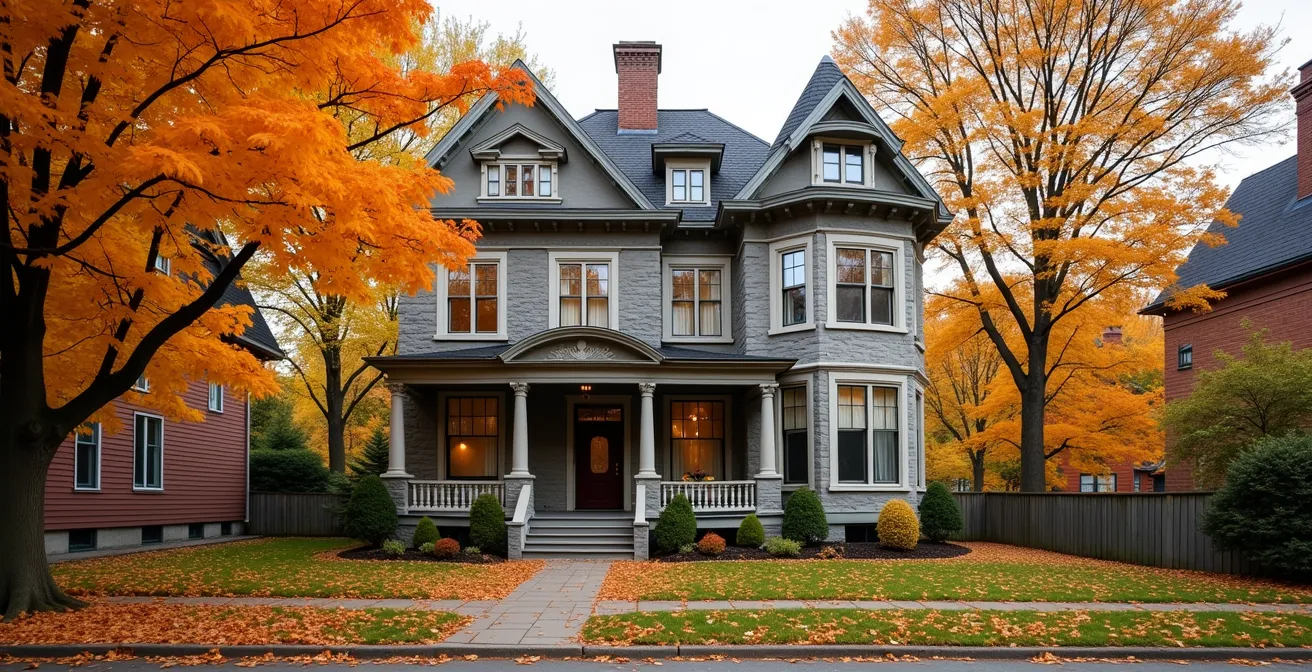
The romantic allure of a Quebec heritage home hides a stark reality: you’re not just buying a house, you’re inheriting a complex and costly set of legal and structural obligations.
- Permits and insurance are not simple paperwork; they are systemic hurdles designed to protect heritage, often at great personal expense and with significant delays.
- “Charm” comes with a non-negotiable price tag in specialized materials, mandatory repairs dictated by historical accuracy, and extreme energy inefficiency.
Recommendation: Success requires treating the property less like a purchase and more like a stewardship—balancing modern ambition with deep, informed historical respect.
The allure is undeniable. A greystone façade on the Plateau, a Victorian silhouette in Westmount, or a colourful plex in Rosemont. For the lover of architecture, owning a piece of Quebec’s history feels like the ultimate dream. You envision yourself sipping coffee by an original bay window, surrounded by the irreplaceable character of plaster mouldings and century-old hardwood. This romantic vision is powerful, and it’s what drives the market for these magnificent properties. But as a heritage architect who has guided countless clients through this journey, I must be frank: this dream comes with a silent, binding contract with the past.
Most prospective buyers focus on the obvious challenges: the old plumbing, the knob-and-tube wiring, the drafty windows. They budget for a new kitchen and a modern bathroom. What they fail to account for is the intricate, often unforgiving system that governs these homes. This isn’t just a real estate transaction; it’s what I call the “Heritage Covenant.” You are becoming a custodian, and the rules of that custodianship are written by municipal bylaws, provincial heritage acts, and the unyielding laws of material science. The true cost isn’t just in the renovations, but in the time, the bureaucracy, and the compromises required to bring a 19th-century structure into the 21st century without erasing its soul.
Forget the generic advice about “getting good contractors.” The reality is a bureaucratic gauntlet of permits, an insurance industry wary of risk, and the physical challenge of heating a structure designed long before the concept of thermal efficiency existed. This guide will not just list potential expenses. It will deconstruct the specific, systemic challenges you will face as the owner of a heritage home in Quebec. We will explore the “why” behind the costs, so you can move from naive romantic to informed steward, ready to make a decision with your eyes wide open.
This article breaks down the essential financial and logistical realities you must confront. From navigating municipal permits to understanding the structural integrity of a 1920s plex, we will cover the critical questions that determine whether your heritage dream becomes a rewarding reality or a financial nightmare.
Summary: The Realities of Heritage Home Ownership in Quebec
- How to Get a Renovation Permit Approved in a Heritage District Without Delays?
- Why Insurance Companies Refuse to Cover Houses Built Before 1950?
- Heating a Victorian Home: How to Stop Burning $500 a Month in Hydro?
- Brick vs. Stone: Which Facade Material Requires Less Maintenance?
- Is the “Charm Premium” of Historic Districts Worth the Investment?
- Removing Load-Bearing Walls: The Engineering Reality in 1920s Plexes
- Wood Windows: Dealing with Heritage Requirements in Protected Zones
- Revitalizing the “Shoebox” Home: How to Modernize Without Destroying Character?
How to Get a Renovation Permit Approved in a Heritage District Without Delays?
The first and most formidable challenge is not a hammer or a saw, but a stack of paper. In a protected heritage district in Quebec, you cannot simply decide to change your front door or replace a window. Every exterior modification, and many interior ones, must pass through a rigorous approval process. This is the bureaucratic gauntlet, a system designed to preserve architectural integrity, and it demands patience and meticulous preparation. The idea of “without delays” is optimistic; the goal is to minimize them by understanding the machine you’re dealing with.
The process involves multiple layers of government, from your local borough’s permit office to, in some cases, the provincial *ministère de la Culture et des Communications*. They will scrutinize your plans for historical appropriateness, material choices, and overall impact on the building’s character and its streetscape. A simple window replacement can turn into a months-long negotiation if you propose a material, like vinyl, that is deemed incompatible with the building’s era. Data shows that the wait is real; according to Montreal permit processing data, the timeline can range from one to four months, and that’s for standard permits. Heritage projects often take longer.
Success hinges on pre-emptive compliance. Before you even hire a designer, you must become an expert on your home’s specific heritage designation and your borough’s unique requirements. Do not present them with a dream; present them with a plan that already respects their rules. This means having detailed drawings from an architect or technologist who understands heritage constraints and providing clear evidence that your proposed materials are historically congruous. Being prepared is your only defence against costly delays.
Your Action Plan: Securing a Heritage Renovation Permit in Montreal
- Verify Heritage Status: Before anything else, consult the Répertoire du patrimoine culturel du Québec online to understand the specific classification and constraints tied to your property.
- Initial Submission: Prepare and submit your complete permit request, including detailed architectural plans, at your local borough or suburban city permit office.
- Subsidy Application: If applicable, send all required subsidy request documents (e.g., for facade restoration) via email to the Division du patrimoine. This is often a separate but parallel process.
- Contractor Bids: Obtain at least two detailed quotes from contractors holding a valid Régie du bâtiment du Québec (RBQ) licence. These quotes are often mandatory for the permit and subsidy applications.
- Energy Evaluation: If your renovation involves energy efficiency upgrades like insulation or new systems, schedule and complete the required pre- and post-retrofit energy evaluations through programs like Rénoclimat.
Why Insurance Companies Refuse to Cover Houses Built Before 1950?
Once you’ve navigated the permit office, your next challenge is convincing an insurance company to share your risk. For insurers, “historic charm” translates to “unquantifiable liability.” Many standard carriers will simply refuse to quote a policy for a home built before 1950, especially if its core systems haven’t been completely modernized. Their reluctance is not arbitrary; it’s based on a cold calculation of the high-risk components inherent in older construction, forming a daunting insurability risk profile.
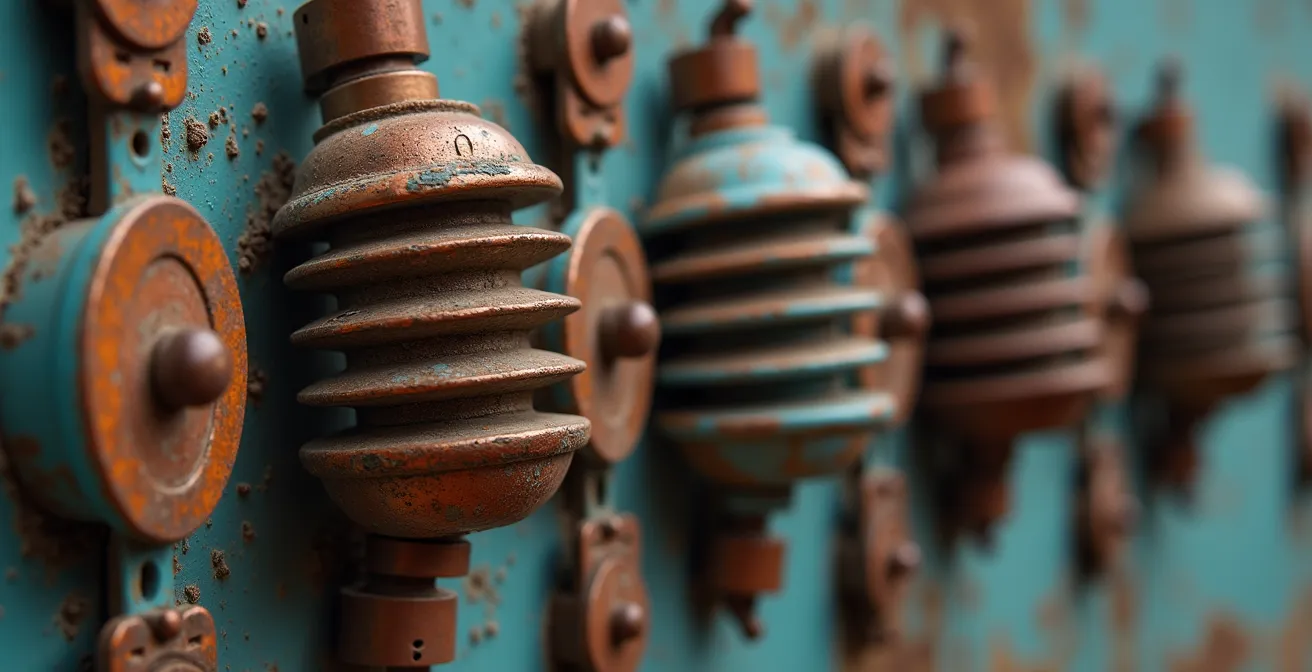
The primary red flags for insurers are outdated electrical and plumbing systems. Knob-and-tube wiring, galvanized steel plumbing, and original heating oil tanks are considered active fire and water damage hazards. Furthermore, the very materials that give a home its character—such as plaster walls, intricate woodwork, and custom-sized windows—are astronomically expensive to replace. An insurer knows that a small kitchen fire won’t just require new cabinets; it could mean sourcing specialized artisans to replicate 19th-century plasterwork, driving claim costs through the roof.
Case Study: The Two Tiers of Heritage Insurance in Quebec
The path to insuring an old house in Quebec is not uniform. As a case study from the Insurance Bureau of Canada highlights, the property’s official status is critical. Homes with a simple “inventoried” status under the Cultural Heritage Act have no strict conservation requirements upon damage, making them relatively easier to insure. The real challenge arises with “classified” properties. For these homes, owners are legally obligated to repair damage using original or period-appropriate materials and techniques. As detailed in an analysis of insuring old houses, this requirement dramatically increases potential claim costs. To secure coverage, owners often need to work with specialized brokers and proactively obtain a “Four-Point Inspection” that certifies the state of the electrical, plumbing, roofing, and HVAC systems.
To secure a policy, you must proactively de-risk your property in the insurer’s eyes. This means providing documentation of all system upgrades and, if necessary, commissioning a Four-Point Inspection from a certified professional. Expect to pay higher premiums—often significantly so—and be prepared to work with specialized brokers who have relationships with companies that understand and are willing to cover the unique risks of heritage properties.
Heating a Victorian Home: How to Stop Burning $500 a Month in Hydro?
Owning a beautiful Victorian home in January can feel like living in a magnificent, and incredibly expensive, work of art. These structures were built in an era of cheap energy and without any concept of modern building science. The result is what I call the “thermal sieve”: a building envelope riddled with air leaks, uninsulated walls, and vast, single-pane windows that radiate cold. It’s not uncommon for new owners to face Hydro-Québec bills of $500, $700, or even more per month during the winter, a staggering operational cost that quickly erodes the romance.
The culprits are numerous. The balloon-framing construction common in the era creates hollow, uninsulated wall cavities that run from the stone foundation to the attic. Original wood windows, while beautiful, offer minimal thermal resistance (an R-value of 1, compared to R-3 to R-5 for modern units). Ornate fireplaces, while charming, often have leaky dampers that act as open highways for heated air to escape. You are essentially paying to heat the neighbourhood.
The solution is a systematic, two-pronged attack: air sealing and upgrading your heating system. However, heritage designation often restricts your options. You can’t simply wrap the exterior in foam insulation. Instead, you must focus on less invasive, but highly effective, measures: professionally air-sealing the attic and basement, adding interior storm windows, and insulating wall cavities where possible. The most impactful change is often replacing an old, inefficient furnace with a modern cold-climate heat pump. Fortunately, the government recognizes this burden. Quebec’s Rénoclimat and LogisVert programs offer substantial financial aid for these upgrades, with the Rénoclimat program now offering increased financial assistance of up to tens of thousands of dollars. These subsidies are not just a bonus; they are an essential financial tool to make the home livable and affordable in the long term.
Brick vs. Stone: Which Facade Material Requires Less Maintenance?
The facade is your home’s public face and its primary shield against the harsh Canadian climate. In Quebec’s heritage districts, this shield is typically made of brick or stone—most iconically, the Montreal greystone. While both materials evoke a sense of permanence, their long-term maintenance profiles and costs are vastly different. Choosing between a brick or stone home, or budgeting for its upkeep, requires understanding how each material ages and reacts to our punishing freeze-thaw cycles.
Brick is a relatively uniform, manufactured product. Its primary vulnerability is the mortar between the bricks. Over decades, this mortar erodes and requires “repointing”—a meticulous and costly process of grinding out the old mortar and replacing it. If water infiltrates and freezes, it can cause bricks to spall (flake) or create a “bulging wall,” a serious structural issue requiring immediate and expensive repair. However, finding replacement bricks that match the colour, size, and texture of 100-year-old originals can be a significant challenge.
Greystone (limestone), on the other hand, presents a more complex challenge. While the stone itself is durable, it is susceptible to delamination, where layers peel off like an onion, often due to frost. Repairing greystone is a specialized art. It requires sourcing matching limestone from a limited number of Quebec quarries and employing masons who understand the unique properties of this sedimentary rock. As a result, the labour and material costs are consistently higher than for brickwork.
| Maintenance Type | Brick Cost/sq.ft | Stone Cost/sq.ft | Frequency |
|---|---|---|---|
| Repointing | $20-30 | $35-45 | Every 20-30 years |
| Bulging Wall Repair | $55-65 | $55-65 | As needed |
| Complete Facade Replacement | $40-50 | $60-80 | 50-75 years |
| Annual Cleaning | $2-3 | $3-4 | Yearly |
Ultimately, while both materials require significant long-term investment, brick is generally the less expensive material to maintain over the life of the home. The availability of materials and the larger pool of qualified masons make repairs more accessible and affordable compared to the highly specialized and costly world of greystone restoration.
Is the “Charm Premium” of Historic Districts Worth the Investment?
This is the ultimate question every prospective buyer of a heritage home must answer. You pay a premium to buy in a desirable historic district, and as we’ve seen, you continue to pay a premium for permits, insurance, maintenance, and heating. So, does the intangible value of “charm” and “character” justify the very tangible, and often substantial, financial outlay? The answer is nuanced and depends entirely on your financial capacity and personal priorities.
The “charm premium” is real, but it’s a double-edged sword. On one hand, properties in designated heritage areas tend to hold their value well, protected from incongruous development that can devalue a neighbourhood. The aesthetic cohesion and unique sense of place are powerful assets. On the other hand, this value is predicated on the home being impeccably maintained according to strict rules, and the cost of that maintenance can be staggering. For example, heritage homes typically face 25-40% higher insurance premiums, a direct financial tax on charm.
Viewing a heritage home purely through a modern ROI lens is often a recipe for frustration. The investment is not just financial; it’s emotional and custodial. The “return” is the daily experience of living in a space with a story, the pride of stewardship, and the connection to a specific architectural history. To make the investment “worth it,” you must find value in these intangibles. A successful owner is one who internalizes the Heritage Covenant and sees the extra costs not as a burden, but as the necessary price of preserving something unique. You can maximize your investment’s financial side by meticulously documenting all renovations, focusing on energy efficiency to cut operational costs, and leveraging any available municipal tax credits for heritage properties.
Removing Load-Bearing Walls: The Engineering Reality in 1920s Plexes
The number one request from clients renovating an old Quebec plex is to create an open-concept ground floor. They dream of a bright, flowing space combining the kitchen, dining, and living areas. The obstacle to this dream is almost always a thick, central wall. In homes from the 1920s to the 1940s, this is rarely a simple partition. It is the structural spine of the building, a load-bearing wall holding up the floors above. Removing it is not a demolition job; it is a complex and expensive surgical operation that requires deep engineering expertise.
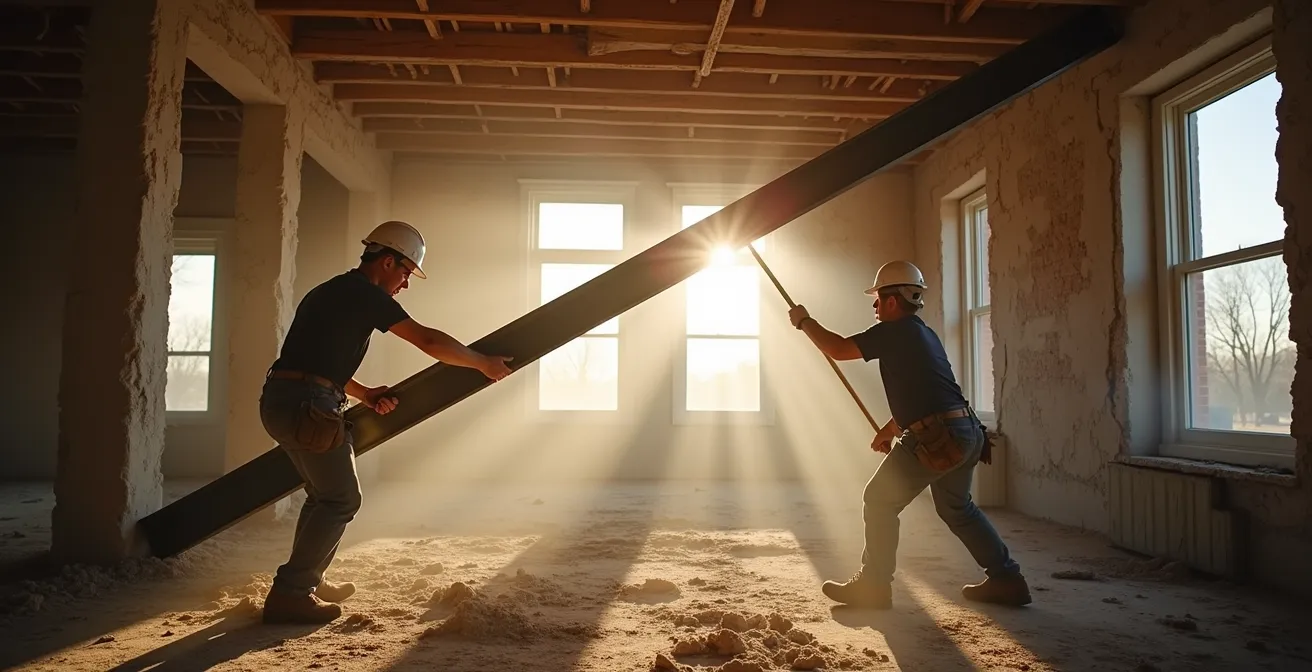
In these plexes, particularly those with “brick-on-wood” construction, the interior walls are an integral part of the system that keeps the exterior brick facade from bowing outwards. Simply cutting an opening without a proper plan can have catastrophic consequences. The process must begin with a structural engineer. They will analyze the loads, design the appropriate support system—typically a massive laminated veneer lumber (LVL) or steel I-beam—and specify the size of the temporary support walls needed during construction. Their stamped plans are non-negotiable and are required for the building permit, for which Montreal permit fees alone cost $9.80 per $1,000 of the project’s value, adding another layer of cost.
Case Study: The True Cost of Open Concept in a Rosemont Triplex
The renovation of a 1940s triplex in Rosemont illustrates the timeline and costs perfectly. The project to open up a 25×40 foot ground floor began with a $3,500 fee for a structural engineer’s analysis and plans. The permit process took four months. The renovation itself involved installing heavy steel I-beams, costing $8,000 for materials and specialized labour, plus dealing with party wall agreements with neighbours. The engineer discovered the building’s structure required more reinforcement than initially thought. The total project timeline stretched to eight months, and the final cost for just the structural modification reached $45,000. This is the engineering reality behind a seemingly simple design choice.
The cost and complexity of removing a load-bearing wall are the most common budget-breakers in a heritage renovation. What seems like a simple aesthetic choice on a design show is, in reality, a major structural intervention that should never be underestimated.
Wood Windows: Dealing with Heritage Requirements in Protected Zones
Windows are the eyes of a house, and in a heritage property, they are one of the most defining features of its character. They are also one of the biggest points of conflict between an owner’s desire for energy efficiency and a heritage board’s mandate for historical preservation. In many protected zones in Quebec, you simply cannot replace original wood windows with modern vinyl or even aluminum-clad units. You are faced with a choice: restore the originals or commission costly, custom-made replicas. This is the principle of “engineered authenticity” in action.
Restoring original, single-pane wood windows is a labour of love. It involves stripping decades of paint, repairing rotted wood, re-glazing the panes, and installing specialized weatherstripping. The result is beautiful, but the energy performance remains poor. The most common compromise is to add exterior or, more discreetly, interior storm windows to improve the R-value.
If the original windows are beyond repair, you must commission custom wood replicas. This involves finding a specialized *menuisier* (woodworker) who can replicate the exact historical profiles of the sashes and frames. These modern replicas can be built with double-paned glass for much better energy efficiency, but they come at a very high price. A single custom wood window can cost thousands of dollars, making a whole-house replacement a six-figure project. This is a far cry from the cost of standard off-the-shelf windows.
| Window Option | Cost per Window | Heritage Approval | Energy Efficiency |
|---|---|---|---|
| Restore Original | $800 – $1,200 | Always Approved | Poor (R-1) |
| Custom Wood Replica | $1,500 – $2,500 | Usually Approved | Good (R-3) |
| Wood-Clad Aluminum | $1,200 – $1,800 | Some Districts | Excellent (R-5) |
| Storm Windows Addition | $300 – $500 | Generally Approved | Improved (R-2.5) |
The choice is a difficult balance of budget, aesthetics, and performance. Before you fall in love with a home for its beautiful, wavy-glass windows, you must have a clear understanding of the financial and regulatory commitment required to maintain or replace them.
Key Takeaways
- Heritage ownership is a stewardship, not just a purchase, governed by a “Heritage Covenant” of rules and obligations.
- The biggest costs are often systemic: navigating the “bureaucratic gauntlet” of permits and the “insurability risk profile” that deters standard insurers.
- Success depends on respecting the home’s character; modernizing with “engineered authenticity” is possible but expensive, especially for key elements like walls and windows.
Revitalizing the “Shoebox” Home: How to Modernize Without Destroying Character?
Amidst all these warnings and high costs, there is a path to success. Perhaps no building type better illustrates the potential for a successful heritage project than the humble “shoebox” house. Found in working-class Montreal neighbourhoods like Villeray and Rosemont, these small, single-story brick homes represent a unique challenge: how to adapt a modest, historically significant structure for modern life without erasing its humble character.
The temptation is to gut-renovate and fill the space with luxury finishes—marble countertops, high-end fixtures, and an aggressive open-concept layout. This is often a mistake. The financial and aesthetic success of a shoebox renovation lies in respect for its origins. These homes were built with sturdy, high-quality materials that are simply not used today. As one expert notes, the difference is stark. As a Canadian Heritage Home Expert from the Canadian Woodworking Heritage Homes Guide states, “They don’t make them like they used to – walls made of strong, withstanding plaster versus drywall used in many homes today”. Preserving these original plaster walls, restoring the narrow-plank hardwood floors, and maintaining the simple brick facade are key to honouring the home’s character.
Case Study: A Profitable, Respectful Villeray Shoebox Transformation
A typical Villeray shoebox, purchased for $425,000, underwent a renovation that carefully balanced modern needs with historical preservation. The project focused on a modest rear extension ($65,000) for a modern kitchen and a finished basement ($35,000) for extra living space. Crucially, the facade was restored, not replaced ($25,000), and original interior elements were kept. By avoiding luxury materials that would clash with the home’s DNA, the total renovation cost was contained. The property later sold for $675,000, demonstrating a significant return on investment. The key was that the modernization supported, rather than overwrote, the home’s authentic working-class character.
The shoebox home teaches us the most important lesson of the Heritage Covenant: the most successful projects are not impositions of modern taste, but dialogues with the past. By working *with* the building’s original character, you can create a unique, functional, and financially rewarding home that is so much more than the sum of its parts.
If you are considering this journey, the first step is to arm yourself with knowledge. An informed decision, grounded in the realities of engineering, bureaucracy, and finance, is the only way to ensure your love for architecture translates into a home you will cherish, not a project you will regret. Begin by assessing your chosen property not just for its beauty, but for its hidden obligations.