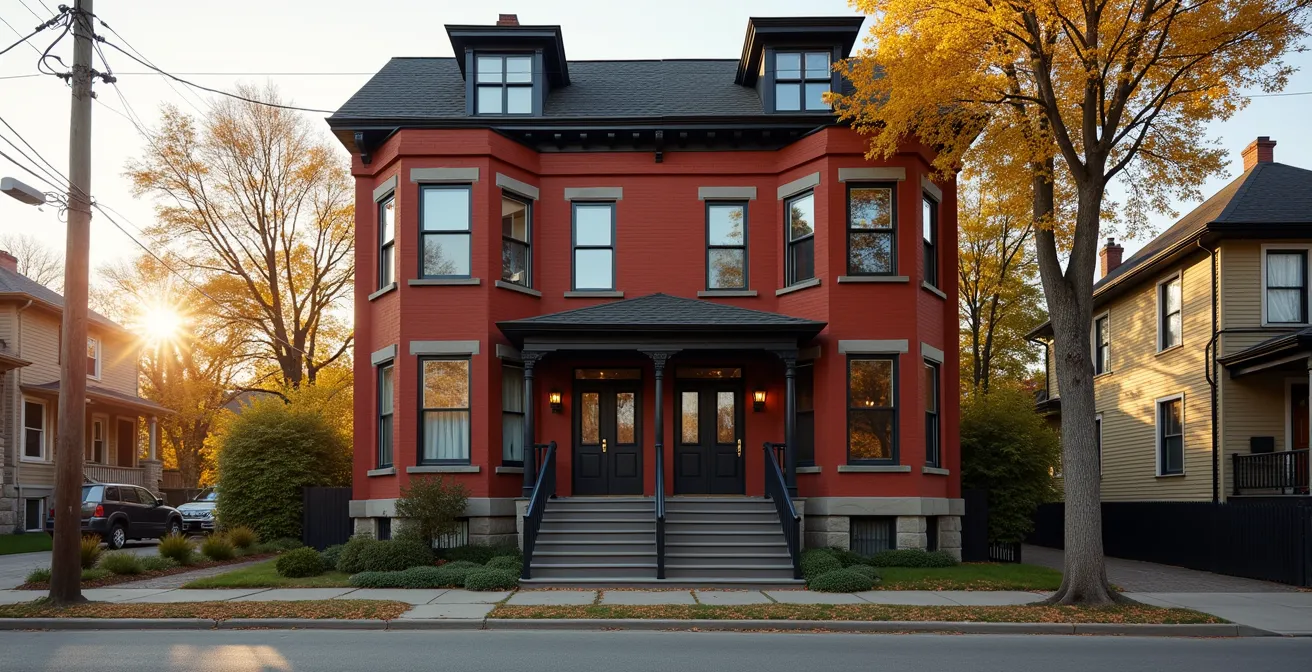
Buying an owner-occupied plex in Quebec isn’t just about acquiring a home; it’s about launching a small business that can subsidize your lifestyle.
- Master Quebec’s unique and often underestimated costs, particularly the “Welcome Tax,” which can add thousands to your budget.
- Strategically combine federal programs like the FHSA and HBP to build a powerful down payment and access larger properties.
- Understand that the most significant financial risks and rewards lie in Quebec-specific legal structures and regional market differences.
Recommendation: To succeed, you must shift your mindset from simply being a ‘homebuyer’ to becoming an ‘investor-occupant’ to unlock true financial freedom in the Quebec market.
For many first-time buyers in Quebec, the dream of homeownership feels like a constant battle against rising prices and interest rates. You’ve been told to save diligently, get pre-approved, and hunt for a property that ticks all the boxes. But what if the conventional approach is wrong? What if the key isn’t just to buy a home, but to buy an asset that works for you from day one?
The standard advice often overlooks a strategy uniquely suited to Quebec’s housing landscape: owner-occupancy in a multi-unit property, or ‘plex’. This isn’t just about having a tenant; it’s about a fundamental shift in perspective. Instead of viewing your mortgage as a pure expense, you can transform it into a partially subsidized living cost, funded by your rental income. This is the concept of the lifestyle subsidy—where your investment actively pays for a portion of your life.
But this path is not for the unprepared. The Quebec market is filled with specific legal traps, financial levers, and regional quirks that generic Canadian real estate advice completely misses. The true key to success is not just finding the right property, but mastering the specific rules of the game in La Belle Province. This guide will walk you through the real-world strategies and critical warnings you need to turn your first home into your best investment.
To navigate this journey effectively, we will break down the essential steps and considerations. This article covers everything from accurately calculating your real costs to leveraging unique financial tools and understanding the market dynamics specific to Quebec.
Summary: Living in Your Investment: A First-Time Buyer’s Guide to Owner-Occupancy in Quebec
- Why You Need to Budget an Extra 3% for Closing Costs in Quebec?
- Rent or Buy in Montreal: Which Option Wins When Rates Hit 5%?
- How to Secure a Mortgage as a Non-Permanent Resident in Canada?
- The Condo Syndicate Trap: What 40% of New Owners Fail to Check
- When to Buy Your First Home: Seasonal Trends in Quebec Real Estate
- How to Combine the FHSA and HBP to Maximize Your Down Payment?
- How to Buy a Million-Dollar Plex with Only 5% Down Payment?
- Quebec Housing Markets: Why Prices in the Regions Are Catching Up to Montreal
Why You Need to Budget an Extra 3% for Closing Costs in Quebec?
The most common mistake first-time buyers make in Quebec is underestimating closing costs. Standard advice suggests budgeting 1.5% of the purchase price, but in Quebec, this is a dangerous miscalculation. The primary culprit is the Land Transfer Tax, colloquially known as the “Welcome Tax.” This mandatory fee is calculated on a progressive scale and can be substantial. For example, on a $500,000 duplex in Montreal, the Welcome Tax alone is approximately $6,750.
This isn’t just a minor detail; it’s a significant closing cost blind spot that can derail your purchase. Unlike in other provinces, this tax is a major line item that must be paid in cash shortly after the transaction closes. A specialized Quebec Welcome Tax calculator shows that fees can quickly climb to between 3% and 4% of the purchase price for higher-value properties, a far cry from the 1.5% often quoted.
But the Welcome Tax is only the beginning. When buying a plex, you must also factor in higher notary fees (often $1,500-$3,000 due to the complexity of existing leases), a mandatory property inspection, and title insurance—especially critical for older Montreal properties with potential boundary issues. Forgetting these specifically Quebec-centric costs can leave you thousands of dollars short right when you can least afford it.
Here are the key costs to anticipate beyond the standard estimates:
- Welcome Tax: Calculated on the higher of the purchase price or municipal assessment, ranging from 1.5% to 3% or more.
- Notary Fees: More expensive for plexes due to lease transfers and more complex title searches.
- Property Inspection: Essential for identifying structural issues in older buildings.
- Title Insurance: Protects against ownership claims and encroachment issues common in dense urban areas.
- Immediate Repair Fund: Prudent to set aside funds for tenant-requested fixes or mandatory safety upgrades upon taking possession.
Failing to account for this “extra 3%” is not just an inconvenience; it can force you to drain your emergency fund before you even move in, putting your entire investment on a precarious footing from day one.
Rent or Buy in Montreal: Which Option Wins When Rates Hit 5%?
With interest rates hovering around 5%, the classic “rent vs. buy” debate becomes more complex, especially in a market like Montreal. On the surface, renting may seem cheaper month-to-month. However, this simple comparison ignores the most powerful advantage of owning a plex in Quebec: the lifestyle subsidy. When you own a duplex or triplex and live in one unit, your tenant’s rent directly reduces your personal housing cost and builds your equity.
This completely reframes the financial equation. Your net monthly cost can often become comparable to, or even lower than, the cost of renting a similar-sized apartment, all while you are building an asset. Furthermore, the portion of your mortgage interest, property taxes, and maintenance related to the rental unit becomes tax-deductible, an advantage renters simply don’t have.

As you can see in the illustration, the concept relies on balance. The income from one side of the property directly counteracts the costs of the other. It’s a powerful financial machine hiding in plain sight. Let’s look at a realistic breakdown.
This table compares the true monthly costs and benefits, factoring in the rental income from an owner-occupied duplex. As the data from the Canada Mortgage and Housing Corporation (CMHC) shows, the numbers tell a compelling story.
| Scenario | Monthly Cost | Equity Building | Tax Benefits |
|---|---|---|---|
| Rent 3-bedroom in Montreal | $2,200 | $0 | None |
| Buy $500K duplex (5% down) | $3,200 mortgage + costs | $650/month | Rental income deductible |
| Buy duplex with tenant income | $1,700 net cost | $650/month | Multiple deductions |
When interest rates are high, the ability to generate rental income is no longer just a “nice-to-have”—it becomes the critical factor that makes buying a superior long-term financial decision over renting in Montreal.
How to Secure a Mortgage as a Non-Permanent Resident in Canada?
For newcomers to Canada, securing a mortgage can seem like a daunting hurdle, surrounded by myths and misinformation. The most common misconception is that it’s impossible without permanent residency (PR). This is incorrect, but the path is indeed different and requires careful preparation. Canadian lenders and insurers have specific programs for temporary foreign workers, but the requirements are stricter.
The single most important factor is the down payment. While Canadian citizens can buy an owner-occupied plex with as little as 5% down, non-permanent residents face a higher barrier. According to CMHC guidelines, non-permanent residents typically need a 35% minimum down payment if they don’t have a credit history in Canada. However, with a strong employment history in Quebec and established Canadian credit, some lenders may offer more flexible options.
Building a Canadian credit history is non-negotiable. Lenders need to see evidence of your financial reliability within the Canadian system. This doesn’t happen overnight. It requires a proactive strategy starting at least a year before you plan to apply for a mortgage.
To position yourself for success, you need to demonstrate stability and integration into the Quebec economy. Here are the essential steps:
- Establish Canadian Credit: Open a secured credit card and ensure utility bills are registered in your name. Pay every bill on time for at least 12 months.
- Document Employment Stability: You’ll need an employment letter from your Quebec employer confirming your salary and position, along with several months of pay stubs.
- Build a Banking Relationship: Open a Canadian bank account and maintain consistent deposits for at least six months to show a stable cash flow.
- Prepare Down Payment Documentation: If your down payment is coming from abroad, you must have certified translations of foreign bank statements and any gift letters.
- Engage a Specialist: Work with a mortgage broker who has explicit experience with CMHC’s programs for temporary foreign workers. They know which lenders are more receptive to non-PR applications.
Ultimately, securing a mortgage as a non-PR in Quebec is a marathon, not a sprint. It’s about methodically building a profile of financial trustworthiness that meets the specific criteria of Canadian lenders.
The Condo Syndicate Trap: What 40% of New Owners Fail to Check
When buying a unit in a plex, many first-time buyers focus on the physical condition of their apartment, but they overlook the single most important factor: the financial and legal health of the co-ownership syndicate. In Quebec, especially with older plexes converted into condos, you are not just buying real estate; you are entering into a business partnership with the other owners. A poorly managed syndicate can turn your dream investment into a financial nightmare.
A particularly perilous structure found in Montreal is the ‘Copropriété Indivise’ (undivided co-ownership). Unlike a standard ‘divided’ condo where each owner has a separate title and mortgage, in an undivided co-ownership, all owners are on a single mortgage and a single property tax bill. This creates a state of profound financial interdependence. If your co-owner defaults on their share of the payment, the bank can hold you liable for the entire amount. This is a catastrophic risk that many inexperienced buyers are completely unaware of.

Thorough due diligence is your only protection. This means going beyond the inspection report and becoming a forensic accountant for the syndicate. You must review years of financial statements, meeting minutes, and legal documents to uncover any hidden problems. This is where a specialized notary or real estate lawyer becomes your most valuable ally.
Your Audit Checklist for Quebec Co-ownership Properties
- Review the last 3 years of syndicate meeting minutes (procès-verbaux) to identify recurring disputes, owner apathy, or major upcoming decisions.
- Verify that a contingency fund study (étude du fonds de prévoyance) has been completed within the last 5 years, as required by Quebec law, and that the fund is adequately capitalized.
- Scrutinize the financial statements for any pending special assessments (‘cotisations spéciales’) and check the maintenance log for upcoming major repairs (roof, foundation, balconies).
- Examine the declaration of co-ownership in detail to understand voting rights, use restrictions, and the exact formula for allocating common expenses.
- Confirm if there is a professional management company or assess the risks of self-management, which can be high in small syndicates with inexperienced owners.
Ignoring the health of the syndicate is like buying a car without checking the engine. The exterior might be beautiful, but a dysfunctional core can lead to years of financial stress and regret.
When to Buy Your First Home: Seasonal Trends in Quebec Real Estate
Timing the market is notoriously difficult, but understanding Quebec’s unique seasonal trends can give you a significant strategic advantage, both as a buyer and a future landlord. The province’s real estate market doesn’t just follow the typical spring-fall cycle; it is heavily influenced by a cultural phenomenon known as “Moving Day.”
In Quebec, the vast majority of residential leases traditionally begin and end on the same day: July 1st. This is not just a quaint tradition; it’s a massive market driver. Quebec’s unique Moving Day tradition means that nearly 60% of all leases turn over on this date, creating a surge in rental demand in the preceding months. For a plex owner-occupant, this is a critical piece of intelligence.
Buying in the late winter or early spring (February to April) aligns your purchase perfectly with this cycle. It gives you enough time to close the transaction and have your rental unit ready to advertise in May and June, precisely when the largest pool of tenants is actively searching for their next home. This maximizes your chances of securing a quality tenant quickly and at a competitive rent, minimizing your vacancy risk from day one.
Conversely, buying in the late summer or fall can be more challenging from a landlord’s perspective. The pool of available tenants shrinks dramatically after July 1st, potentially forcing you to accept a lower rent or endure a few months of vacancy until demand picks up again. From a buyer’s perspective, however, the fall and winter often see less competition and more motivated sellers, which can present negotiation opportunities. You must weigh the benefit of a potential discount against the risk of a slower start for your rental income.
Therefore, the “best” time to buy depends on your primary goal: if it’s to maximize your immediate rental income, align your purchase with the pre-July 1st rush. If your priority is to find a deal with less competition, the off-season might be your window of opportunity.
How to Combine the FHSA and HBP to Maximize Your Down Payment?
For first-time buyers in Canada, the government has provided two powerful tools to accelerate homeownership: the First Home Savings Account (FHSA) and the Home Buyers’ Plan (HBP). While each is beneficial on its own, their true power is unlocked when you strategically combine them. This combination, which I call the “Plex Hack,” is the single most effective way to build a substantial down payment while generating significant tax deductions.
The FHSA allows you to contribute up to $8,000 per year (to a lifetime maximum of $40,000), with contributions being tax-deductible, and withdrawals for a first home purchase being tax-free. The HBP allows you to borrow up to $60,000 from your own Registered Retirement Savings Plan (RRSP) tax-free, which you must then repay over 15 years.

When used together by a couple, the potential is enormous. Two partners can collectively save in their FHSAs and withdraw from their RRSPs, creating a formidable down payment in a relatively short period. This strategy can be the difference between being able to afford a small condo versus a cash-flowing duplex.
Case Study: The Plex Hack in Action
A Montreal couple demonstrates the power of this strategy. According to an analysis by financial planners, they maximized their down payment by each contributing $8,000 annually to their FHSAs for two years, totaling $32,000. They then each withdrew $60,000 from their RRSPs via the HBP, adding another $120,000. As detailed in the case study on combining the FHSA and HBP, their combined $152,000 down payment allowed them to purchase a $500,000 duplex while avoiding costly CMHC insurance and claiming $32,000 in tax deductions over two years.
Here is the step-by-step strategy to implement the “Plex Hack”:
- Years 1-2: Each partner contributes the maximum $8,000 per year to their individual FHSA, generating an immediate tax deduction.
- Year 2 (Purchase Year): Withdraw all FHSA funds completely tax-free to use for the down payment. This withdrawal does not need to be repaid.
- Simultaneously: Withdraw up to $60,000 each from your RRSPs under the Home Buyers’ Plan.
- Years 3-17: Begin repaying the HBP amount to your RRSP at a minimum rate of 1/15th of the borrowed amount per year. Use rental income to accelerate these repayments if possible.
- Ongoing: Maximize tax efficiency by deducting mortgage interest and other eligible expenses related to the rental portion of your property.
By mastering this strategy, you are not just saving for a home; you are actively using the tax system to co-fund your investment, giving you a crucial advantage in Quebec’s competitive market.
How to Buy a Million-Dollar Plex with Only 5% Down Payment?
The idea of buying a million-dollar property with only a 5% down payment ($50,000) might sound like a fantasy, but in the world of owner-occupied multiplexes in Canada, it is a reality. Thanks to mortgage loan insurance programs from providers like CMHC, buyers can purchase duplexes, triplexes, or fourplexes with a low down payment, provided they live in one of the units. However, “possible” does not always mean “advisable.”
The catch is the mortgage insurance premium itself. For a high-ratio mortgage (less than 20% down), this premium is significant. According to CMHC’s current rate structure, a 5% down payment on a purchase of this size incurs a premium of 4.00% of the mortgage amount. This premium is typically added to your total mortgage, meaning you pay interest on it for the life of the loan. On a $950,000 mortgage, that’s an extra $38,000 you’ll be financing.
The more critical question is cash flow. A massive mortgage, even at reasonable interest rates, creates an enormous monthly payment. The rental income from the other units will help, but it rarely covers the entire expense on such a leveraged property. This leaves you with a substantial monthly shortfall that you must be financially prepared to cover out of pocket. This is not a strategy for the faint of heart or those with unstable income.
Let’s run the numbers for a reality check. The table below outlines the estimated monthly expenses for a $1 million duplex in Montreal with a 5% down payment. It provides a stark look at the financial commitment required.
| Monthly Expense | Amount | Annual Total |
|---|---|---|
| Mortgage Payment (5.5% rate) | $5,800 | $69,600 |
| CMHC Insurance (in mortgage) | $210 | $2,520 |
| Property Tax | $835 | $10,000 |
| School Tax | $125 | $1,500 |
| Insurance & Maintenance | $450 | $5,400 |
| Total Before Rental Income | $7,420 | $89,020 |
| Projected Rental Income | -$2,000 | -$24,000 |
| Net Monthly Cost | $5,420 | $65,020 |
While this strategy offers a path to acquiring a significant asset with minimal capital, it carries immense risk. The monthly cash-flow burden is huge, and a minor disruption—like a job loss or a non-paying tenant—could quickly lead to financial disaster. It should only be considered by high-income earners with a very secure financial foundation.
Key Takeaways
- Owner-occupying a plex in Quebec transforms a home into a “lifestyle subsidy” machine, where rental income offsets your living costs.
- Quebec’s market has unique financial traps, like the Welcome Tax and undivided co-ownership laws, that require specialized due diligence.
- Strategically combining the FHSA and HBP is the most powerful method for first-time buyers to build a large down payment and gain a competitive edge.
Quebec Housing Markets: Why Prices in the Regions Are Catching Up to Montreal
For decades, the Montreal real estate market was the undisputed center of the universe in Quebec. But a powerful new trend is reshaping the landscape: regional arbitrage. Spurred by the rise of remote work and a search for a better quality of life, buyers are increasingly looking beyond the metropolis to cities like Sherbrooke, Trois-Rivières, and Gatineau. This migration is causing property prices in the regions to appreciate at a faster pace than in Montreal, creating a unique opportunity for savvy investors.
Regional arbitrage involves selling a high-priced asset in a major city to buy a larger, more profitable one in a smaller region. The numbers are compelling. For example, recent market data shows a 12% annual increase in Gatineau plexes, outpacing growth in many Montreal boroughs. The key is the difference in capitalization rates (cap rates)—the ratio of a property’s income to its purchase price. Regions like Estrie often boast cap rates of 5.5% or higher, compared to Montreal’s tight 3.5-4%. This means your investment dollar generates more income outside the big city.
Case Study: Lifestyle Arbitrage from Montreal to Sherbrooke
A family’s move perfectly illustrates this trend. As highlighted in an analysis of multiplex buying strategies in Quebec, they sold their $450,000 Montreal condo to purchase a $380,000 triplex in Sherbrooke. With two rental units generating $1,800 per month, their net housing cost plummeted from $2,100 a month to just $800 a month. In the process, they gained an additional 800 square feet of living space and a backyard, dramatically improving their quality of life while strengthening their financial position.
This strategy is not about abandoning Montreal, but about leveraging its high property values. For a first-time buyer, it could mean starting your investment journey in a regional city where acquisition costs are lower and cash flow is stronger. You can build equity faster in a market with more room for growth, potentially using that equity later to enter the Montreal market from a position of strength.
The decision to invest in a region is both a financial and a lifestyle choice. It offers a path to faster financial freedom and a different pace of life, proving that the best opportunities in Quebec real estate are no longer confined to a single island.