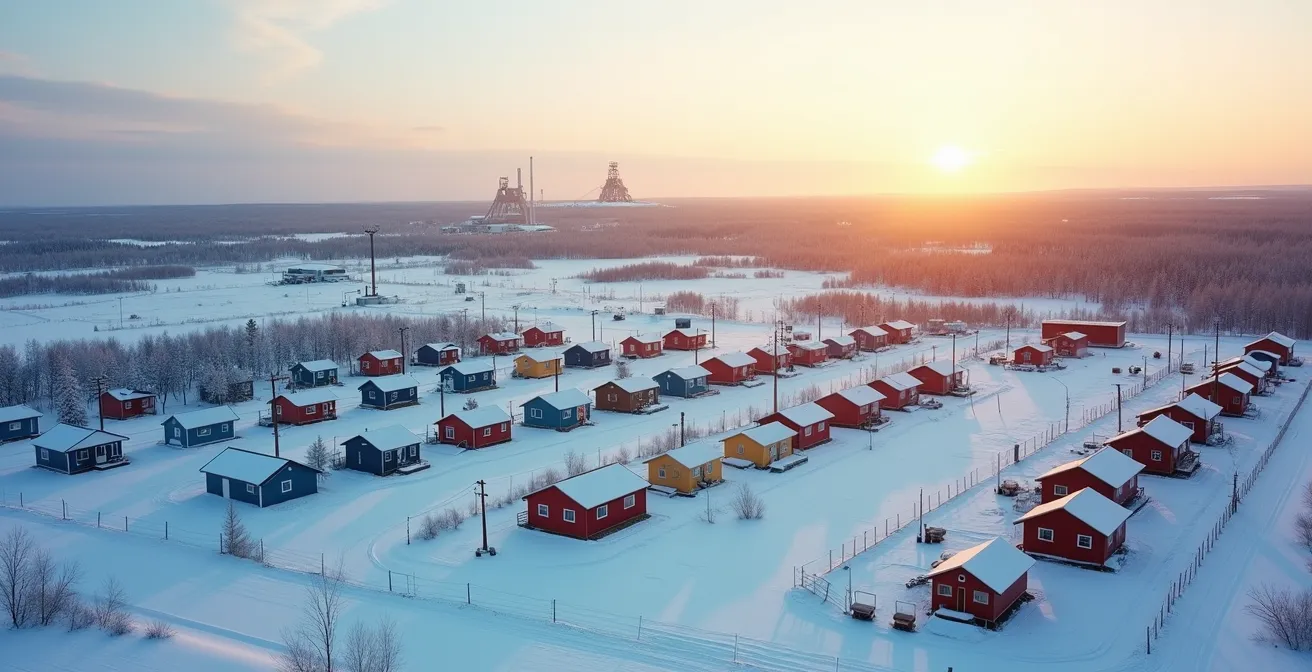
Yes, but the sub-$200k price tag is just the beginning of the story, not the end.
- True affordability depends on mastering the hidden costs of “climate-proofing” your home for extreme winters.
- The local economy’s link to resource cycles creates both high-yield investment opportunities and significant liquidity risks.
Recommendation: Shift your focus from the purchase price to understanding the complete socio-economic ecosystem. This is the key to unlocking true financial freedom and a rewarding lifestyle in Canada’s North.
The allure is undeniable. Scrolling through real estate listings and seeing detached homes for under $200,000 in places like Val-d’Or or Rouyn-Noranda feels like discovering a secret code to financial freedom. For remote workers, adventurers, or anyone priced out of Canada’s major urban centres, the Abitibi-Témiscamingue region of Quebec seems to offer an escape hatch—a chance to own a home and embrace a life connected to the vast Canadian wilderness. Many guides will simply tout the low prices and the outdoor activities, painting a simple picture of affordability.
But this perspective misses the most crucial point. The low entry price isn’t a market anomaly; it’s a direct reflection of a unique socio-economic ecosystem governed by two powerful forces: the cyclical nature of the resource industry and the unforgiving reality of a subarctic climate. To simply focus on the sticker price is to ignore the variables that will truly define your financial success and quality of life in the North. The real question isn’t just *if* you can buy a house for under $200k, but what it truly costs to live well in it.
This article moves beyond the surface-level appeal. We will dissect the impact of mining cycles on property values, detail the non-negotiable home upgrades required to withstand -40°C, and explore the realities of services and financing in a remote region. By understanding this complete picture, you can determine if the Northern lifestyle is not just an affordable choice, but the right investment for you.
To navigate this complex landscape, this guide breaks down the key factors you must consider before making a move to Quebec’s resource belt. Explore the sections below to gain a comprehensive understanding of the opportunities and challenges ahead.
Summary: A Guide to Buying in Abitibi
- How Does the Mining Industry Impact Real Estate Cycles in Val-d’Or?
- -40°C Living: What Upgrades Does a Northern Home Absolutely Need?
- Healthcare and Education: What to Expect When Moving to a Remote Region?
- How Long Does It Take to Sell a House in a Remote Community?
- Snowmobiling from Your Doorstep: The Unique Perks of Northern Properties
- Can a Prefab Pod Really Survive a Saguenay Winter Without Freezing?
- Why Banks Require Higher Down Payments for Properties in Remote Zones?
- Investing in Resource Towns: High Yields, High Risks, and Worker Housing
How Does the Mining Industry Impact Real Estate Cycles in Val-d’Or?
Val-d’Or, which translates to “Valley of Gold,” is not just a name; it’s an economic identity. The city sits on the Abitibi gold belt, one of the most prolific in the world, which has produced over 45 million ounces of gold since the 1930s. This geological blessing is the engine of the local economy, but it creates a distinct pattern of boom-and-bust cycles that directly influences the real estate market. When commodity prices are high and mines are expanding, demand for housing soars, pushing prices up. Conversely, when prices fall or a mine automates or closes, the market can cool rapidly.
This isn’t just a theoretical risk. We can see real-world examples in other Canadian resource towns. In Timmins, Ontario, another northern mining community, property values have fallen significantly since 2020. This decline occurred despite strong gold prices, primarily because automation in the mines reduced the need for a large local workforce. This illustrates a crucial modern risk: even a healthy industry doesn’t guarantee a stable housing market if employment dynamics change.
For a potential buyer, this resource volatility means you are not just buying a house; you are investing in a commodity-linked market. The low entry price reflects this inherent risk. While a boom can lead to rapid equity gain, a downturn can make it difficult to sell without a loss. A savvy buyer must assess the long-term outlook of the region’s key industries, not just the current price of a home.
-40°C Living: What Upgrades Does a Northern Home Absolutely Need?
The fantasy of a cozy northern cabin meets the harsh reality of a -40°C windchill. An affordable home in Abitibi can quickly become a financial drain if it’s not properly equipped for the climate. Standard construction is simply not enough. The concept of “climate-proofing” is not a luxury but a fundamental necessity for both comfort and financial survival. An improperly insulated house will lead to astronomical heating bills that can easily offset any mortgage savings.
This means a significant portion of your budget must be allocated to specific, high-performance upgrades. We’re not talking about cosmetic renovations; these are critical systems. Key investments include triple-pane windows, enhanced insulation that meets or exceeds Quebec’s Novoclimat standards, and a high-efficiency, low-temperature heat pump designed to operate effectively even in deep cold. Furthermore, power outages during ice storms are a regular occurrence, making a backup generator a wise, if not essential, addition.

The good news is that the government recognizes these challenges. To encourage energy efficiency, substantial financial aid is available. For instance, homeowners can receive over $11,000 in combined grants from provincial and federal programs when making significant energy retrofits, such as switching from oil heating. This assistance can make the high upfront cost of climate-proofing much more manageable. When budgeting, you must factor in these potential upgrades and available grants from the very beginning.
Your Essential Northern Home Upgrade Checklist
- Assess Heating: Install a low-temperature heat pump specifically designed for cold climates, with its capacity measured at -8°C.
- Inspect Envelope: Plan for upgrades to triple-pane windows and enhanced insulation to meet Quebec’s Novoclimat standards for maximum efficiency.
- Plan for Outages: Budget for and install a backup generator as a crucial safeguard against frequent winter power outages from ice storms.
- Check Air Quality: Ensure a Heat Recovery Ventilation (HRV) system is installed to maintain fresh air without losing precious heat.
- Examine Foundation: Get a professional inspection for foundation protection against frost heave, a common issue on the Canadian Shield.
Healthcare and Education: What to Expect When Moving to a Remote Region?
Financial freedom and a wilderness lifestyle are compelling, but they must be balanced with the practicalities of daily life, particularly access to services. With a population density in cities like Val-d’Or of only 9.3 people per square kilometre, the reality is that services are more centralized and can be less specialized than in a major metropolitan area. This is a trade-off, not necessarily a deficit, but one you must be prepared for.
In terms of healthcare, you will find well-equipped regional hospitals and local clinics (CLSCs) that handle primary care effectively. However, for highly specialized medical procedures or consultations, you may need to travel to larger centres like Montreal or Quebec City, which can be a full day’s journey. Wait times to get a family doctor can also be long, a common issue across Quebec but sometimes exacerbated in remote regions. It is crucial to research the specific services available in the town you are considering and factor in potential travel for specialized care.
On the education front, the region offers a full public school system in both French and English, as well as CÉGEPs (post-secondary colleges) like the Cégep de l’Abitibi-Témiscamingue. This provides a solid educational foundation. For university-level studies, the Université du Québec en Abitibi-Témiscamingue (UQAT) has campuses in Val-d’Or and Rouyn-Noranda. However, the range of programs is more focused than at a large urban university. The model in Thunder Bay, Ontario, offers an interesting parallel, where the city successfully attracts students and skilled workers through federal immigration pilots, enriching the community and sustaining its services despite its remoteness.
How Long Does It Take to Sell a House in a Remote Community?
In a hot urban market, a house can sell in days. In a northern resource town, the timeline is far less predictable. This is known as liquidity risk—the risk that you may not be able to sell your asset quickly without taking a significant price cut. While the low entry price is attractive, the exit strategy is a critical financial consideration that is often overlooked. The same factors that make housing affordable can make it difficult to sell when you need to.
The “days on market” can stretch for months, or even longer, particularly during an economic downturn or in the dead of winter when fewer buyers are looking. The pool of potential buyers is inherently smaller than in a large city. Your buyer is likely someone moving to the region for a specific job, a returning local, or an adventurer like yourself. This limited demand means pricing your home correctly from the start is absolutely paramount. Overpricing a home in a low-volume market can cause it to languish for an extended period, forcing eventual price reductions.
The experience of other Canadian resource towns provides a stark warning. The following table shows how property values have been affected by industry downturns and limited opportunities, directly impacting the ability of homeowners to sell.
| Town | Industry | Value Change | Key Challenge |
|---|---|---|---|
| Timmins, ON | Gold Mining | -13% since 2020 | Automation reducing jobs |
| Terrace, BC | Forestry/Aluminum | -17% over 4 years | Industry downturns |
| Sydney, NS | Former Steel/Coal | -15% since 2020 | Limited job opportunities |
This data, highlighted in an analysis of challenging Canadian real estate markets, underscores that a low purchase price does not guarantee a safe investment. You must be prepared for the possibility that selling your home will be a marathon, not a sprint, and have the financial resilience to weather a slow market if necessary.
Snowmobiling from Your Doorstep: The Unique Perks of Northern Properties
While it’s crucial to be pragmatic about the risks, it’s equally important to acknowledge the incredible rewards. The reason people are drawn to the North is not just the price of housing, but the unparalleled quality of life it can offer. This is the “lifestyle dividend”—the non-monetary return on your investment that comes from direct access to nature and a strong community spirit. In many Abitibi towns, you can literally ride your snowmobile or cross-country ski from your backyard onto a vast network of trails.
This isn’t just about the wilderness. Towns like Val-d’Or have invested heavily in recreational infrastructure. The city boasts over 100 parks, extensive cycling tracks, and is a cultural hub that even hosted the Quebec Games. It’s home to the Val-d’Or Foreurs, a major junior hockey team, which fosters a powerful sense of local pride. This combination of untamed nature and organized community life is a unique perk that city living cannot replicate. As the real estate experts at RE/MAX Québec note, the connection to the outdoors is a defining feature of the region.
Several Abitibi cities are established nearby stretches of water that allow fishing and water-related activities, such as Macamic and Preissac along with Témiscaming, which is located by Lake Kipawa.
– RE/MAX Québec, Discover Abitibi-Témiscamingue
This direct integration of lifestyle and property is the true payoff. The value isn’t just in the four walls of your house, but in the lake you can fish in after work, the trails you can explore on the weekend, and the tight-knit community you become a part of. For the right person, this lifestyle dividend is worth far more than any fluctuation in property value.
Can a Prefab Pod Really Survive a Saguenay Winter Without Freezing?
As buyers look for innovative and cost-effective housing, prefabricated homes and minimalist “pods” are gaining popularity. The question is, can a structure built in a factory truly withstand the brutal winters of a region like Saguenay or Abitibi? The answer is a conditional yes, but it depends entirely on specifications, not marketing. A standard prefab unit is not designed for this environment; you need one engineered specifically for extreme cold climates.
Survival comes down to the same principles as a traditional home: insulation, airtightness, and an efficient heating system. A northern-ready prefab must feature superior wall and roof insulation (well beyond code), triple-pane windows, and meticulous sealing to prevent heat loss. Most importantly, it must accommodate a robust heating system, such as a low-temperature heat pump paired with a backup source. Simply put, if the prefab doesn’t meet or exceed Quebec’s Novoclimat energy efficiency standards, it’s not a viable option.
Beyond the structure itself, logistical costs can be substantial. You must consider:
- Transportation Costs: Shipping a module to a remote location can add tens of thousands of dollars to the final price.
- Site Preparation: This includes building a proper, frost-protected foundation and ensuring crane access, which can be expensive and complex on the rocky terrain of the Canadian Shield.
- Financing Eligibility: Lenders, particularly CMHC, often require guaranteed year-round road access to the property to approve a mortgage. A remote, off-grid pod may not qualify.
A prefab pod can be a fantastic solution, but only if you choose a model designed for the North and fully budget for the significant logistical and site-specific costs involved.
Why Banks Require Higher Down Payments for Properties in Remote Zones?
Securing a mortgage in a remote area can present unique hurdles. While you might find a home for $180,000, your bank may not view it the same way as a property in a large city. Lenders perceive higher risk in markets with low liquidity and economies tied to a single industry. To mitigate this risk, they often require a larger down payment and may be stricter with their lending criteria.
The reason is simple: if you default on your mortgage, the bank needs to be confident it can sell the property to recoup its losses. As we’ve discussed, selling a home in a resource town can be slow and unpredictable. A larger down payment reduces the bank’s loan-to-value ratio, giving them a bigger financial cushion. While the minimum down payment in Canada can be as low as 5%, don’t be surprised if a lender asks for 10%, 20%, or even more for a property in a small, remote community.

Furthermore, if your down payment is less than 20%, you will be required to have mortgage loan insurance, typically from the Canada Mortgage and Housing Corporation (CMHC). According to the Government of Canada, these mortgage loan insurance premiums range from 0.6% to 4.5% of the mortgage amount and are added to your total loan. CMHC also has its own risk assessment criteria, and they may be more hesitant to insure loans in areas with what they deem to be unstable market conditions. Having a strong credit history, stable employment, and a substantial down payment are your best tools for a smooth financing process.
Key Takeaways
- The sub-$200k price is an entry point, not the final cost; budget for essential “climate-proofing” upgrades.
- Real estate values are tied to resource industry cycles, creating both opportunity and significant risk (resource volatility).
- Selling a home can take much longer (liquidity risk), requiring financial patience and a solid exit strategy.
Investing in Resource Towns: High Yields, High Risks, and Worker Housing
For investors, resource towns can seem like a gold rush. During a boom, the influx of workers creates intense demand for rental housing, leading to high rental yields and low vacancy rates. It’s not uncommon to see investors purchase multiple properties to house workers on contract. However, this high-yield environment is intrinsically linked to high risk. When a project ends or commodity prices fall, those same workers leave, and vacancy rates can spike overnight, leaving investors with empty properties and mortgage payments.
The key to successful investing here is to look beyond the immediate boom. A sustainable investment strategy might focus on properties that appeal not just to transient workers, but also to long-term residents—families working in stable sectors like healthcare, education, or local government. Properties with features that enhance the northern lifestyle, such as large garages for recreational vehicles or proximity to community services, tend to hold their value better through economic cycles.
The affordability is undeniable when compared to national averages. This table, based on data from an industry guide to affordable Canadian housing, puts the region in perspective, showing its relative affordability but also hinting at the economic drivers that create that value.
| Location | Average Price | Key Industry | Investment Risk |
|---|---|---|---|
| Northern New Brunswick | $169,300 | Forestry | Medium |
| Cape Breton, NS | $186,300 | Tourism/Services | Medium-High |
| Portage La Prairie, MB | $161,000 | Agriculture | Low-Medium |
| Saguenay, QC | $267,000 | Aluminum/Forestry | Medium |
Ultimately, investing in a resource town is an active, not passive, endeavour. It requires constant monitoring of industry trends, a strong understanding of local housing needs, and a financial buffer to withstand the inevitable downturns. The potential for high returns is real, but it is directly proportional to the risk you are willing to assume.
To truly capitalize on the opportunity presented by a sub-$200k home in Abitibi, your approach must be holistic. It requires moving beyond the initial excitement of the price tag to a deeper analysis of the climate, economy, and lifestyle. By planning for upgrades, understanding market cycles, and embracing the unique lifestyle dividends, you can build a truly prosperous and fulfilling life in Canada’s North.