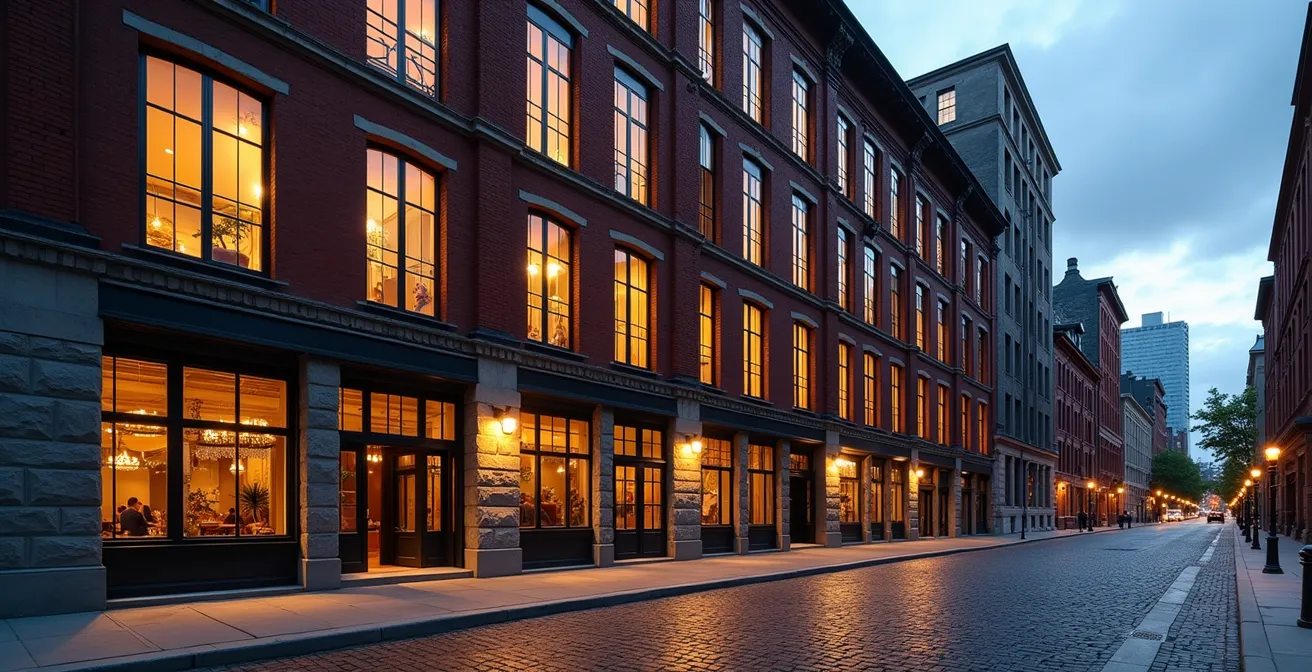
Investing in an Old Montreal loft is less about buying real estate and more about acquiring a high-maintenance historical asset.
- The romantic lifestyle is challenged by significant logistical friction, including chronic parking shortages and the realities of living in mixed-use buildings.
- Heritage buildings are subject to Quebec’s Bill 122, leading to frequent and costly special assessments for mandatory façade and structural repairs.
- Short-term rental (Airbnb) profitability is precarious, as condo syndicates hold the power to ban the practice at any time, overriding municipal permits.
Recommendation: Proceed only after a rigorous due diligence process that goes far beyond a standard inspection, focusing on the syndicate’s financial health, meeting minutes, and the building’s maintenance logbook.
The allure is undeniable. A sprawling loft in Old Montreal, with its 19th-century stone walls, soaring ceilings, and views over cobblestone streets. It’s a piece of European history nestled in the heart of Canada’s most vibrant city. For a high-net-worth individual, it’s more than a home; it’s a statement, a tangible piece of a prestigious lifestyle. The dream involves morning croissants from the local patisserie, evenings spent exploring world-class restaurants at your doorstep, and the cultural cachet that comes with an address in the city’s historic core.
But as a broker who has navigated this exclusive market for years, I must be frank. The sellers of this dream rarely discuss the fine print. While everyone talks about the historic charm, few will give you the unvarnished truth about the logistical and financial realities that come with it. The common advice is to embrace the vibrant atmosphere and the walking lifestyle, but this glosses over the fundamental challenges. Is the prestige of owning a piece of Montreal’s crown jewel worth the potential for a logistical and financial nightmare?
The answer isn’t a simple yes or no. It lies in understanding the specific, often hidden, costs associated with these unique properties. This isn’t about minor inconveniences; it’s about potentially massive special assessments, insurance complexities, and regulatory risks that can turn a dream investment into a source of constant stress. Forget the tourist brochure. This is the insider’s guide to what it truly means to own in Old Montreal.
This article will dissect the primary challenges you’ll face as an owner. We will explore the unromantic side of living above commercial spaces, quantify the infamous parking puzzle, demystify the enormous financial risks tied to heritage buildings, and clarify the precarious legality of short-term rentals. By understanding these hurdles, you can make an informed decision, armed with the knowledge to protect your investment.
Summary: A Buyer’s Guide to the Realities of Old Montreal Lofts
- Why Living Above a Restaurant in Old Montreal Is Not Always Romantic?
- How to Solve the Parking Puzzle When Living on Saint-Paul Street?
- Why Converting 19th-Century Warehouses Leads to Massive Special Assessments?
- Can You Still Legally AirBnb Your Loft in the Old Port?
- Old Montreal Lofts: How Have Prices Evolved Over the Last Decade?
- Buying a Condo for Airbnb: The Risk of sudden Syndicate Bans
- The Bilbao Effect: How New Museums Transform Run-Down Neighborhoods?
- Short-Term Rentals in Quebec: How to Legally Profit from the Tourism Boom?
Why Living Above a Restaurant in Old Montreal Is Not Always Romantic?
The fantasy is compelling: your own apartment perched above a charming European-style bistro, the delightful scent of fresh bread and coffee wafting up to your window. This is a core part of the Old Montreal sales pitch. However, the reality of living in a mixed-use heritage building brings a set of challenges that are far from romantic. The most immediate are the sensory ones: persistent cooking odours that seep into your home, the low hum of commercial ventilation systems at all hours, and the inevitable increase in pests that a food-service business attracts.
Beyond the daily annoyances lie significant financial and safety considerations. Your insurance premiums will likely be higher. Insurers view units above restaurants as higher risk due to the increased potential for fire from commercial kitchens. This isn’t a minor detail; it’s a material fact that must be disclosed and can impact your eligibility for standard coverage. You may need a specialized policy to cover risks like damage from grease trap failures or ventilation system malfunctions.
Furthermore, the high turnover of staff and delivery trucks creates constant traffic and noise, eroding the sense of private, residential tranquility. Late-night garbage disposal, early-morning deliveries, and the chatter of patrons on a summer terrace all become part of your domestic soundscape. The romantic image quickly fades when faced with the operational realities of a commercial enterprise operating directly below your living space. It’s a classic case of the lifestyle you buy not always matching the lifestyle you actually live.
How to Solve the Parking Puzzle When Living on Saint-Paul Street?
If there is one universal truth about living in Old Montreal, it’s the perpetual challenge of parking. For residents of iconic streets like Rue Saint-Paul, this isn’t a minor inconvenience; it’s a significant source of logistical friction that impacts daily life and carries a hefty price tag. The narrow, historic streets were not designed for the automobile, and the supply of on-street parking is minuscule compared to the demand from residents, tourists, and workers.
Relying on a resident permit (SRRR) is a gamble. Zones are limited, and even with a permit, you are not guaranteed a spot. The real test comes in winter. Montreal’s intensive snow-clearing operations mean you must constantly move your vehicle to comply with temporary no-parking signs, often with little notice. Failure to do so results in expensive tickets and towing fees, turning a simple snowfall into a stressful and costly event.

The most common “solutions” involve either a significant financial outlay or a complete lifestyle change. As the data shows, securing a guaranteed spot means committing to a substantial ongoing expense. The alternative is to forgo car ownership entirely, embracing the area’s walkability and relying on public transit and ride-sharing services. This is a viable option, but it requires a conscious trade-off of convenience and freedom, especially for travel outside the city center.
This table, based on recent data, breaks down the true annual cost of solving the Old Montreal parking puzzle. As shown in a comparative analysis of Montreal housing data, the convenience of a dedicated spot comes at a premium that can rival a small mortgage payment itself.
| Parking Option | Annual Cost | Availability | Winter Challenges |
|---|---|---|---|
| SRRR Resident Permit | $140-$280 | Limited zones | Must move for snow removal |
| Indoor Garage (monthly) | $2,400-$4,200 | Guaranteed spot | No weather issues |
| No Car + REM/Uber | $1,800-$3,600 | Always available | N/A |
Why Converting 19th-Century Warehouses Leads to Massive Special Assessments?
The exposed brick walls and original wood beams of a converted 19th-century warehouse are the aesthetic heart of an Old Montreal loft. What buyers often fail to appreciate is that this heritage comes with a specific and legally mandated financial burden. The single greatest financial risk of owning in this area is the special assessment (cotisation spéciale), a large, one-time fee levied by the condo syndicate to cover major, unbudgeted repairs.
The primary driver of these assessments is Quebec’s Bill 122. This legislation is designed to ensure the safety and longevity of older buildings, but it places a heavy onus on owners. As building inspection experts Genispec explain, the law mandates that buildings of five or more storeys undergo a thorough façade inspection by a certified engineer every five years. According to their analysis of the law, building owners must obtain an in-depth verification report and maintain a logbook of all repairs. This isn’t a suggestion; it’s a legal requirement with significant financial consequences.
When an engineer’s report identifies necessary work—re-pointing masonry, repairing stone cornices, or fixing structural issues—the syndicate must act. If the building’s contingency fund (fonds de prévoyance) is insufficient to cover the multi-million-dollar cost, a special assessment is the only option. In a building with 50 units, a $2 million façade repair translates to a sudden, mandatory bill of $40,000 per owner. This is the “logistics nightmare” in its purest financial form, and it has blindsided many unprepared investors.
Checklist for Due Diligence on Heritage Building Syndicates
- Request the last 5 years of Bill 122 facade inspection reports from the syndicate to identify recurring issues.
- Review the contingency fund study (étude du fonds de prévoyance) to see if it adequately plans for upcoming major repairs.
- Analyze at least 3 years of syndicate meeting minutes, looking for any discussion of structural problems, water infiltration, or potential special assessments.
- Verify the building’s maintenance logbook for a history of proactive compliance with heritage standards.
- Calculate your potential special assessment exposure by dividing the estimated cost of future repairs by the number of units.
Can You Still Legally AirBnb Your Loft in the Old Port?
For many investors, the high purchase price of an Old Montreal loft is justified by the prospect of lucrative short-term rental (STR) income from the constant flow of tourists. The logic seems sound: buy in a tourism hotspot and let Airbnb cover the mortgage. However, this strategy is built on increasingly shaky ground. The legal landscape for STRs in Quebec is a minefield, and the most significant power does not lie with the city, but with your future neighbours.
While the City of Montreal and the Government of Quebec have specific zones and permit requirements (like the CITQ registration) for STRs, these are only the first hurdle. The ultimate authority rests with the condo syndicate, governed by the building’s Declaration of Co-ownership. This legal document is the constitution of the building, and under Quebec’s Civil Code, it can be amended by a “super-majority” vote of the co-owners (typically 75% or 90% of the owners, depending on the clause).
This means that even if you buy a condo where Airbnb is currently permitted by both the city and the syndicate, that can change overnight. A single syndicate meeting can result in a vote to ban all rentals under 31 days. These bans are legally binding and supersede any municipal permission you may hold. There is very limited legal ground for “grandfathering” existing STR operations, meaning your business model can be eliminated with almost no notice, forcing you into the less profitable long-term rental market.

This regulatory risk is the silent killer of many Old Montreal investment strategies. It highlights the absolute necessity of not just reading the current Declaration of Co-ownership, but also understanding the culture of the building and the sentiment of the other owners *before* you buy.
Old Montreal Lofts: How Have Prices Evolved Over the Last Decade?
After outlining the significant risks, we arrive at the central question for any investor: what about the reward? Despite the logistical hurdles and financial landmines, the market performance of Old Montreal real estate remains a powerful draw. The district’s unique character, protected status, and global appeal create a strong foundation for long-term value appreciation. The very things that make it challenging to own—the heritage status and limited supply—are also what make it so valuable.
The Montreal real estate market, as a whole, has shown robust growth. For instance, recent market analysis indicates a 5.8% year-over-year increase in median home prices across the city, demonstrating a healthy and resilient market. While this figure represents the entire metropolitan area, the “blue chip” nature of Old Montreal often allows it to outperform general market trends. Properties here are seen as a store of value, much like a piece of art, attracting both domestic and international buyers seeking stability and prestige.
The demand side of the equation is further bolstered by a broader shift in housing preferences. Condominiums have become an increasingly dominant dwelling type in Canada. Data from Statistics Canada shows that condominium apartments accounted for 45.1% of completed homes in 2024, a significant rise from 38.6% a decade prior. This structural shift towards higher-density living, combined with Old Montreal’s irreplaceable location and architectural character, creates a powerful tailwind for property values.
The investment thesis for Old Montreal is therefore a classic high-risk, high-reward scenario. The potential for substantial capital gains is real, but it is intrinsically linked to the buyer’s ability to navigate the complexities we’ve discussed. The price evolution reflects a market that values scarcity and prestige, but it doesn’t automatically negate the carrying costs and risks associated with ownership.
Buying a Condo for Airbnb: The Risk of sudden Syndicate Bans
Let’s dive deeper into the single most potent threat to an Airbnb-focused investment strategy: the sudden syndicate ban. As we’ve established, a co-ownership syndicate holds the power to prohibit short-term rentals, effectively pulling the rug out from under your business model. This isn’t a hypothetical risk; it’s a frequent occurrence in Montreal buildings as residents grow tired of the security issues, noise, and wear-and-tear associated with a constant flow of tourists.
The financial impact of such a ban is immediate and severe. An investor who purchased a property based on projections of high nightly rates from tourism is suddenly forced to compete in the long-term rental market. The revenue difference is stark. According to data from the Canada Mortgage and Housing Corporation (CMHC), there is a significant gap between rents for purpose-built rental apartments and those for privately-owned condos. A report highlights that the average two-bedroom rent differential can be several hundred dollars per month, with condos fetching a premium. However, this premium rarely closes the massive gap between long-term rental income and the potential revenue from a successful Airbnb.
A typical scenario sees monthly cash flow decrease by 40-60% when switching from a well-managed STR to a long-term lease. For a highly leveraged investor, this can instantly create a negative cash flow situation, where the monthly rent no longer covers the mortgage, condo fees, property taxes, and the looming threat of special assessments. The investment transforms from a cash-generating asset into a monthly liability. This underscores the danger of a business plan with a single point of failure and highlights the importance of having a “Plan B” where the numbers still work as a long-term rental, even if the returns are less spectacular.
Key Takeaways
- The prestige of an Old Montreal address is real, but it comes with significant, often hidden, costs related to logistics, maintenance, and regulation.
- Quebec’s Bill 122 is a major financial risk factor, mandating expensive inspections and repairs that frequently lead to large special assessments for co-owners.
- Relying on Airbnb income is a high-risk strategy, as condo syndicates have the legal power to ban short-term rentals at any time, drastically impacting your revenue.
The Bilbao Effect: How New Museums Transform Run-Down Neighborhoods?
While we’ve focused on the risks, it’s important to contextualize them within the broader story of Old Montreal’s enduring and growing appeal. The area’s value isn’t just static; it’s constantly being reinforced by its role as Montreal’s cultural and touristic heart. This phenomenon is a localized version of the “Bilbao Effect,” where investment in high-profile cultural institutions revitalizes an area and drives up real estate values. While Old Montreal is far from “run-down,” the principle of cultural capital driving economic and property value holds true.
The continuous investment in the Old Port, the addition of new attractions, and the global recognition of its unique heritage create a powerful economic moat around the district. This is the “prestige” side of the equation, and it’s a tangible force. As a major Canadian brokerage, Royal LePage, notes in a market report, the area’s appeal is multi-faceted. They state:
Old Montreal offers a variety of experiences for those who enjoy a vibrant atmosphere and spending time in green spaces.
– Royal LePage Real Estate Services, Old Montreal Real Estate Market Report
This “vibrant atmosphere” is an economic engine. It draws millions of tourists, fuels the high-end restaurant and retail scene, and creates the very demand that underpins property values. The city’s overall growth trajectory also provides a strong backdrop. CMHC data on housing starts in Montreal shows a recovery from recent lows, indicating renewed momentum in the construction sector. This underlying confidence in the city’s future provides a stable foundation for a prime district like Old Montreal.
Investing here is a bet on the endurance of that cultural capital. It’s an understanding that while you may face high maintenance costs, you are owning a piece of a finite and increasingly desirable asset class. The logistical challenges are the price of admission for owning property in a living museum that is also the city’s main tourist attraction. For the right buyer, this trade-off is the very definition of a prime real estate investment.
Short-Term Rentals in Quebec: How to Legally Profit from the Tourism Boom?
So, you’ve understood the risks, from special assessments to syndicate bans. How does a savvy investor legally and safely profit from Old Montreal’s tourism boom? The key is to move beyond a simplistic, high-risk Airbnb strategy and embrace a more nuanced approach. The smartest investors are now looking at the spectrum of rental strategies available in Quebec, each with different legal requirements, risk profiles, and target markets.
The high-risk, high-reward strategy is the traditional Short-Term Rental (STR) of under 31 days. As we’ve discussed, this requires navigating a trifecta of approvals: municipal zoning, a CITQ permit, and, most importantly, the ongoing blessing of the condo syndicate. It also necessitates commercial insurance, which is more costly than a standard policy.
A much safer and increasingly popular alternative is the Medium-Term Rental, defined as a lease of 31 days or more. This strategy cleverly bypasses the entire regulatory framework of STRs. You do not need a CITQ permit, and it is not subject to the same tax registrations. Crucially, it is much harder for a syndicate to ban, as it falls under the standard rules for residential leasing. The target market shifts from tourists to corporate clients, film crews, or individuals renovating their homes. The income is more stable and the operational intensity is far lower, though the nightly rate is less.
The following table, drawing from expert insurance and rental market knowledge, outlines the strategic differences. Understanding these options is critical for building a resilient investment plan, as highlighted in guides on Quebec condo insurance and rental strategies.
| Rental Strategy | Legal Requirements | Insurance Cost Impact | Target Market |
|---|---|---|---|
| Short-Term (under 31 days) | CITQ permit, GST/QST registration, syndicate approval | Commercial insurance required | Tourists, weekend visitors |
| Medium-Term (31+ days) | Standard lease agreement only | Standard condo insurance | Corporate clients, film crews |
| Long-Term (12 months) | Régie du logement lease | Standard condo insurance | Local residents |
Ultimately, owning in Old Montreal can be a profoundly rewarding investment, both financially and personally. The prestige is real, and the lifestyle can be unparalleled. But that prestige is earned through diligence, not simply purchased. By understanding the logistical realities, quantifying the financial risks, and crafting a resilient strategy, you can navigate the nightmare and secure your piece of the dream. The next logical step is to apply this knowledge to a specific property by conducting a thorough due diligence investigation.
Frequently Asked Questions about Old Montreal Real Estate
Can a syndicate ban Airbnb even if the city allows it?
Yes, absolutely. Under Quebec’s Civil Code, a condo syndicate can amend its Declaration of Co-ownership to ban or restrict short-term rentals, typically with a super-majority vote. This internal building rule overrides any permissions granted by the municipality.
What happens to existing Airbnb operators when a ban is enacted?
In most cases, existing operators must cease their short-term rental activities immediately. Grandfather clauses have very limited legal standing for STR bans in Quebec condo buildings, as the Declaration of Co-ownership is the governing legal document for the property.
What is the financial impact of switching from Airbnb to long-term rental?
The financial impact can be significant. It’s common to see a monthly revenue decrease of 40-60%. This can quickly turn a profitable investment into a negative cash flow situation, especially when factoring in high condo fees, property taxes, and the risk of special assessments.