Stop getting lost in the maze of Quebec’s energy grants; the key isn’t which grant to pick, but the strategic order you use them.
- The Rénoclimat evaluation is the non-negotiable first step that unlocks all major funding.
- Your grant money is directly tied to measured performance improvements, not just the act of upgrading.
- Air sealing and insulation often provide the highest return before tackling big-ticket items like heat pumps or windows.
Recommendation: Schedule your Rénoclimat pre-retrofit evaluation before you buy or install anything to create a personalized, fundable upgrade plan.
If you’ve searched for “MaPrimeRénov” in Quebec, you’re not alone, but you’re looking at a program from France. This common confusion highlights a major challenge for Quebec homeowners: navigating a complex web of local and federal energy grants. You see names like Rénoclimat, the Canada Greener Homes Initiative, and LogisVert, and it feels like a buffet of options. The typical approach is to pick an upgrade, like a heat pump, and then hunt for a grant to cover it. This is the single biggest mistake you can make.
The reality is that these programs aren’t a menu; they are an interconnected system with a specific logic. Chasing individual grants is inefficient and leaves money on the table. The secret to maximizing your funding lies in understanding this system’s logic and following its prescribed order of operations. It’s not about the upgrades themselves, but about proving their impact through a measured process.
The true key to unlocking tens of thousands of dollars in grants and loans isn’t a specific technology, but a mandatory first step: the government-mandated Rénoclimat energy evaluation. This guide, written from the perspective of a Rénoclimat advisor, will not just list grants. It will reveal the system’s strategy, showing you how to turn a bureaucratic process into a game plan for funding your home’s energy transformation, from the foundational blower door test to the final EnerGuide rating that boosts your property value.
In this comprehensive guide, we’ll break down the strategic steps to navigate Quebec’s energy efficiency programs. You will learn not just what upgrades to make, but how to sequence them to ensure every dollar you invest is matched by the maximum available government funding.
Summary: Quebec Energy Grants: A Rénoclimat Advisor’s Guide to Maximizing Your Funding
- The Blower Door Test: Why You Must Do It Before Touching a Single Wall?
- Heat Pump vs. Furnace: Which System is Best for Quebec’s Climate?
- Spray Foam vs. Cellulose: Which Insulation Offers the Best ROI for Attics?
- Draft Proofing: The Cheap DIY Fix That Saves 15% on Heating Bills
- Is Solar Power Worth It in Quebec with Hydro Rates So Low?
- Heating a Victorian Home: How to Stop Burning $500 a Month in Hydro?
- Does a High EnerGuide Rating Really Help You Sell for More?
- Window Replacement: Triple Glaze or Double Glaze for Quebec Winters?
The Blower Door Test: Why You Must Do It Before Touching a Single Wall?
Many homeowners see the mandatory blower door test as a bureaucratic hurdle. As an advisor, I can tell you it’s the most critical part of your entire project. Think of it as the diagnostic scan that creates your treasure map. This test doesn’t just find leaks; it quantifies your home’s starting point, generating your initial EnerGuide rating. Without this baseline, the government has no way to measure your improvement, and without measured improvement, there is no funding. It is the absolute, non-negotiable master key to the system.
The process is simple: a powerful fan is mounted in an exterior doorway, depressurizing your house. This allows your Rénoclimat advisor to measure the total air leakage, expressed in air changes per hour (ACH). A leaky older home might have an ACH of 7.0, while a modern, efficient home aims for 1.5. This single number dictates your entire strategy. It tells you whether to prioritize air sealing over insulation or windows. It is a mandatory requirement for accessing both the provincial Rénoclimat program and the federal Canada Greener Homes Loan.
After your retrofits are complete, a second blower door test is performed. The difference between your “before” and “after” scores is the concrete proof of your home’s improved performance. This improvement is what unlocks the grant money. A significant drop in your ACH score leads to a better EnerGuide rating and, consequently, a larger cheque. By completing this process, homeowners not only gain access to grants but see tangible results; Natural Resources Canada reports that homeowners who completed retrofits saved an average of $386 per year. The test isn’t a hoop to jump through; it’s the mechanism that proves your work is valuable and worthy of public funds.
Heat Pump vs. Furnace: Which System is Best for Quebec’s Climate?
For decades, a furnace was the default for Quebec winters. Today, the conversation is dominated by heat pumps, and for good reason: they don’t create heat, they move it. This makes them incredibly efficient, even in cold weather. Modern cold-climate heat pumps can operate effectively down to -25°C or even -30°C, covering the vast majority of a Quebec winter. The “system logic” of government grants heavily favors this technology because of its massive potential for reducing grid demand.
The primary advantage is efficiency. Hydro-Québec states that a high-efficiency heat pump can be up to three times more efficient than traditional electric baseboard heaters. This translates directly into lower bills, with the LogisVert program from Hydro-Québec reporting savings of up to 40% on heating costs for eligible households. This efficiency is also why they are a cornerstone of provincial and federal grant programs. A furnace, no matter how efficient, still burns fuel or uses resistive heating, whereas a heat pump leverages ambient energy.
The decision is made even easier by a strategy of “grant stacking.” You can combine funding from multiple sources for a single installation. While the federal Greener Homes Grant is closed to new applicants, the interest-free loan remains, and Hydro-Québec’s LogisVert program offers substantial rebates. Understanding how these programs interact is key to maximizing your return on investment.
This table provides a snapshot of the major heat pump grant programs available in Quebec. Note how eligibility is tied to performance standards like ENERGY STAR certification, reinforcing the system’s focus on rewarding quality installations.
| Program | Grant Amount | Eligibility | Status |
|---|---|---|---|
| LogisVert (Hydro-Québec) | Up to $6,700 | ENERGY STAR certified heat pumps | Active |
| Canada Greener Homes Grant | Up to $5,000 | Existing applicants only | Closed to new applicants |
| Canada Greener Homes Loan | $40,000 interest-free | Through Rénoclimat evaluation | Active |
| Oil to Heat Pump Program | Up to $10,000 | Low-median income households | Active |
Spray Foam vs. Cellulose: Which Insulation Offers the Best ROI for Attics?
Once your blower door test reveals significant air leakage from the top of your house, the attic becomes your top priority. The two main choices for insulation are spray foam and blown-in cellulose. Neither is universally “better”; the best choice depends entirely on your specific goals and budget, and how you plan to leverage the grant system. Your Rénoclimat advisor will help you decide, but understanding the core differences is crucial.
Cellulose insulation is made from recycled paper products and treated for fire resistance. It’s an excellent thermal insulator and is typically the more affordable option. It’s blown into the attic to the desired depth, filling gaps between joists effectively. However, it does not create an air barrier. If your attic floor has many penetrations (like pot lights or plumbing stacks), you will still need to perform detailed air sealing separately to stop heat loss.
Closed-cell spray foam, on the other hand, acts as an all-in-one solution. When applied, it expands to fill every crack and crevice, creating a seamless thermal blanket and a powerful air and vapor barrier simultaneously. This is its key advantage. While the material cost is higher, it can drastically reduce your home’s ACH score from the blower door test, leading to a larger jump in your EnerGuide rating and potentially unlocking higher grant amounts. It combines insulation and air sealing in a single step.
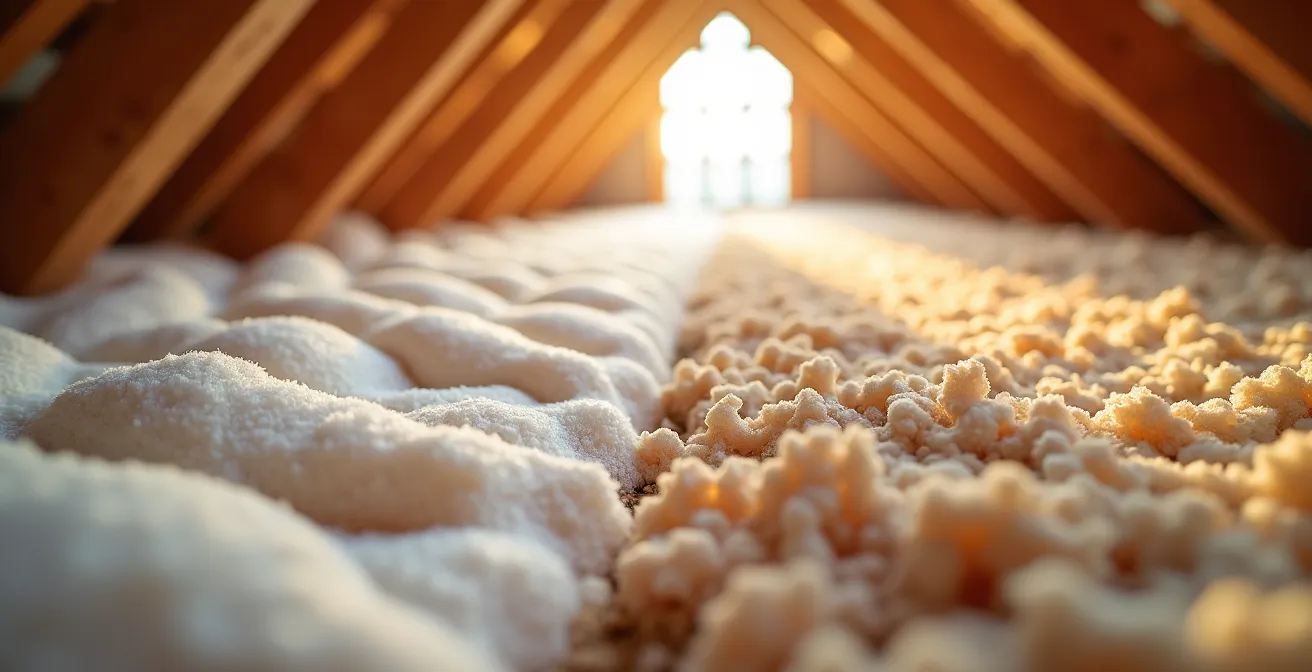
As you can see, the textures are fundamentally different. Cellulose is a fibrous fill, while spray foam creates a rigid, monolithic barrier. For homeowners focused on maximizing their grant by achieving the biggest possible improvement in airtightness, spray foam is often the strategic choice. For those on a tighter budget where the existing air barrier is already decent, cellulose combined with manual air sealing can provide an excellent return on investment.
Your Action Plan: The Rénoclimat Insulation Upgrade Playbook
- Schedule your pre-retrofit energy evaluation with a Rénoclimat advisor to establish a baseline EnerGuide score.
- Target upgrading the insulation over a minimum of 20% of the total surface area of your home to qualify for financial assistance.
- Prioritize attic insulation if your blower door test shows significant air leakage from the upper levels of the house.
- Consider spray foam for its combined insulation and air-sealing benefits to maximize your EnerGuide score improvement and, consequently, your grant amount.
- Complete the post-retrofit evaluation to confirm the energy performance improvement and officially unlock your Rénoclimat funding.
Draft Proofing: The Cheap DIY Fix That Saves 15% on Heating Bills
Before you even think about new windows or a high-tech heat pump, you must address air leakage. As an advisor, this is the first thing I look for. It is, without a doubt, the single most cost-effective retrofit you can make. The government knows this, which is why your Renovation Upgrade Report has a specific target for improving your home’s airtightness. According to Natural Resources Canada, tackling drafts should be considered first in any retrofit strategy.
Why is it so critical? A home with many small, unsealed gaps is like wearing a winter coat full of holes. It doesn’t matter how thick the coat is; the cold air will always get in. Hydro-Québec estimates that air and ventilation leaks can account for up to 25% of a home’s total heat loss. This is wasted money flying out through cracks around windows, doors, electrical outlets, and foundation sills.
The beauty of draft proofing is that much of it can be a DIY project. Simple, inexpensive materials like caulking, weatherstripping, and foam gaskets for outlets can make a huge difference. By doing some of this basic work *before* your initial Rénoclimat evaluation, you establish a better baseline. This allows the professional air sealing work, which is eligible for grants, to focus on more complex areas. This strategy can help you achieve a more dramatic improvement between your pre- and post-retrofit evaluations, potentially pushing you into a higher grant bracket.
Don’t underestimate the power of these small fixes. Sealing your home is the foundation of all other energy efficiency upgrades. Installing a $15,000 heat pump in a drafty house is like trying to fill a leaky bucket; you’ll be paying to heat the outdoors. By focusing on draft proofing first, you make every subsequent investment more effective and ensure you get the most out of both your new equipment and the government grants designed to pay for it.
Is Solar Power Worth It in Quebec with Hydro Rates So Low?
This is a question every Quebec advisor hears constantly. With some of the lowest electricity rates in North America, does it make financial sense to invest in solar panels? The simple answer is: it’s more viable than you think, but not for the reason most people assume. The key isn’t about immediate savings on your Hydro bill; it’s about leveraging long-term, interest-free financing to build a future-proof asset.
While provincial grants for solar have ended, the federal government has stepped in with a powerful financial tool. The Canada Greener Homes Loan is the game-changer for solar in Quebec. This program offers up to $40,000 interest-free over 10 years for eligible retrofits, including solar panel installations. This zero-interest financing completely changes the return on investment calculation. You are essentially using the government’s money, for free, to install an asset that will generate power for 25+ years.
Furthermore, Hydro-Québec’s net metering program is another crucial piece of the puzzle. This program allows you to “bank” the surplus energy your panels produce during long, sunny summer days. You send that excess power to the grid and receive credits. In the winter, when solar production is lower and your consumption is higher, you draw power from the grid and use those credits to offset your bill. It effectively turns the Hydro-Québec grid into a giant, free battery for your home.
Concerns about Quebec’s climate are also often misplaced. Regions like the Eastern Townships and the Montérégie receive plenty of solar irradiation, comparable to Germany, a global leader in solar energy. While production dips in winter, it’s far from zero, and the high output from April to October more than compensates. The investment isn’t about zeroing out your bill tomorrow; it’s a long-term play on energy independence and property value, made possible by strategic use of federal financing.
Heating a Victorian Home: How to Stop Burning $500 a Month in Hydro?
Owners of beautiful century homes in Montreal or the Eastern Townships know the pain: stunning architectural details paired with astronomical heating bills. These homes were built in an era of cheap energy and often feature “balloon framing,” where wall cavities run uninterrupted from the foundation to the attic, creating superhighways for heat to escape. Tackling this challenge requires a surgical approach, not a sledgehammer.
The first step is to resist the urge to immediately gut the walls. The “system logic” of Rénoclimat is your best friend here. A blower door test is even more critical in a Victorian home because it will precisely identify where your biggest air leaks are. Often, the worst offenders are not the walls themselves, but the unsealed foundation sill, the original sash windows, and the cavernous, uninsulated attic. Attacking these areas first provides the highest return on investment.
When it comes to insulating walls, dense-pack cellulose is often the best choice for preserving heritage. It can be blown into wall cavities through small, easily patched holes, avoiding the need to tear down original plaster and lath. For the foundation, closed-cell spray foam is ideal for creating a robust air and moisture barrier in the rim joist area—a notorious source of drafts. This targeted approach respects the home’s character while making it dramatically more comfortable and efficient.
Combining these insulation and air sealing strategies with a modern cold-climate heat pump can transform a “hydro-guzzler” into a comfortable, efficient home. The grant and loan programs are designed to support exactly this kind of deep retrofit. As an advisor, I’ve seen homeowners cut their winter bills by more than half. It’s a significant investment, but the financial assistance makes it achievable, and the results are profound. As confirmed in an analysis by the National Bank of Canada, the savings are real.
Households that have renovated their homes using the Canada Greener Homes Loan save an average of $386 per year on energy.
– National Bank of Canada, Home renovation grants in Canada: Aid and eligibility requirements
Does a High EnerGuide Rating Really Help You Sell for More?
After all the work is done—the insulation, the new heat pump, the sealed drafts—you’re left with one final, crucial document: your post-retrofit EnerGuide report. Many homeowners see this as the final piece of paperwork to get their grant money. This is a mistake. Your new, high EnerGuide rating is not an endpoint; it’s a powerful marketing asset that can directly increase your home’s resale value.
Think of it as an official “efficiency score” for your house. In a competitive real estate market, buyers are increasingly savvy about long-term ownership costs. A home with a documented low heating bill and a high EnerGuide rating is more attractive than an equivalent home without one. It provides proof of quality construction and promises lower monthly expenses. Real estate experts confirm that homes with documented energy upgrades often sell faster and closer to the asking price.
To leverage this effectively, you need to create what I call an “Energy Passport” for your home. This is not just a single report but a curated binder that documents the entire journey. It serves as tangible proof to potential buyers that your home is a superior product. This passport turns abstract claims of “recent renovations” into a verifiable, data-backed investment.
Here’s how to build your home’s Energy Passport to maximize its impact when you sell:
- Compile the official pre- and post-retrofit EnerGuide evaluation reports from your certified advisor.
- Organize all grant approval letters and documentation from Rénoclimat and the Canada Greener Homes programs.
- Keep copies of all contractor invoices, especially those showing licensed professional installation of key systems like heat pumps or spray foam.
- Include a portfolio of before-and-after photos of major upgrades (e.g., old vs. new insulation depth, new windows).
- Create a simple summary sheet showing the reduction in your monthly Hydro-Québec bills post-retrofit.
- When listing your property, ensure your real estate agent uses specific French and English keywords on Centris.ca, such as “Cote ÉnerGuide exceptionnelle,” “Rénové selon Rénoclimat,” and “High EnerGuide Rating.”
Key Takeaways
- The Rénoclimat evaluation is the non-negotiable “master key” that must be completed before any work begins to qualify for major grants.
- Air sealing is the highest return-on-investment retrofit and should be prioritized to make all other upgrades more effective.
- Grant funding is performance-based; the amount you receive is directly tied to the measured improvement in your home’s EnerGuide score.
Window Replacement: Triple Glaze or Double Glaze for Quebec Winters?
Windows are often one of the most expensive upgrades, so making the right choice is critical. In Quebec, the debate between double- and triple-glazed windows comes down to a balance of budget, performance, and grant maximization. The government’s “performance-based funding” model is on full display here: the better the window you choose, the more grant money you receive per opening.
The performance of a window in winter is measured by its U-factor. The lower the U-factor, the better it insulates. Standard double-glazed windows might have a U-factor of around 1.6 W/m²K, while high-performance triple-glazed units can go below 1.05 W/m²K. This difference is significant. According to ENERGY STAR, upgrading from single-pane windows can save up to $583 per year on energy bills, and much of that saving is amplified by choosing a higher-performance window.
For most of southern Quebec, a high-quality, double-glazed, low-E, argon-filled window that is ENERGY STAR certified is a very good choice. It offers a substantial upgrade over old windows and qualifies for a solid base grant. However, if you live in a colder region like Abitibi or the Gaspé Peninsula, or if your goal is to maximize both comfort and grant money, triple-glazed windows are the strategic move. They provide superior comfort by eliminating cold drafts near the window and significantly reduce outdoor noise.
The grant structure is designed to incentivize this better performance. As you move up from a basic ENERGY STAR certified window to an “ENERGY STAR Most Efficient” model, the grant amount per window increases. This helps offset the higher upfront cost of triple-glazing. Your advisor will help you run the numbers, but often the increased grant amount makes the incremental cost for triple-glazing much smaller than you’d think.
The following table, based on the Canada Greener Homes Initiative guidelines, shows how grant eligibility is directly tied to the window’s U-factor. This demonstrates the core principle: the system rewards you for choosing higher performance.
| Window Type | U-Factor Requirement | Grant Amount | Best For |
|---|---|---|---|
| ENERGY STAR Certified | ≤1.22 W/m²K | Up to $125/opening | Mild Quebec regions |
| ENERGY STAR Most Efficient | ≤1.05 W/m²K | Up to $250/opening | Most Quebec locations |
Now that you understand the strategy behind Quebec’s energy efficiency programs, from diagnostics to specific upgrades, the path to a more comfortable and affordable home is clear. The key is to follow the system’s logic. Your next and most important step is to move from planning to action. To get a personalized roadmap and unlock access to these programs, you must begin the official process by scheduling your pre-retrofit evaluation with a certified Rénoclimat advisor.
Frequently Asked Questions on Energy Efficiency in Quebec
Can solar panels work effectively in Quebec’s climate?
Yes, Quebec receives sufficient solar irradiation hours comparable to Germany, a global solar leader. Regions like the Eastern Townships have more than enough sun for viable solar investments.
How does net metering work with Hydro-Québec?
Hydro-Québec’s net metering program allows you to send surplus energy to the grid in summer and receive credits to reduce winter bills when solar production is lower.
Is federal funding still available for solar installations?
While provincial solar grants have ended, the Canada Greener Homes Loan remains available, offering interest-free financing up to $40,000 for solar panel installations.