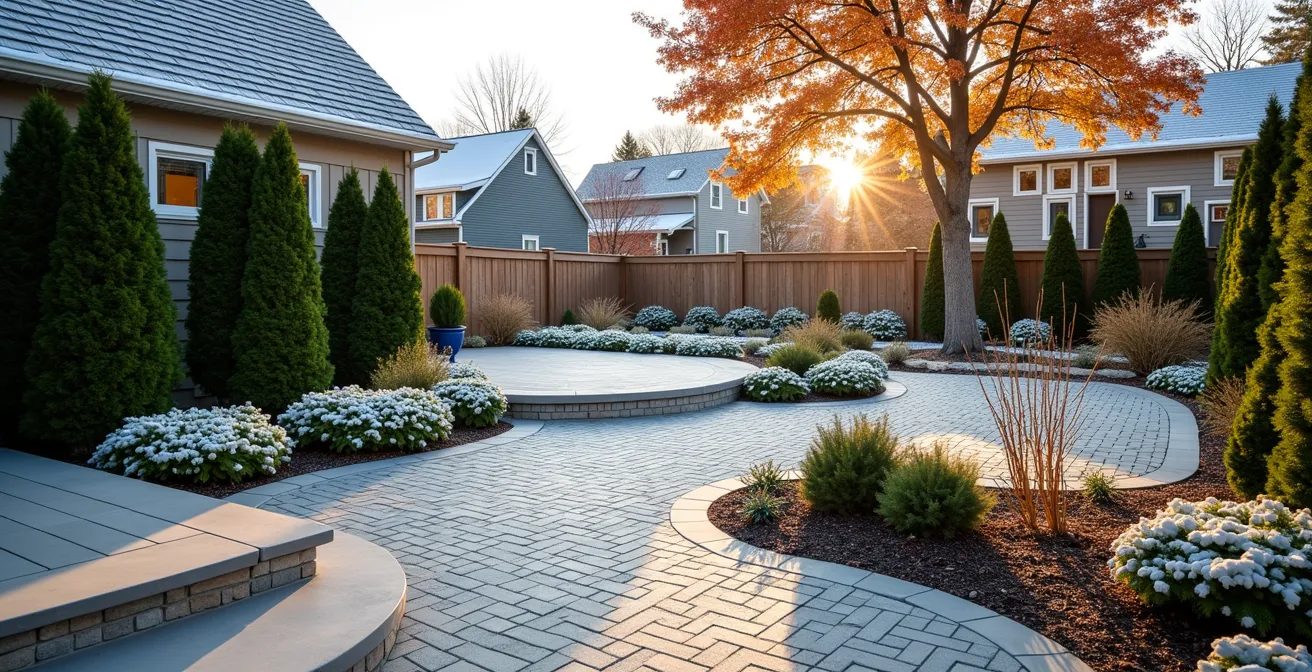
The key to a beautiful Quebec backyard isn’t choosing ‘hardy’ plants; it’s engineering a resilient four-season system where every element—from the ground up—is selected to master our extreme freeze-thaw cycles.
- Flexible interlock pavers prevent heaving and cracking where rigid concrete fails.
- Composite decking’s higher upfront cost is offset by eliminating the costly, recurring maintenance demanded by pressure-treated wood in our climate.
- Proper yard grading isn’t just a detail; it’s the single most important step to protecting your home’s foundation from water damage caused by snowmelt.
Recommendation: Before buying a single plant, assess your property’s grading. A 2% slope away from your foundation is the mandatory first investment for any successful and lasting landscape design in Quebec.
Every Quebec homeowner knows the cycle of hope and frustration. You spend the short, beautiful summer creating a perfect backyard oasis, only to see patios heave, plants wither, and wood warp after another unforgiving winter. The common advice is to simply “choose hardy plants” or “build a strong deck,” but this advice often leads to the same disappointing results year after year. Homeowners are left wondering why their investment seems to melt away with the spring thaw, turning a source of pride into a recurring chore.
The issue isn’t a lack of effort; it’s a flawed strategy. A successful Quebec landscape isn’t just a collection of tough-looking elements. It must be approached as an integrated, engineered system designed specifically for four-season resilience. The secret lies not in fighting the climate, but in making strategic choices that work with its most powerful force: the freeze-thaw dynamic. This means understanding the material science behind your patio, the root systems of your privacy hedges, and the critical importance of water management.
But what if the solution was to shift your perspective from passive survival to active design? Instead of asking “What will survive the winter?”, we should be asking “What materials and designs will perform best through all four seasons?”. This is the approach of a landscape architect. It’s about creating beauty that is also a marvel of engineering, ensuring your outdoor living space is as functional and stunning in January as it is in July.
This guide will walk you through that professional process. We will deconstruct the key decisions every Quebec homeowner faces, moving from the foundational elements below the ground to the plants that bring it to life and the features that add tangible value to your property. By the end, you will have a new framework for creating a backyard that not only survives but truly thrives in our unique climate.
Summary: A Landscape Architect’s Guide to a Resilient Quebec Yard
- Hardiness Zone 5b: Which Plants Actually Survive a Montreal Winter?
- Interlock vs. Stamped Concrete: Which Paving Resists Freeze-Thaw Heaving?
- Fast-Growing Hedges: Cedar vs. Willow for Instant Privacy from Neighbors?
- Composite vs. Pressure Treated Wood: Is the Maintenance Savings Worth the Cost?
- Grading the Yard: How to Slope Land Away from Your Foundation?
- Pool or No Pool: Which Feature Actually Adds Value to a Family Home?
- First Impressions: How $1,000 in Landscaping Can Sell Your House Faster?
- The Terroir Value: Why Vineyards and Orchards Boost Nearby Property Values?
Hardiness Zone 5b: Which Plants Actually Survive a Montreal Winter?
The first rule of Quebec gardening is understanding your true climate, and that reality is changing. While many gardeners still think of Montreal as a solid Zone 5b, climate warming has shifted the goalposts. In fact, a recent update confirmed that Montreal has been reclassified to Zone 6a, reflecting warmer minimum temperatures. This opens up some new possibilities, but the core principle remains: success lies in choosing plants evolved for our region, not just those rated for a specific zone. A plant’s ability to handle heavy snow load, ice, and fluctuating spring temperatures is just as important as its cold tolerance.
Instead of gambling on exotic species, a resilient four-season landscape is built on a foundation of native plants. These are the champions of survival, offering beauty and function throughout the year. For example, Serviceberry (Amelanchier) provides beautiful spring blossoms, edible summer fruit, and strong structure in winter. Native grasses are another unsung hero, providing texture that persists above the snow and crucial habitat for overwintering insects. This creates a yard that is alive and interesting even in the depths of winter.
The true art of four-season design is creating “winter interest.” This means selecting plants that offer color and texture when everything else is dormant. Nothing achieves this better than the vibrant stems of Red Osier Dogwood against a backdrop of fresh snow. By focusing on these native survivors, you create a garden that is not only tougher and lower-maintenance but also ecologically connected and visually appealing year-round.
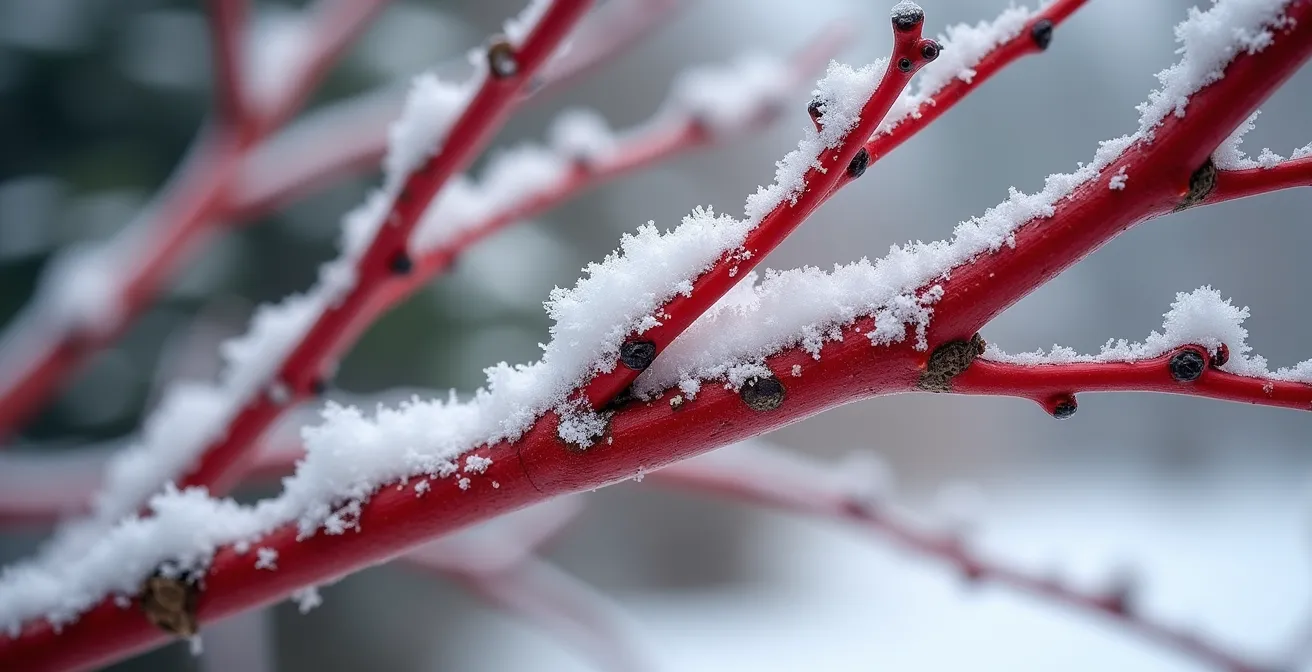
As you can see, the intense color of the dogwood provides a stunning visual focal point in an otherwise monochrome landscape. This is a key strategy for a garden that feels designed, not abandoned, during the winter months. To maximize plant survival, consider creating warmer microclimates by installing evergreen windbreaks (like cedar hedges) on the north and west sides of your property, shielding more delicate plants from the harshest winds.
Interlock vs. Stamped Concrete: Which Paving Resists Freeze-Thaw Heaving?
Your patio or walkway is the foundation of your outdoor living space, and in Quebec, its biggest enemy is the freeze-thaw dynamic. Water seeps into the ground, freezes, expands, and then thaws, causing the ground to shift. This relentless cycle puts immense stress on hardscaping. While stamped concrete offers a lower initial installation cost, its rigid, continuous slab structure makes it extremely vulnerable. A single crack, which is almost inevitable, compromises the entire surface and leads to costly, difficult repairs.
Interlocking pavers, by design, are the superior engineering solution for our climate. They form a flexible system where each paver can move independently with the ground, preventing the stress that causes cracking. The sand-filled joints allow for this minute movement without compromising the integrity of the surface. While the upfront cost is higher, the long-term value is undeniable. An Ottawa-based analysis revealed that interlock pavers can last for decades, while stamped concrete often shows significant cracking after just 10-15 Quebec winters. The modular design not only ensures longevity but also makes repairs simple and inexpensive—you just replace the one or two affected pavers, not the entire patio.
The following table, based on a recent cost comparison for landscaping in Canada, breaks down the key differences in performance and lifecycle cost.
| Factor | Interlocking Pavers | Stamped Concrete |
|---|---|---|
| Installation Cost (per sq ft) | $15-$30 CAD | $8-$15 CAD |
| Freeze-Thaw Resistance | Excellent – flexible joints | Poor – prone to cracking |
| Repair Difficulty | Easy – replace individual pavers | Complex – resurface entire slab |
| Maintenance Cost (annual) | $1-$3 CAD per sq ft | Minimal until cracks appear |
| Lifespan in Quebec Climate | 30+ years | 15-20 years |
Ultimately, choosing interlock over concrete is an investment in peace of mind. It’s a decision to build a resilient system that works with our climate, not against it, saving you money and headaches over the 30+ year lifespan of the product.
Fast-Growing Hedges: Cedar vs. Willow for Instant Privacy from Neighbors?
In the quest for instant privacy, homeowners often gravitate towards the fastest-growing plants available. While willows can shoot up quickly, they are a classic example of a short-term solution creating a long-term problem in an urban or suburban setting. Willow trees have notoriously aggressive and water-seeking root systems that can invade and damage foundations, septic systems, and especially weeping tiles within a 15-foot radius. This makes them a high-risk choice for most residential lots.
The smarter, safer choice for reliable year-round privacy is the Eastern White Cedar (Thuja occidentalis). As a native species, it is perfectly adapted to our climate, is salt-tolerant (a huge benefit near roads and walkways), and maintains its dense foliage through the winter, providing a true four-season screen. While its growth is more measured than a willow’s, a well-planted cedar hedge establishes itself robustly and has the added benefit of being able to bend under heavy snow loads without breaking, a critical trait for surviving Quebec winters.
Before planting any hedge, however, it’s imperative to consult your local regulations. For instance, specific landscaping bylaws in Montreal dictate rules around hedge height, especially concerning pool enclosures and property setbacks in designated heritage areas. A common requirement for pool safety, for example, is a maximum height of 1.2 meters for certain enclosure elements to ensure visibility. A smart strategy for creating a dense and visually interesting privacy screen is to layer your plantings: use cedars as the structural backbone, add faster-growing but less-invasive deciduous options like Swedish Aspen for quick height, and fill in with mid-level native shrubs for density and texture.
Composite vs. Pressure Treated Wood: Is the Maintenance Savings Worth the Cost?
A deck is the centrepiece of summer living, but in Quebec, it’s a structure that endures extreme abuse, from -30°C winter lows to +35°C summer highs. The choice between traditional pressure-treated (PT) wood and modern composite decking comes down to a simple question: do you want to invest your money upfront or your time and money continuously? While the average landscaping project in Montreal costs around $5,500, the materials you choose for a feature like a deck will dramatically influence the long-term cost of ownership.
Pressure-treated wood has a lower initial cost, but this saving is quickly eroded by a demanding maintenance schedule. In our climate, a PT wood deck requires staining or sealing every two years to prevent splitting, warping, and rot. This recurring project costs $500-$800 in materials and consumes a full weekend of labor. Composite decking, which costs 2-3 times more to install, virtually eliminates this. Its maintenance is limited to an annual cleaning with soap and water. A 5-year cost analysis for Montreal decks shows that when you factor in the biennial staining costs and labor for PT wood, the total ownership cost of composite decking often breaks even and becomes cheaper over the life of the deck.
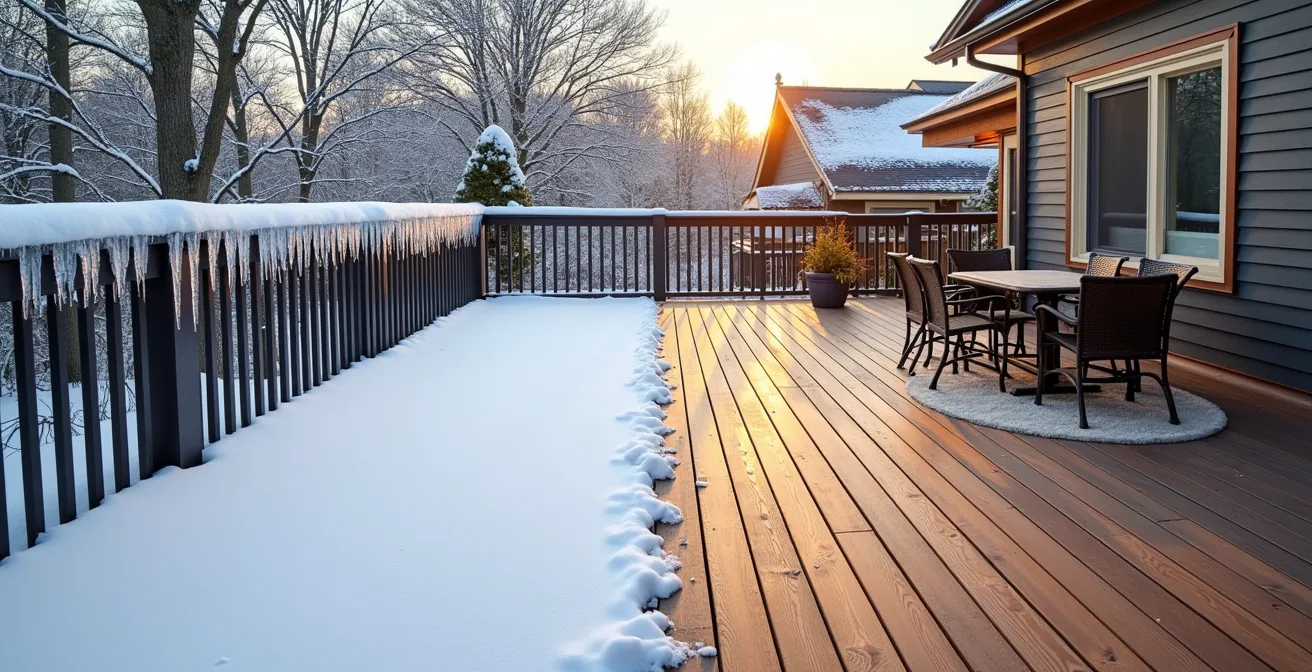
Performance in our four-season climate is another critical factor where composites excel, as illustrated by the winter/summer split view. Modern PVC-capped composites are stable in our wide temperature range and offer good slip resistance when icy. A key consideration for summer, however, is that darker composite colors can get very hot under direct sun, making them uncomfortable for bare feet. Lighter colors or pressure-treated wood, which stays cooler, may be a better choice for sun-drenched, south-facing decks. Before building any deck, always check with your municipality about permit requirements.
Grading the Yard: How to Slope Land Away from Your Foundation?
Of all the elements in a landscape design, proper grading is the least glamorous but most important. It is the single most critical factor in protecting your home’s biggest investment: its foundation. In Quebec, the immense volume of water from spring snowmelt creates tremendous hydrostatic pressure against foundation walls. If the land around your house is flat or slopes inward, that water has nowhere to go but down, leading to leaks, cracks, and a damp basement. This is not an aesthetic issue; it’s a structural one.
The solution is to create “positive drainage,” and the rule is simple and non-negotiable. Quebec’s building code effectively requires a 2% minimum slope away from the foundation for at least the first 10 feet. This equates to a drop of about one-quarter inch for every foot of distance (or roughly 6 inches of drop over that 10-foot span). This gentle, often unnoticeable slope is enough to direct thousands of litres of water safely away from your home and into the yard or municipal drainage systems.
While some minor grading tasks can be a DIY affair, anything involving the critical area near your foundation is best left to experts. Here’s a quick guide to help you decide:
- DIY Task: Adding a few bags of topsoil to fill a minor low spot in the middle of the yard.
- DIY Task: Creating a small swale or decorative dry creek bed to direct water in a garden bed.
- Call an Expert if: The work involves more than a few inches of soil or requires heavy machinery.
- Call an Expert if: You are regrading any land within three feet of your foundation walls.
- Call an Expert if: Your property has complex systems like a septic field or existing french drains.
Fixing your yard’s grade isn’t just a recommendation; it’s the foundation of a dry, healthy home and a resilient landscape. It is the first dollar you should spend on any backyard renovation.
Pool or No Pool: Which Feature Actually Adds Value to a Family Home?
The debate over whether a swimming pool adds or subtracts value from a home is a common one in real estate. In many colder climates, a pool is seen as a liability—a short season of enjoyment followed by a long season of costly maintenance. However, Quebec is a significant outlier. With short but hot and humid summers, Quebecers have embraced pool culture more than anyone else in North America. The province boasts over 300,000 in-ground and above-ground pools, which translates to roughly one pool for every 29 people, the highest per-capita rate on the continent.
This widespread adoption has turned pools from a niche luxury into a desirable family feature. While you’ll rarely recoup the full installation cost (which can range from $40,000 to $100,000+), the market’s acceptance means a pool is no longer the value-killer it might be elsewhere. Recent Canadian real estate analysis suggests that a well-maintained, modern in-ground pool can add an average of 7% to a home’s resale value in markets like Quebec. The key is “well-maintained” and “modern.” An old pool with a torn liner and outdated equipment can quickly become a detraction, signalling a major expense to potential buyers.
For a family-oriented buyer, a pool can be the deciding factor that makes your home stand out. It represents a built-in “staycation” and a hub for summer activity. However, the value added is entirely dependent on the target buyer. For couples, empty-nesters, or those seeking a low-maintenance lifestyle, a pool can still be a negative. The decision to install one should therefore be driven primarily by your family’s desired lifestyle, with the potential ROI considered a secondary, but tangible, benefit in Quebec’s unique market.
First Impressions: How $1,000 in Landscaping Can Sell Your House Faster?
When selling your home, curb appeal isn’t just about making things look nice; it’s about signaling to potential buyers that the property has been well-maintained. A neglected exterior can make a buyer wonder what other, more serious issues might be hiding inside. You don’t need a complete overhaul to make a powerful first impression. A strategic investment of just $1,000, focused on high-impact tasks, can generate a significant return and help your house sell faster.
The goal is to create a clean, fresh, and cared-for look. This means focusing on fixing flaws and adding vibrant, welcoming touches. Start by pressure washing walkways, siding, and any hardscaping to instantly remove a layer of grime. Fresh, dark mulch in all garden beds is one of the highest-ROI actions you can take; it makes plant beds look crisp and colours pop. Finally, address the most common eyesores: patchy lawns and a drab entrance. A few rolls of new sod can fix a worn-out front lawn, and large, beautiful planters at the front door provide a burst of life and color that draws the eye.
Even in winter, the principles of curb appeal apply, though the tactics change. A winter showing strategy focuses on demonstrating that the home is safe and welcoming despite the weather. This means impeccably cleared walkways and stairs, effective de-icing, high-quality doormats to handle slush, and ensuring all exterior lighting is functional to create a warm glow during early evening showings. Instead of dormant flower beds, use hardy evergreen arrangements in planters to provide year-round color and life.
Your $1,000 High-ROI Landscaping Plan
- Power Wash Surfaces: Rent a pressure washer to clean walkways, the driveway, and siding. Estimated Cost: $150.
- Apply Fresh Mulch: Cover all visible soil in garden beds with a thick layer of fresh black or dark brown mulch for a crisp, uniform look. Estimated Cost: $300.
- Install Entry Planters: Purchase two large, high-quality planters and fill them with lush, seasonal arrangements to frame the front door. Estimated Cost: $250.
- Patch the Lawn: Replace any dead or patchy sections of your front lawn with fresh sod for an instant green-up. Estimated Cost: $200.
- Level Sunken Pavers: Identify and repair 2-3 of the most obviously sunken or uneven pavers in your main walkway. Estimated Cost: $100.
This targeted approach addresses the small details that collectively create a powerful first impression, suggesting a home that is move-in ready and meticulously cared for.
Key Takeaways
- A landscape’s success in Quebec is determined by its ability to manage the freeze-thaw cycle, not just endure cold temperatures.
- Investing more upfront in flexible systems (interlock) and low-maintenance materials (composite) saves significant money and labor over the asset’s lifespan.
- Native plants and proper grading are the two most crucial, non-negotiable elements for a resilient, low-maintenance, and structurally sound Quebec property.
The Terroir Value: Why Vineyards and Orchards Boost Nearby Property Values?
The term “terroir” is most often associated with winemaking, describing how a region’s specific climate, soil, and landscape impart a unique character to its grapes. However, this concept of unique, place-based value extends directly to residential real estate. Properties located in areas with a strong, cohesive aesthetic and sense of place consistently command higher values. It’s not just about a single pretty house; it’s about contributing to a neighborhood’s collective character.
This effect is most visible in designated heritage areas. For instance, properties in historic districts like Old Montreal or Westmount can see values 15-20% higher than similar homes elsewhere. This premium is a direct result of strict architectural and landscaping bylaws that enforce a cohesive “terroir,” ensuring that every home contributes to a shared, high-quality aesthetic. The whole becomes greater than the sum of its parts.
Homeowners can create their own form of “micro-terroir” to add unique value to their property. This moves beyond standard landscaping and into creating a productive, story-rich environment. Planting a small stand of cold-hardy apple varieties suitable for cider, cultivating a patch of haskap berries (a super-fruit perfectly adapted to our climate), or designing an extensive kitchen garden with Quebec-adapted herbs all add a layer of function and character that is highly appealing. While a greenhouse can extend the season for more sensitive plants, focusing on these cold-hardy edibles creates a story and a tangible product from your land. This “edible landscape” transforms a simple backyard into a place with a unique identity and purpose, a quality that resonates deeply with modern buyers seeking authenticity and connection to their environment.
By applying these principles of four-season resilience, you can move beyond the frustrating cycle of repair and replacement. The next logical step is to create a master plan for your own property, starting with an assessment of your grading and foundation, and building a landscape that is not only beautiful but engineered to last for decades to come.