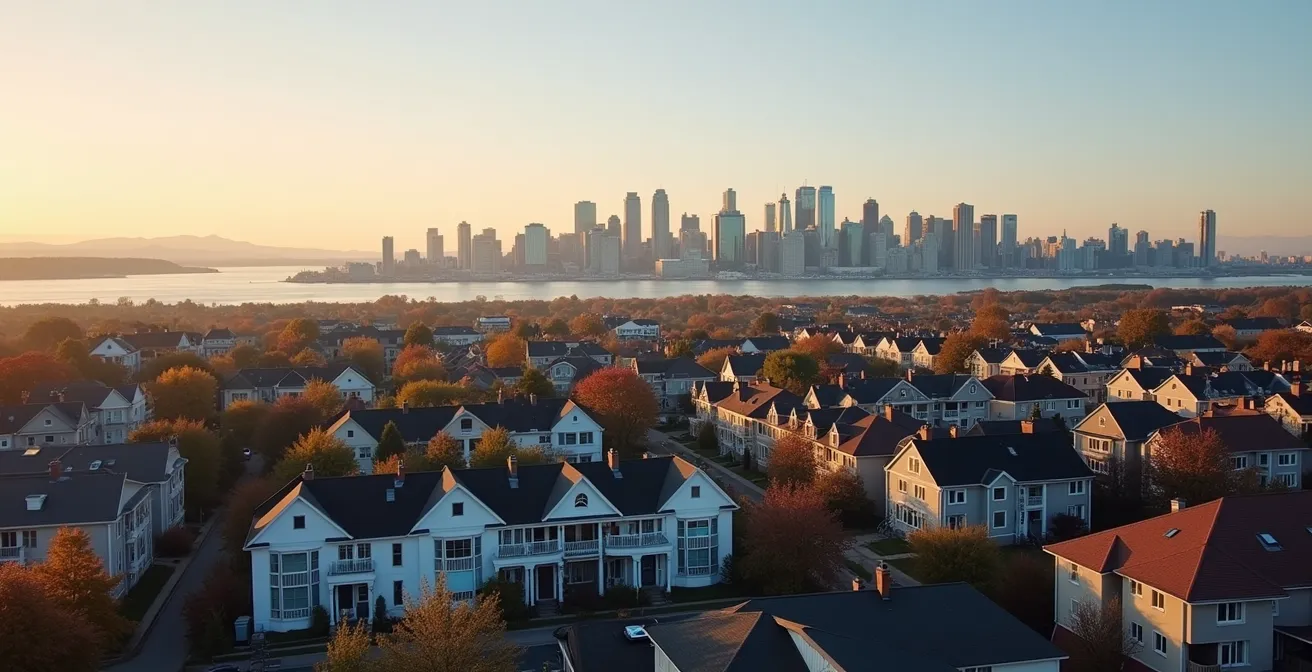
The convergence of real estate prices between Montreal and Quebec’s regions is not a temporary trend, but a fundamental economic rebalancing driven by strategic municipal planning and evolving lifestyle calculations.
- Beyond remote work, factors like childcare costs, municipal tax rates, and infrastructure projects are creating new pockets of value.
- Identifying the next “boom town” involves tracking leading indicators like zoning changes and economic diversification, not just lagging price data.
Recommendation: Instead of chasing prices, investors and homebuyers should analyze a region’s economic structure and municipal strategy to anticipate future growth.
For years, the narrative of Quebec’s real estate market was simple: Montreal was the sun, and every other region existed in its orbit. The dream of homeownership for many young professionals and families in the metropolis has increasingly felt out of reach, pushing them to look outward. The common explanation for the subsequent price surge in the regions is the rise of remote work, a convenient but incomplete answer. This post-pandemic shift was merely an accelerator for a much deeper trend that was already underway.
While the ability to work from a laptop in the Eastern Townships is a powerful catalyst, it doesn’t explain the whole picture. It fails to account for why certain towns are booming while others stagnate, or why the very definition of “value” is being rewritten. The real story lies in a complex interplay of factors: a strategic “lifestyle arbitrage” calculated by families, proactive municipal governments wielding new powers to spur development, and the powerful, often volatile, cycles of resource-based economies.
This article moves beyond the headlines to provide an analyst’s perspective on this great rebalancing. We will dissect the true cost-benefit analysis driving families out of the city, provide a framework for identifying future growth areas before they peak, and analyze the inherent risks and rewards of investing in different types of regional markets. This is a guide to understanding the structural shifts that are reshaping Quebec’s real estate map for the decade to come.
To navigate this complex landscape, this guide breaks down the key market dynamics. We will explore the specific drivers pushing families towards regional hubs, the methods to spot emerging hot spots, the risks of single-industry towns, and the direct impact of major infrastructure projects on property values.
Summary: An Analyst’s Guide to Quebec’s Shifting Real Estate Landscape
- Why Are Young Families Fleeing Montreal for Towns Like Trois-Rivières?
- How to Identify the Next Boom Town Before Prices Skyrocket?
- The Risk of Buying in a “One-Company Town” When the Mill Closes
- Montreal vs. Quebec City: Where Does Your Down Payment Go Further?
- When Will the Seller’s Market Finally End in the Suburbs?
- How Does the Mining Industry Impact Real Estate Cycles in Val-d’Or?
- How Will the REM Expansion Change Property Values in the North Shore?
- Affordable Real Estate: Where to Find Entry-Level Homes in Quebec Today?
Why Are Young Families Fleeing Montreal for Towns Like Trois-Rivières?
The exodus of young families from Montreal is often simplified to a quest for a backyard and a lower mortgage. While a significant motivator, this view overlooks the sophisticated financial calculation at play: lifestyle arbitrage. This isn’t just about the sticker price of a home; it’s about the total cost of living and the quality of life that money buys. Families are conducting a detailed cost-benefit analysis where factors like childcare, municipal taxes, and daily conveniences weigh heavily.
A critical piece of this puzzle is childcare. While Quebec’s subsidized daycare system is famous, availability is not uniform across the province. In urban centres, waitlists can be long, forcing parents into expensive private options. An official 2021 study confirms the landscape, noting that while 88% of Quebec children in childcare attend recognized settings, the type and accessibility of these spots vary greatly. A family securing a $9.35-per-day spot in a regional CPE versus paying $50-60 per day for a private daycare in Montreal sees an annual saving of thousands of dollars per child. This single factor can be equivalent to a significant portion of a mortgage payment.
This detailed financial analysis extends to other hidden costs. Municipal taxes are often lower in regional towns, and auto insurance rates can also vary. When these savings are combined with a lower principal on a mortgage, the financial case for moving becomes compelling. It’s a strategic relocation designed to maximize disposable income and access to essential family services, not just a romantic escape from the city.
Action plan: Calculate your total family cost savings
- Calculate the base mortgage payment difference between a target Montreal property and a comparable one in a regional town.
- Add the estimated annual savings from municipal tax variations, which can be 15-20% lower in the regions.
- Factor in SAAQ auto insurance differences based on the new postal code, which can amount to a couple of hundred dollars per year.
- Include the significant impact of childcare costs: compare the reality of securing a subsidized spot versus paying for unsubsidized care.
- Account for new commute costs; even with remote work, occasional travel to a central office needs to be budgeted against daily Montreal transit or driving expenses.
How to Identify the Next Boom Town Before Prices Skyrocket?
Spotting the next high-growth area is less about chasing past performance and more about identifying leading indicators of an economic rebalancing. While rising prices are a lagging indicator, proactive municipal strategy and a diversifying economic base are forward-looking signals of sustainable growth. The savviest buyers look for towns that are not just cheap, but are actively laying the groundwork for future prosperity.
One of the most powerful, yet often overlooked, indicators is a change in municipal planning and zoning. Until 2027, Quebec municipalities have been granted what some analysts call “municipal superpowers” to fast-track real estate projects by bypassing certain urban planning rules. This is a game-changer.
Case Study: Saint-Jérôme and Beloeil’s Proactive Zoning
Cities like Saint-Jérôme and Beloeil have leveraged new provincial flexibility to accelerate development. By monitoring city council minutes and zoning variance applications, observers could see a clear intent to increase housing density and approve new commercial projects long before the construction cranes appeared. Desjardins’ economic studies note this trend, highlighting how Montreal itself is fast-tracking projects, demonstrating that these planning shifts are a reliable predictor of where investment and population growth will be channelled next.
Another key is economic diversification. A town’s resilience and long-term appreciation potential are directly tied to the breadth of its employment base. A region heavily reliant on a single industry is vulnerable, while one with a healthy mix of sectors like education, healthcare, technology, and government services offers greater stability.
This paragraph introduces a table that allows for a comparative analysis of different Quebec cities based on their economic mix and recent performance. As the data from a Royal LePage market analysis shows, cities with higher diversification often exhibit strong, stable growth.
| City | Economic Mix Score | Key Sectors | Price Growth YoY |
|---|---|---|---|
| Quebec City | High | Government, Tourism, Tech | +15.0% |
| Sherbrooke | High | University, Healthcare, Manufacturing | +5.6% |
| Trois-Rivières | Medium | Services, Manufacturing, Education | +11.0% |
| Val-d’Or | Low | Mining-dependent | Variable |
The Risk of Buying in a “One-Company Town” When the Mill Closes
The allure of rapidly appreciating home prices in some regional towns can mask a significant underlying risk: a lack of economic diversification. A “one-company town,” historically reliant on a single mill, factory, or natural resource, operates on a knife’s edge. The town’s entire economic ecosystem, from property values to retail health, is tied to the fortunes of that one industry. This creates a pattern of cyclical volatility, where boom times are dramatic but the subsequent busts can be devastating for homeowners who bought at the peak.
The health of these towns is often dictated by global commodity prices or international trade agreements, factors far outside local control. A sudden drop in resource prices, the imposition of tariffs, or a corporate decision to relocate production can trigger a domino effect: layoffs lead to population decline, which in turn leads to a glut of housing supply and falling property values. The dream of a profitable investment can quickly turn into the nightmare of a depreciating asset with few potential buyers.
Case Study: Val-d’Or’s Dependence on Mining
The city of Val-d’Or in Abitibi-Témiscamingue serves as a modern example of a resource-dependent economy. Its real estate market’s value is directly correlated with the global prices of gold and, more recently, lithium, typically with a 6- to 12-month lag. While the city is actively trying to diversify by expanding the local UQAT university campus and supporting Indigenous-led economic projects, mining remains the overwhelming economic engine. This makes it a high-risk, high-reward market where timing is everything and long-term stability is not guaranteed.
Investors and homebuyers considering such a market must do so with their eyes wide open. They are not just buying a property; they are taking a position on a specific commodity or industry. A thorough analysis of the dominant industry’s long-term outlook, as well as the town’s genuine efforts to diversify its economy, is a non-negotiable part of due diligence. Without this, a buyer risks becoming a casualty of the next down cycle.
Montreal vs. Quebec City: Where Does Your Down Payment Go Further?
For those looking for an urban lifestyle outside of Montreal, Quebec City presents the most direct comparison. Both are historic, vibrant centres, but they offer vastly different answers to the question of affordability and lifestyle. A direct comparison of their real estate markets reveals just how much further a down payment can go in the provincial capital, illustrating a clear case of lifestyle arbitrage on an urban scale.
The most striking difference is the aggregate home price. While both markets have seen appreciation, the gap remains substantial. The latest market data shows a significant price advantage in Quebec City. A report highlighting market trends confirms this, with Quebec City’s aggregate home price at $452,700 versus Montreal’s $635,000 in the third quarter of 2025. This nearly $200,000 difference means a 20% down payment is almost $40,000 smaller in Quebec City, a massive barrier to entry removed for first-time buyers.
However, the analysis cannot stop at the purchase price. A holistic view of ownership costs and lifestyle factors is essential. Quebec City’s higher concentration of stable government jobs provides an economic buffer not as prevalent in Montreal. While Montreal may offer more diverse private-sector opportunities, the job security in the capital is a major, often unquantified, benefit.
The following table breaks down the total cost of ownership beyond the mortgage, providing a clearer picture of the day-to-day financial realities in each city.
| Factor | Montreal | Quebec City |
|---|---|---|
| Median Home Price | $635,000 | $452,700 |
| Average Municipal Tax Rate | Higher | Lower |
| Public Transit Monthly Pass | $97 | $91.75 |
| Walkability Score | Variable by borough | High in central areas |
| Government Job Concentration | Lower | Higher (stability factor) |
When Will the Seller’s Market Finally End in the Suburbs?
For prospective buyers watching suburban prices climb, the most pressing question is: when will the pendulum swing back? The answer lies not in speculation, but in monitoring key market indicators that signal a shift in the balance of power between buyers and sellers. While a full-blown buyer’s market may not be on the immediate horizon, understanding the metrics that define a seller’s market allows for a more strategic purchasing timeline.
The most critical metric in Quebec is “months of inventory.” This figure represents how long it would take to sell all currently listed properties at the current pace of sales. In Quebec, a market with under 8 months of inventory is generally considered a seller’s market. Recent data provides a clear picture of the current situation. For instance, the latest figures show 4.6 months of inventory in the Montreal CMA as of November 2025, indicating that sellers still firmly hold the advantage. A consistent trend upward, approaching the 8-month mark, would be the first major sign of a cooling market.
Another powerful indicator to watch is the Sales-to-New-Listings Ratio (SNLR). This ratio compares the number of homes sold to the number of new listings entering the market. A ratio above 60% signals that demand is outpacing supply, characteristic of a seller’s market. As this ratio begins to dip consistently into the 40-60% range, it suggests a move towards a more balanced market.
Finally, external macroeconomic factors play a crucial role. Bank of Canada interest rate decisions directly impact borrowing costs and buyers’ purchasing power. Furthermore, the persistence of corporate return-to-office mandates, particularly those requiring 3-4 days per week onsite, could temper the relentless demand for sprawling suburban homes and shift focus back towards properties with easier commutes. Watching these indicators in concert provides the clearest forecast for an eventual market shift.

How Does the Mining Industry Impact Real Estate Cycles in Val-d’Or?
The real estate market in a resource town like Val-d’Or does not follow the same rules as a diversified urban economy. Its rhythm is dictated by the global commodities market, creating a distinct pattern of cyclical volatility. Understanding these boom-and-bust cycles is essential for anyone considering an investment in the region. Property values in Val-d’Or directly track the prices of gold and lithium, but with a critical delay.
Analysis of historical data shows a clear correlation: significant movements in commodity prices are typically reflected in the real estate market 6 to 12 months later. When gold prices surge, mining companies increase investment and hiring, drawing a workforce to the town. This influx of demand first hits the rental market, causing rents and occupancy rates to spike. The ownership market follows as workers decide to settle more permanently. Conversely, when commodity prices fall, projects are scaled back, workers depart, and both rental and ownership markets cool rapidly.
This dynamic creates a unique investment landscape. The city’s large “fly-in/fly-out” workforce, who live in temporary camps or rentals during their work rotations, generates a strong and potentially lucrative rental market. For investors, this can mean higher rental yields compared to traditional residential markets. However, this also comes with higher vacancy risk during downturns. A property that cash-flows positively during a boom can quickly become a liability when the cycle turns. Therefore, investing in Val-d’Or requires a dual focus: an understanding of real estate fundamentals and a keen eye on the long-term outlook for key commodities.
How Will the REM Expansion Change Property Values in the North Shore?
Large-scale public transit projects are one of the most powerful catalysts for real estate appreciation, and the Réseau express métropolitain (REM) is fundamentally reshaping the value proposition of Montreal’s suburbs. For the North Shore, the REM is more than a train; it’s a direct link to the economic heart of the city, creating what urban planners call transit-oriented value. This is the measurable premium that properties command due to their proximity to efficient, reliable transit.
The effect is not just theoretical; it’s already being priced into the market. Even before the full network is operational, communities along the REM lines are seeing a “transit premium.” For example, data tracking prices near future stations reveals a clear upward trend. One REM proximity analysis shows the median home price in Deux-Montagnes, the terminus of one North Shore branch, increased from $487,000 in 2021 to $503,500 in the first quarter of 2022, a direct reflection of anticipated demand.
This value creation is most pronounced in areas that are actively planning for it. These “transit-oriented developments” (TODs) are master-planned communities designed to maximize the benefits of the new infrastructure. They feature higher-density housing, walkable commercial areas, and public spaces, all centred around the new station.
Case Study: The Bois-Franc Transit-Oriented Development
The area around the future Bois-Franc station is a prime example of the REM’s transformative power. With a promised travel time of just 16 minutes to downtown Montreal, the development has spurred a wave of new condo and townhouse projects. Real estate developers launched major projects within walking distance of the station footprint years before its opening, explicitly marketing the upcoming rail access as a primary feature. This demonstrates that the market prices in the benefit of infrastructure long before the first train ever runs.
For buyers and investors, this means the window of opportunity to “buy on the rumour” is closing in some areas but may still be open in others. Analyzing the development plans for municipalities further along the REM’s future phases can reveal where the next wave of transit-oriented value will be created.
Key Takeaways
- The regional price boom is a structural economic rebalancing, not just a fleeting remote-work trend.
- True “lifestyle arbitrage” involves calculating total costs, including childcare and taxes, not just the mortgage.
- Identifying future growth requires tracking leading indicators like municipal zoning changes and economic diversification scores.
Affordable Real Estate: Where to Find Entry-Level Homes in Quebec Today?
In a market defined by rising prices, the search for affordability requires a more creative and strategic approach. While the headlines focus on the hot markets, pockets of value still exist for first-time buyers and investors willing to look beyond the obvious. The key is to synthesize the principles of economic rebalancing and lifestyle arbitrage to identify regions with untapped potential. Quebec as a whole remains relatively affordable within Canada, a fact demonstrated by its lower-than-average mortgage delinquency rates.
Data from the Canada Mortgage and Housing Corporation (CMHC) supports this, showing Quebec’s mortgage arrears rate at 0.19% compared to the national average of 0.23% in the first quarter of 2025. This indicates a healthier and less-strained market overall, providing a stable foundation for investment. The strategy, therefore, is to find micro-markets that offer both a low cost of entry and a plausible path to future growth.
This involves looking at regions that are just beginning to appear on the radar for remote workers or that are benefiting from local economic revitalization efforts. These areas may not have the explosive growth of the most popular suburbs, but they offer a sustainable entry point into the property ladder. An effective search strategy should include:
- Exploring under-the-radar regions: For remote workers, areas like the Mauricie, Centre-du-Québec, and even parts of the Gaspésie offer incredible value and quality of life, with high-speed internet becoming increasingly available.
- Researching municipal incentives: Some smaller towns offer tax credits or other financial incentives for new residents or new graduates to combat depopulation and stimulate the local economy.
- Considering alternative ownership models: Co-ownership agreements with family or friends can be a powerful way to pool resources for a down payment. Similarly, intergenerational homes with secondary suites can provide rental income or shared living spaces to offset costs.
- Leveraging government programs: Programs like the Rénoclimat grant can provide significant financial assistance for renovating an older, more affordable home, increasing its value and energy efficiency.
Frequently Asked Questions on Quebec Housing Markets: Why Prices in the Regions Are Catching Up to Montreal
How quickly do mining town property values react to commodity price changes?
Property values typically show a 6-12 month lag following significant commodity price movements, with rental markets reacting more quickly than ownership markets.
Is rental property more profitable than flipping in mining towns?
Rental properties catering to transient mining workers often provide steadier returns than flipping, which is more vulnerable to boom-bust cycles.
What diversification efforts are reducing Val-d’Or’s mining dependency?
The forestry sector, UQAT university expansion, and Indigenous-led economic development projects provide counter-cyclical buffers to mining volatility.
To apply this market analysis effectively, the next step is to evaluate specific regional opportunities against your personal financial capacity and long-term lifestyle goals.