Buying near a Canadian tourist attraction isn’t a simple pro/con decision; it’s an investment in a complex ‘tourism ecosystem’ with its own unique risks and rewards.
- The financial appeal of seasonal rental income is often counterbalanced by lifestyle trade-offs like traffic and the underlying risk of the attraction’s long-term viability.
- A property’s true value is determined by its “resilience quotient”—its ability to withstand shocks like climate events or the attraction’s decline.
Recommendation: Instead of focusing only on proximity, assess the specific type of attraction. Your due diligence must match its unique profile, from checking noise bylaws in a festival zone to evaluating wildfire risk in a national park.
The dream of owning a home steps away from a vibrant tourist attraction is a powerful one. For a potential buyer, the allure is obvious: imagine the convenience of strolling to the zoo with your family, the energy of living near a bustling festival district, or the consistent rental income from a property nestled by a national park. This proximity seems to promise a richer lifestyle and a smarter investment, a belief that drives many to pay a premium for such locations.
Conventional wisdom focuses on a simple trade-off: higher potential rental income versus the nuisances of traffic and noise. But this view is dangerously simplistic. It treats all attractions as monolithic assets and ignores the intricate dynamics at play. As a regional lifestyle consultant, I analyze the true “livability” of these zones, and the reality is far more nuanced. The success of your investment doesn’t just depend on the attraction’s popularity today, but on the resilience and stability of its entire tourism ecosystem.
What if the key to a sound investment wasn’t just the attraction’s draw, but your ability to dissect its specific operational rhythm, its vulnerability to external shocks, and its real impact on neighbourhood character? This guide moves beyond the postcard view. We will deconstruct the unique real estate DNA of different Canadian attractions, from the seasonal volatility of a zoo to the existential risks facing a ski town. By understanding these underlying factors, you can make a decision based not on a dream, but on a clear-eyed analysis of long-term value.
This article provides a framework for evaluating properties near Canada’s major tourist draws. We will explore the distinct challenges and opportunities presented by various types of attractions, equipping you with the critical questions you need to ask before you buy.
Summary: Decoding the Real Value of Properties Near Tourist Hotspots
- Living Near the Zoo: How Seasonal Traffic Affects Neighborhood Quality of Life?
- The “Park Effect”: How National Parks Guarantee Occupancy for Airbnbs?
- Festival Zones: How to Check Noise Bylaws Before Buying Downtown?
- Ghost Towns: What Happens to Tourist Villages When the Attraction Closes?
- Do Properties Near Major Attractions Appreciate Faster Than the Average?
- Tremblant vs. Saint-Sauveur: Which Ski Town Offers Better Long-Term Value?
- The “Museum District” Premium: Is It Worth Paying More to Walk to the Science Centre?
- Quebec Tourism Trends: Betting on the Rise of Ecotourism and “Slow Travel”
Living Near the Zoo: How Seasonal Traffic Affects Neighborhood Quality of Life?
Living near a family-friendly attraction like a zoo or waterpark presents a classic case of seasonal volatility. The idyllic, quiet streets of autumn can transform into congested arteries during the peak summer months. This rhythm directly impacts not just your daily commute but the very financial model of the property. For investors, this peak season is a golden opportunity. In Calgary, for instance, the 10-day Stampede event creates such intense demand that nearby properties can see incredible returns.
This intense seasonality creates a dual reality for residents. During the off-season, you enjoy peaceful surroundings and easy access to amenities. But during peak times, that same proximity becomes a liability, with parking becoming a daily challenge and routine errands requiring strategic planning. Analysis of the Calgary market shows this phenomenon clearly, where proximity to the Stampede grounds can result in summer rental revenues 3x higher than in the winter months, a significant financial incentive that comes with a temporary but intense strain on local infrastructure.
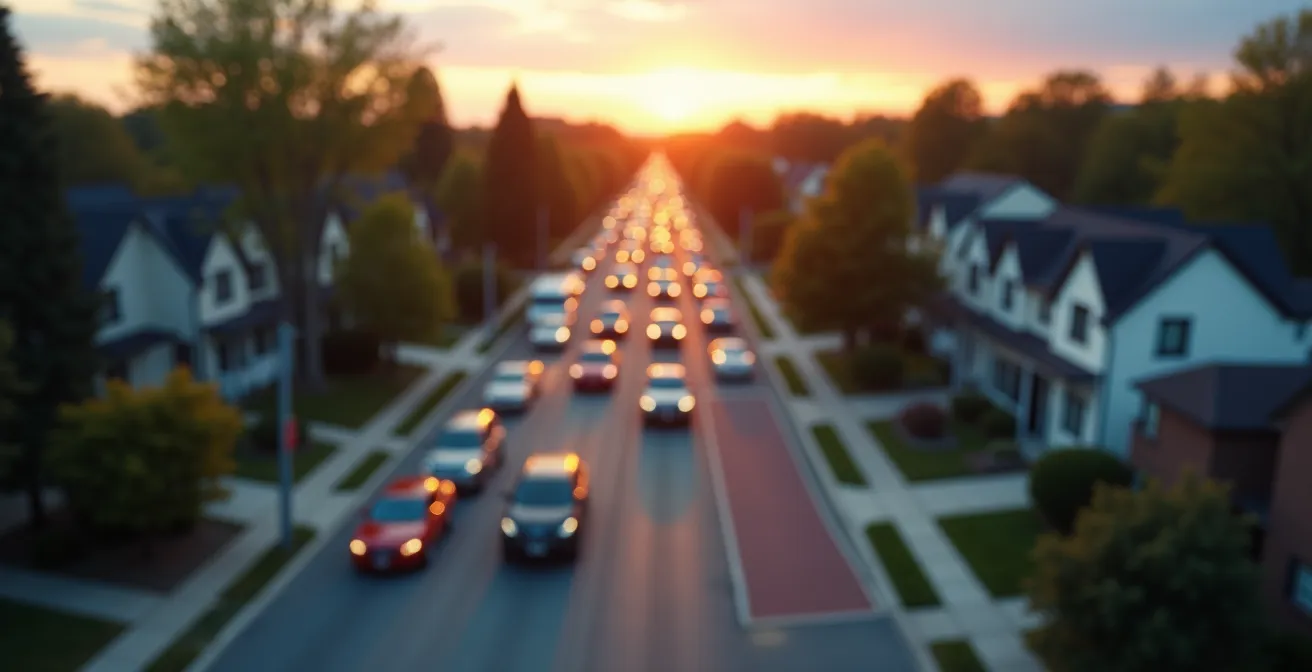
As the image above illustrates, traffic flow can dramatically alter the character of a neighbourhood. For a potential buyer, this means looking beyond a single visit. You must investigate the area during its absolute busiest period—a sweltering Saturday in July, not a placid Tuesday in October. This is the only way to gauge the true “livability cost” of the seasonal surge and decide if the financial upside or off-season tranquility is worth the peak-season disruption.
The “Park Effect”: How National Parks Guarantee Occupancy for Airbnbs?
The term “guarantee” in real estate should always be met with skepticism. While properties near iconic Canadian national parks like Banff and Jasper have historically benefited from a steady stream of global visitors, this high demand masks a growing and significant risk factor: climate change. The very natural beauty that creates the “park effect” also exposes these communities to environmental threats, most notably wildfires. The idea of a risk-free investment in these areas is a dangerous illusion.
The 2024 Jasper wildfire serves as a stark and tragic lesson in the vulnerability of these tourism ecosystems. The disaster, which resulted in an estimated $1.23 billion in insured damage and the destruction of 358 properties, instantly erased the concept of “guaranteed” occupancy. For property owners, this translates into sharply rising insurance premiums and the grim possibility of losing everything. A high booking rate is meaningless when the entire town is under an evacuation order or, worse, gone.
This table, based on recent analysis, highlights the critical need to assess a park town’s “resilience quotient”—balancing its economic draw with its environmental vulnerability.
| Park Town | Annual Visitor Spending (2019) | Climate Risk Factor | Insurance Premium Trend |
|---|---|---|---|
| Banff | 60% of $2.3B regional total | Moderate wildfire risk | Rising steadily |
| Jasper | $700M (pre-2024 fire) | High wildfire risk | Sharply increased post-2024 |
| Canmore | Part of $2.3B regional total | Moderate flood/fire risk | Gradual increase |
As the data shows, not all park towns carry the same level of risk. An investor’s due diligence must now include a thorough climate risk assessment. This involves checking regional wildfire mitigation plans, understanding insurance coverage limitations, and favouring communities that are actively investing in climate resilience, not just marketing their views.
Festival Zones: How to Check Noise Bylaws Before Buying Downtown?
Buying into the vibrant heart of a city’s festival or entertainment district offers an exciting lifestyle, with culture and events right at your doorstep. However, the energy that makes these areas attractive can quickly become a source of conflict if you’re not prepared for the reality of noise. What is considered celebratory ambiance to a tourist can be a major disturbance to a resident. Therefore, attraction-specific due diligence is non-negotiable here, and it starts with a deep dive into municipal noise bylaws.

Cities often create special provisions for these zones, allowing for higher decibel levels and later hours than in typical residential areas. In Montreal’s Quartier des Spectacles, for example, the city balances cultural vibrancy with resident comfort, but venues can still face fines up to $12,000 for noise violations, indicating that conflict is an ongoing reality. Simply assuming standard quiet hours apply is a recipe for frustration. Your investigation must be forensic, as condo or strata rules can sometimes impose stricter limits than the city itself.
Before making an offer on a property in such a zone, you must become an expert on its soundscape. This goes beyond a single visit and requires a methodical check of the legal framework governing noise in that specific location.
Your Action Plan: Verifying Festival Zone Noise Regulations
- Research municipal noise bylaws on the city’s official website, noting specific decibel limits, quiet hours, and any exemptions for entertainment districts.
- Check for borough-specific or neighbourhood-specific regulations, which can differ from or add to city-wide rules.
- Investigate if the property is officially located within a designated entertainment or festival zone, which often have their own set of rules.
- Review the condominium or strata bylaws thoroughly, as they can override municipal permissions, especially concerning short-term rentals and balcony use during events.
- Contact the local bylaw enforcement office or non-emergency police line to inquire about the history of noise complaints for the specific building or street.
This proactive research is the difference between being a happy urbanite who enjoys the festival buzz and a disgruntled resident counting down the days until the event is over.
Ghost Towns: What Happens to Tourist Villages When the Attraction Closes?
The most significant risk in buying into a tourist-driven market is the potential failure of the core attraction. When a town’s economy is overwhelmingly dependent on a single entity—be it a theme park, a specific festival, or a natural wonder—its closure can trigger a catastrophic domino effect. Property values, rental income, and local businesses can all collapse, leaving investors with a devalued asset in a “ghost town.” This is the ultimate test of a tourism ecosystem’s resilience quotient.
While a complete shutdown is the most dramatic scenario, a partial or prolonged disruption can be just as damaging. The aftermath of the Jasper wildfire provides a harrowing, real-world example of this economic fragility.
Case Study: Jasper’s Economic Fallout Post-Wildfire
Following the 2024 wildfire, the town of Jasper faced an existential crisis. Even with the Marmot Basin ski area’s infrastructure surviving, the widespread destruction of homes and businesses created deep uncertainty. Real estate brokers noted an alarming trend of residents choosing not to return, permanently fracturing the community fabric. For a town already weakened by the pandemic and a previous wildfire, this latest disaster has pushed many small, family-run businesses—the lifeblood of the local economy—to the brink of collapse, demonstrating how a single event can threaten the viability of an entire tourist village.
This scenario underscores a critical lesson for buyers: you are not just investing in a property, but in the long-term health of the entire local economy. The financial risk associated with these events is immense; a report noted the 2024 Jasper disaster was the second-most expensive in Alberta history at $1.23B in insured losses, highlighting the escalating stakes for property owners in these beautiful but vulnerable locations.
Before investing, you must assess the town’s economic diversity. How much of its economy relies on that single attraction? Are there other drivers, like a local college, a government office, or a burgeoning tech scene? A diversified economic base is the best insurance policy against becoming a resident of a future ghost town.
Do Properties Near Major Attractions Appreciate Faster Than the Average?
The common assumption is that proximity to a major attraction automatically translates to superior property appreciation. While there is a kernel of truth to this, the reality is far more nuanced and depends heavily on the property type and the overall health of the regional economy. The “attraction premium” is not a universal law but a variable that performs differently across market segments.
As Robert Hogue, Assistant Chief Economist at RBC Economics, notes about a market like Calgary, broader economic factors are key. In an analysis, he stated:
It’s a market where supply and demand are largely aligned, and affordability is only mildly strained. Calgary is also supported by a relatively robust economy and solid population inflows.
– Robert Hogue, Assistant Chief Economist, RBC Economics
This context is crucial. An attraction’s pull can amplify growth in a strong market but can’t single-handedly create it in a weak one. Data from the Calgary market reveals a fascinating split: the appreciation bonus is most pronounced in the condo market, which is closely tied to short-term rental demand from tourists.
This following table, compiled from recent market data, clearly illustrates how different property types perform. As shown in the analysis of real estate appreciation, the gains are not evenly distributed.
| Property Type | 5-Year Appreciation | Location Factor | Key Driver |
|---|---|---|---|
| 2-Storey Houses Calgary | 50%+ | Mixed tourist/residential | Land value & migration |
| Tourist-Adjacent Condos | 22% (2024 alone) | Near attractions | Short-term rental demand |
| Standard Residential | 14% (2024) | Away from attractions | General market growth |
The takeaway is clear: if your goal is to capitalize on appreciation driven directly by tourism, a condo suitable for short-term rentals is a more direct bet. For detached family homes, the appreciation is more closely linked to broader factors like land value and population growth, with the nearby attraction acting as a secondary benefit rather than the primary driver.
Tremblant vs. Saint-Sauveur: Which Ski Town Offers Better Long-Term Value?
Choosing a ski town investment is a classic Canadian dilemma, often pitting a major destination resort against a more locally-focused one. The comparison between Mont-Tremblant and Saint-Sauveur in Quebec is a perfect case study. Both offer fantastic skiing, but they represent two very different investment philosophies. The decision of which offers better long-term value depends entirely on your definition of “value”—are you betting on global tourism or local sustainability?
As noted by real estate analysts, tourist hotspots like national parks and ski resorts create a consistent visitor flow that bolsters property markets. Tremblant, with its large corporate ownership (Alterra Mountain Company) and international reputation, is built on this model. It attracts a global audience, which can lead to higher peak rental rates but also exposes it to the whims of international travel trends and currency fluctuations. Saint-Sauveur, conversely, is primarily a day-trip and weekend destination for the Montreal market, offering a more stable, locally-driven demand base.
The long-term value proposition is reflected in the very infrastructure and development of each town. Your analysis should go beyond a simple comparison of lift ticket prices and look at the underlying factors that ensure a resort’s viability for decades to come. This requires a shift in perspective from a skier to a strategic investor.
Key Evaluation Criteria for Ski Town Investments:
- Climate Resilience: Assess average snowfall trends, elevation, and, critically, the resort’s snowmaking capacity. A resort heavily invested in state-of-the-art snowmaking is better insulated against warmer winters.
- Four-Season Potential: Compare summer vs. winter occupancy rates. Does the town have a robust offering of summer activities (golf, mountain biking, festivals) to smooth out seasonal revenue dips?
- Ownership and Investment: Analyze the ownership structure. A large corporate owner might invest heavily in new lifts and infrastructure, while a locally-owned model might offer a more authentic, stable community feel.
- Market Proximity: Evaluate the distance to a major urban centre. Proximity to a city like Montreal gives Saint-Sauveur a resilient base of visitors, making it less dependent on long-haul tourism.
The “Museum District” Premium: Is It Worth Paying More to Walk to the Science Centre?
Not all attractions are created equal. While zoos and festivals generate buzz and seasonal crowds, cultural institutions like museums, science centres, and art galleries offer a different kind of value. The premium you pay to live in a “Museum District” is less about capturing tourist dollars and more about investing in a high “livability” quotient. This is the “livability premium”: the price you pay for a stable, culturally rich, and highly walkable neighbourhood.
Unlike a theme park, a major museum is a stable anchor. These institutions are typically well-funded, non-profit entities with deep roots in the community. They don’t generate the same level of disruptive noise or traffic as a festival. Instead, they foster a desirable neighbourhood character, attracting cafes, bookstores, and a demographic that values quiet intellectual pursuits. For a family with children, the educational benefit of being able to walk to a science centre is an intangible but powerful asset.
The return on investment here is twofold. Financially, these neighbourhoods tend to have strong, stable property values. They are less susceptible to the boom-and-bust cycles of more volatile tourist attractions. Because their appeal is tied to permanent cultural infrastructure, they are seen as a safer long-term bet. But the more significant return may not be financial at all. It’s the daily quality of life: the access to green space often surrounding these institutions, the architectural beauty, and the sense of being connected to the city’s cultural heartbeat. For many buyers, particularly empty-nesters or young professionals, this lifestyle ROI can outweigh a purely speculative financial gain.
However, paying this premium requires a clear understanding of your personal priorities. If your primary goal is generating short-term rental income, a museum district is likely not your best bet. But if you are buying a home to live in and value stability, walkability, and cultural access, the premium paid for that location can be one of the wisest investments you’ll ever make.
Key Takeaways
- Investing near a tourist attraction requires analyzing its specific ‘tourism ecosystem’, not just its general popularity.
- Seasonal attractions create income volatility, while even ‘guaranteed’ draws like national parks face significant climate-related risks.
- Due diligence must be attraction-specific, from checking noise bylaws in festival zones to assessing a ski town’s four-season viability.
Quebec Tourism Trends: Betting on the Rise of Ecotourism and “Slow Travel”
As we’ve seen, the traditional model of mass tourism creates a fragile real estate ecosystem, prone to volatility and risk. A forward-thinking investor should look beyond the current hotspots and consider where the market is headed. In Quebec, and across Canada, a significant trend is emerging: the rise of ecotourism and “slow travel.” This movement prioritizes sustainability, authentic experiences, and minimal environmental impact, creating a more resilient and stable model for tourism.
Properties in regions embracing this ethos, such as parts of Charlevoix or the Eastern Townships, offer a different kind of investment. Instead of relying on a single, massive attraction, their appeal is based on a network of smaller, sustainable draws: farm-to-table restaurants, artisan trails, hiking networks, and small-scale wellness retreats. This diversified portfolio of attractions makes the local economy inherently more robust. It’s less likely to collapse if one small winery or hiking trail closes.
This model fosters a healthier tourism ecosystem. It avoids the massive infrastructure strain, traffic congestion, and noise pollution associated with mega-attractions. The result is a higher quality of life for residents and a more sustainable property market. For a buyer, investing in a “slow travel” region is a bet on a long-term trend that aligns with growing consumer demand for authenticity and sustainability. It’s a move away from the speculative boom of a theme park and toward the steady, organic growth of a well-managed, desirable region.
The ultimate smart investment may not be next to the biggest, loudest attraction, but in a community that has thoughtfully cultivated a diverse and sustainable tourism offering. This is where true long-term value and livability are found, creating a market that can thrive for generations, not just for the next tourist season.
To apply these insights, the next logical step is to build a personalized “livability scorecard” for any property you’re considering, weighing the specific risks and rewards of its unique tourism ecosystem.