
Successfully acting as your own General Contractor in Quebec hinges less on project management skills and more on mastering a specific legal and operational framework to mitigate local risks.
- Rigorous contractor vetting through the RBQ’s official registry is non-negotiable to avoid unqualified or uninsured individuals.
- A risk-weighted contingency fund (15-30%) is essential to cover surprises common in older Quebec homes, such as knob-and-tube wiring or vermiculite.
- Understanding the legal hypothec and implementing a 35-day holdback on final payment is your primary shield against unpaid subcontractor claims.
Recommendation: Before signing any contract, draft a payment schedule that explicitly includes a 10-15% holdback clause, payable 35 days after the certified completion of the work.
The allure is undeniable: acting as your own General Contractor (GC) on a Quebec renovation project can save you the typical 10% to 20% contractor markup. For a homeowner with a knack for organization, it seems like a straightforward path to significant savings. While it is perfectly legal to manage the renovation of your own single-family home in Quebec without holding a contractor’s license, the reality is far more complex than simply coordinating trades. Generic advice to “get three quotes” and “have a contract” is dangerously insufficient in this market.
Most guides overlook the minefield of local regulations, building-specific risks, and legal mechanisms unique to Quebec. The difference between a successful project and a financial disaster isn’t your ability to create a timeline; it’s your ability to anticipate and mitigate risks. These include navigating the Régie du bâtiment du Québec (RBQ) licensing system, protecting yourself from a legal hypothec, and planning around the mandatory construction holiday.
This article re-frames the role of the homeowner-GC. Instead of a simple task manager, you must become a risk manager. We will move beyond the platitudes and provide a strategic framework for project execution in Quebec. This guide will equip you with the contractual knowledge and operational foresight to not only save money but, more importantly, to protect your investment from start to finish.
This guide provides a structured approach, breaking down the process into key management pillars. From vetting your team to closing out the project legally, each section is designed to build your expertise and confidence as a Quebec-specific project manager.
Summary: Renovation Management: How to act as Your Own General Contractor in Quebec?
- RBQ License and Insurance: How to Vet a Contractor Before Signing?
- The 20% Rule: Why You Always Need a Contingency Fund for Old House Renos
- Critical Path: How to Schedule Plumbers and Electricians Without Delays?
- Sourcing Materials: When Should You Buy Fixtures Yourself vs. Through the Contractor?
- The Legal Hypothec: How to Protect Yourself Against Unpaid Subcontractors?
- How Building a Garage Can Offer the Highest ROI for Detached Homes?
- Kitchen Remodel: How to Spend $20k to Add $40k to Your Home Value?
- Revitalizing the “Shoebox” Home: How to Modernize Without Destroying Character?
RBQ License and Insurance: How to Vet a Contractor Before Signing?
The first and most critical step in your project is not finding a contractor, but vetting one. In Quebec, relying on word-of-mouth or a contractor’s own claims is insufficient. Your primary tool is the Régie du bâtiment du Québec (RBQ). With over 40,000+ contractors holding valid RBQ licenses, the landscape is vast, and verification is your responsibility. Using the RBQ’s “Licence holders’ repertory” is a non-negotiable due diligence step.
When you check a license number, you’re looking for more than just a “valid” status. Pay close attention to the subclasses. A general contractor for renovations should hold subclass 1.3. Someone building a new home needs a 1.1.1 or 1.1.2. A contractor without the correct subclass is not legally permitted to perform the work, and your project will not be covered by their license security. Also, check the license issue date to gauge their experience level.
Beyond the license, demand proof of two crucial financial protections. First, confirm their civil liability insurance, which should be a minimum of $2 million for any substantial project. Second, verify their RBQ license security—a financial deposit held by the RBQ to compensate clients for damages. This is $40,000 for a general contractor and $20,000 for a specialized one. Finally, request a clearance letter from the CNESST to ensure their worker’s compensation contributions are up to date, protecting you from liability for on-site injuries.
The 20% Rule: Why You Always Need a Contingency Fund for Old House Renos
In Quebec, the “20% rule” for a contingency fund is not a suggestion; it’s a baseline requirement, especially when renovating older homes like plexes or century-old farmhouses. While Statistics Canada reports a modest 0.4% quarterly increase in Q2 2024 for Quebec renovation costs, this macro figure masks the micro-disasters that can derail an individual project budget. Your contingency fund isn’t for cosmetic upgrades; it’s a risk mitigation tool for the unknown lurking behind the walls.
The age and type of your home dictate the real size of your contingency fund. A standard 10% might cover minor surprises in a 1990s build. However, for a pre-1970s Montreal plex, you must adopt a risk-weighted model. The probability of discovering issues like knob-and-tube wiring, vermiculite insulation containing asbestos, or even foundational pyrite is significantly higher.

The table below provides a more realistic framework for budgeting your contingency based on common issues found in Quebec properties. Failing to budget for these high-risk items is not optimism; it’s a failure in project management.
| Risk Category | Common Quebec Issues | Contingency % | Estimated Cost Range |
|---|---|---|---|
| High Risk | Knob-and-tube wiring, vermiculite insulation, foundation pyrite | 30-40% | $15,000-$40,000 |
| Medium Risk | Ice dam damage, crumbling brick in plexes, asbestos | 15-25% | $8,000-$20,000 |
| Low Risk | Final fixtures, cosmetic updates, painting | 5-10% | $2,000-$8,000 |
Critical Path: How to Schedule Plumbers and Electricians Without Delays?
Effective scheduling is more than a simple calendar of trades; it’s the management of a “critical path”—the sequence of tasks that directly impacts the project’s completion date. In Quebec, this path is uniquely influenced by an institutionalized event: the two-week construction holiday. As detailed by the Commission de la construction du Québec (CCQ), this mandatory shutdown in the last two weeks of July can bring a poorly planned summer renovation to a grinding halt. A professional GC plans for this by either front-loading all critical work before mid-July or scheduling tasks that don’t require trades (like painting or material procurement) during this period.
To avoid costly delays between interdependent trades like plumbing and electricity, you must implement a rigorous communication protocol. A “3-Tier Confirmation System” is essential. Start with a 3-Week Lookahead, sending a detailed scope and schedule to all trades to confirm their availability and ensure materials are ordered. Follow up with a 1-Week Confirmation call to verify material arrival and discuss any changes. Finally, implement a Day-Before Protocol: a text or call by 4 PM to confirm the exact arrival time, site access, and parking details.
Your schedule must also build in buffer days around key Quebec-specific milestones. These are not the trades themselves but the inspections they trigger. Scheduling the municipal inspector for the rough-in plumbing and electrical work is a common bottleneck. Similarly, coordinating the final hook-up with Hydro-Québec can take weeks. These are not optional steps; they are immovable points on your critical path and must be booked well in advance. Building in buffer days around these external dependencies prevents a single delay from causing a domino effect across your entire project.
Sourcing Materials: When Should You Buy Fixtures Yourself vs. Through the Contractor?
The decision of who buys the materials is a strategic choice between potential savings and clear lines of responsibility. While buying fixtures yourself—like faucets, lighting, or a unique vanity—can save you the contractor’s markup, it also transfers all warranty responsibility to you. If that high-end faucet you sourced from a boutique is defective, you are responsible for the warranty claim. More importantly, you will have to pay the plumber’s labor cost twice: once for the initial installation and a second time for the re-installation of the replacement unit. This can quickly erase any initial savings.
Conversely, when the contractor supplies standard or technical materials (drywall, plumbing pipes, electrical wire), they are responsible for both the product’s quality and the labor to replace it if it’s defective. This is the safer, more streamlined approach for the building blocks of your renovation. As a project manager, your goal is to minimize risk. For items where installation is complex or failure would be catastrophic, letting the contractor supply the material is a form of insurance.
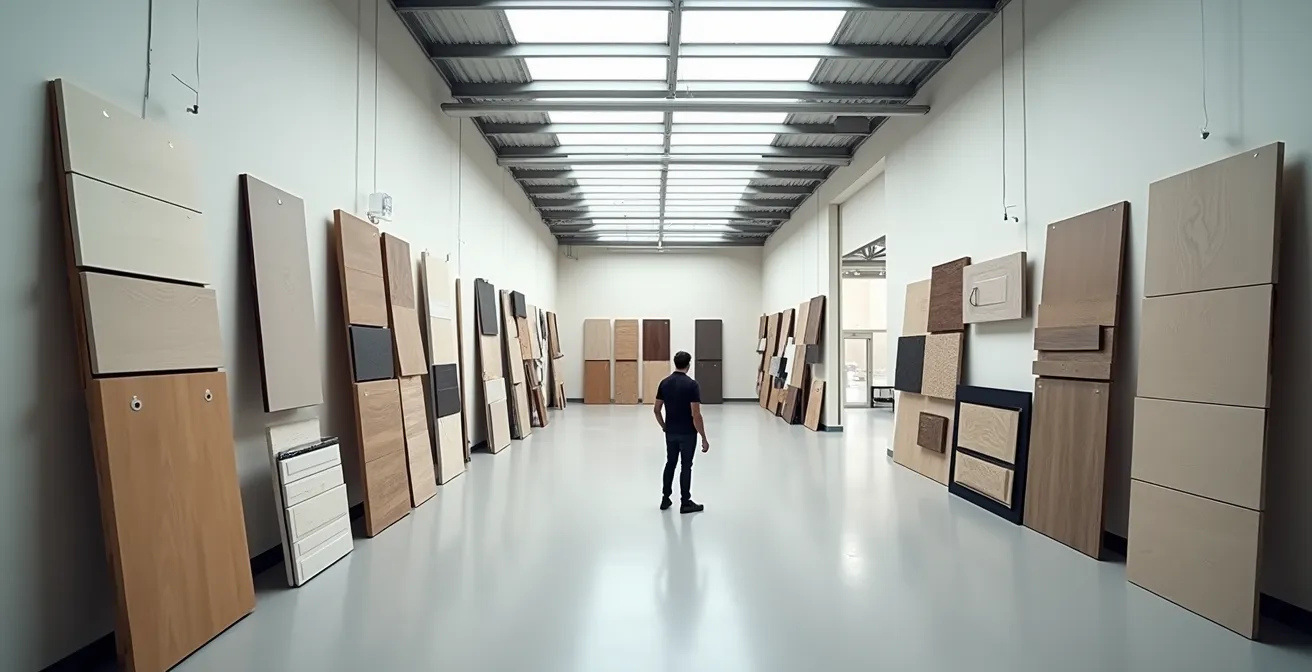
This decision is a classic trade-off. As a rule of thumb, source decorative or unique “finish” items yourself if you accept the warranty risk, but let the professional handle the technical components. The following matrix, based on principles outlined by legal resources like Éducaloi, clarifies this critical decision.
| Who Supplies | Defect Responsibility | Labor Cost for Re-installation | Best For |
|---|---|---|---|
| Homeowner | Homeowner handles warranty claim | Homeowner pays twice | High-end fixtures, unique design pieces |
| Contractor | Contractor manages warranty | Contractor covers labor | Standard materials, technical items |
| Split Approach | Varies by item | Negotiated case-by-case | Mixed renovation projects |
The Legal Hypothec: How to Protect Yourself Against Unpaid Subcontractors?
The most dangerous and least understood risk for a homeowner-GC in Quebec is the legal hypothec of construction. This powerful legal tool allows a subcontractor (e.g., the plumber) or a material supplier who has not been paid by your general contractor to place a lien directly on your property. This means you could be forced to pay a second time for the same work—once to your GC, and again to the unpaid subcontractor to clear the title to your home. Believing this “won’t happen to you” is a critical error; protecting yourself is a procedural matter, not a matter of trust.
Your primary defense is the contractual “retenue,” or holdback. A standard clause in any well-drafted Quebec renovation contract stipulates that you will withhold 10% to 15% of the total contract value until a set period after the project is substantially complete. Under Quebec law, subcontractors have 30 days after the work is finished to register a legal hypothec. Therefore, your holdback period must be a minimum of 35 days.
Releasing the final payment should be a formal, documented process. Do not simply hand over a cheque when the last paintbrush is put away. The 35-day clock starts on the date the work is declared substantially complete—a date that should be agreed upon and signed in writing. Before releasing the holdback, you must request “quittances” (waivers or receipts of payment) from all major subcontractors and material suppliers. This documentation proves your GC has paid them, effectively waiving their right to place a hypothec on your property.
Action Plan: Implementing a 35-Day Holdback Strategy
- Include a contractual ‘retenue’ clause: Specify a 10-15% holdback of the total contract value in your written agreement before any work begins.
- Mark project completion date: Formally document in writing the date the work is substantially complete to start the 35-day countdown.
- Hold the retention: Securely hold the retained funds for a full 35 days after the declared completion date to outlast the legal hypothec claim period.
- Request ‘quittances’ (waivers): Demand proof of payment from all major subcontractors and suppliers before releasing the final payment to your general contractor.
- Document ‘dénonciation de contrat’ notices: Keep a file of any notices you receive from subcontractors informing you they are working on your project. This is your list of potential claimants.
How Building a Garage Can Offer the Highest ROI for Detached Homes?
For a first-time homeowner-GC in Quebec, jumping into a full-scale kitchen or basement renovation can be overwhelming. A detached garage, however, presents a perfect pilot project. It allows you to learn the ropes of project management—from permitting to contractor coordination—on a smaller, lower-risk scale. The work is primarily exterior, simplifying the management of trades like excavation, framing, and roofing without disrupting your daily life inside the house.
From a return on investment (ROI) perspective, a garage is highly valuable in the Quebec market. The harsh winters make a heated, well-insulated garage a significant selling feature. It’s not just a place to park a car; it’s a workshop, a storage area, and a protective buffer for your vehicles against snow and ice. When planning, focus on features that maximize this value: ensure the slab includes proper drainage to manage snowmelt, and invest in high-quality insulation and an insulated garage door to prevent heat loss, which is a major concern for attached garages.
Successfully completing a garage build equips you with invaluable hands-on experience. You will have navigated the municipal permit process, vetted and hired multiple trades, managed a budget with a contingency, and overseen a project from foundation to finish. This “trial run” provides the confidence and the proven contractor relationships needed to tackle more complex and expensive interior renovations. It transforms the abstract principles of project management into tangible, learned skills, significantly de-risking your future, larger-scale projects.
Kitchen Remodel: How to Spend $20k to Add $40k to Your Home Value?
A kitchen remodel consistently offers one of the highest ROIs in home renovation. The key to maximizing this return is strategic spending, not lavishness. The goal is to create a modern, functional, and broadly appealing space. The 20% you save by acting as your own GC can be reinvested into higher-quality materials that directly impact perceived value. According to industry analysis that reveals typical GC fees in Quebec, this saving can amount to $4,000 on a $20,000 budget—enough to upgrade from laminate to quartz countertops.
To stretch a $20,000 budget, you must be surgical in your allocations. The largest portion, typically 30-40% of the budget, should go to cabinets. Here, the choice between stock options like IKEA ($4,000-$6,000) and custom cabinets from a local Quebec cabinetmaker ($8,000-$10,000) is critical. While custom offers a higher-end look, a well-designed IKEA kitchen with upgraded fronts and hardware can provide 90% of the aesthetic for 50% of the cost. This frees up funds for the element that buyers notice most: countertops.
Allocate 15-20% to quartz countertops ($3,000-$5,000). They are a must-have for a modern kitchen and offer a far better return than granite or marble. The skilled labor for electrical and plumbing will be a fixed cost, representing about 25-30% ($5,000-$6,000), regardless of your material choices. Finally, allocate the remaining budget smartly: 15-20% for a matching mid-range appliance package and 10-15% for impactful finishing touches like an undermount sink, a quality faucet, and modern hardware. It’s the cohesive, thoughtful combination of these elements, not one single expensive item, that creates a kitchen that adds double its cost in home value.
Key Takeaways
- Master the System, Not Just the Tasks: Success as a homeowner-GC in Quebec is defined by your ability to navigate the RBQ, the legal hypothec, and the CCQ schedule, not just by coordinating trades.
- Your Budget’s Best Friend is a Risk-Weighted Contingency: A flat 10% contingency is inadequate for older Quebec homes. A 20-30% fund, weighted for risks like pyrite and asbestos, is a realistic necessity.
- The 35-Day Holdback is Your Ultimate Legal Shield: Never release the final 10-15% payment until 35 days after project completion and after receiving payment waivers (quittances) from all major sub-trades.
Revitalizing the “Shoebox” Home: How to Modernize Without Destroying Character?
Renovating a classic Quebec “shoebox” or wartime bungalow presents a unique challenge: how to modernize for today’s living while respecting the home’s inherent character. Unlike new builds, these projects are as much about careful preservation as they are about transformation. Your biggest hurdle may not be structural, but bureaucratic. Montreal’s borough planning committees (Comités consultatifs d’urbanisme or CCU) heavily scrutinize exterior modifications on these homes to maintain neighbourhood aesthetics. Success requires proactive engagement, not reactive fixes. Prepare a file with architectural drawings that show respect for the original massing, provide material samples that match neighbourhood character, and be ready to justify every choice.
Before any demolition, your first step as a project manager is to establish a clear decision framework. Is the issue structural or cosmetic? Start by assessing the floors. If the original hardwood has a slope of more than one inch over eight feet, you may be looking at a necessary structural repair to the subfloor, not just a cosmetic refinishing job. Before dreaming of an open-concept space, hire a structural engineer to assess which walls are load-bearing. This small upfront cost can prevent a catastrophic and expensive mistake.
Document everything. Photograph original moldings, hardware, and built-ins before they are touched. These are the elements that carry the home’s character, and they can often be preserved and integrated into a modern design. Most importantly, budget for professional testing of hazardous materials. Homes from this era are highly likely to contain asbestos in drywall compound or insulation and lead in paint. Disturbing these materials without proper abatement protocols is illegal and poses a serious health risk. A phased approach is wisest: prioritize structural and safety issues first, then move on to the cosmetic preservation that gives these homes their timeless appeal.