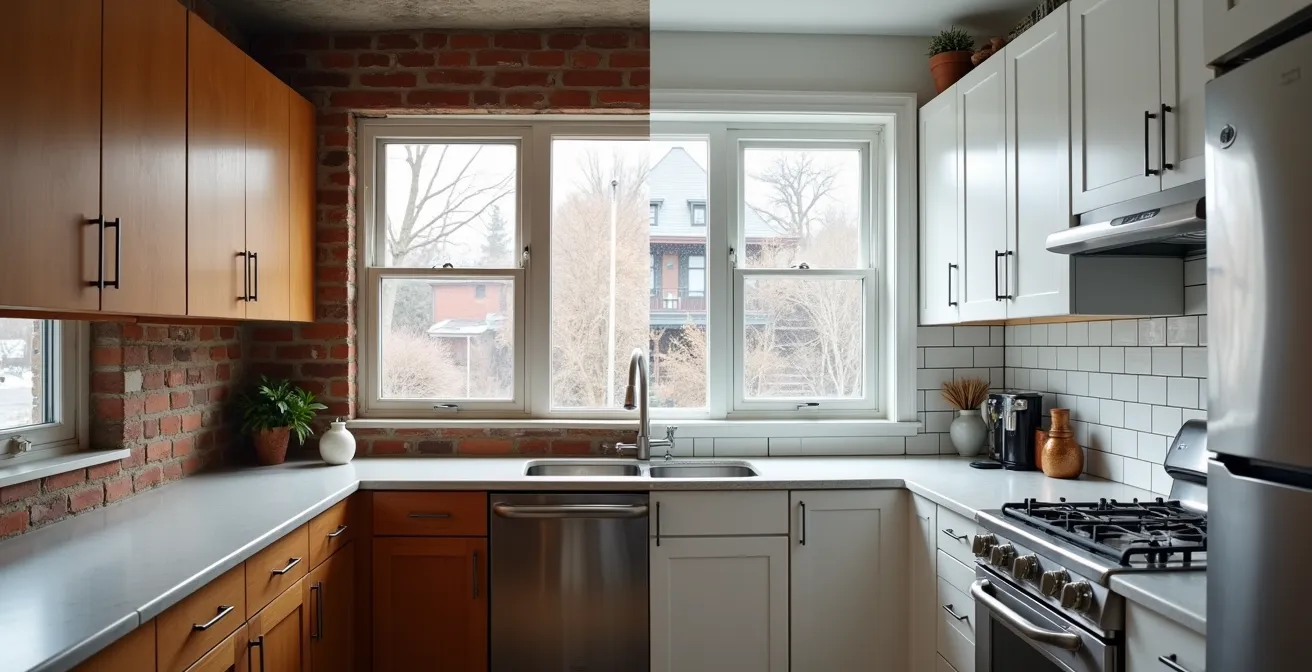
Maximizing your home’s resale value in Quebec isn’t about expensive overhauls; it’s about making strategic, data-driven decisions that yield the highest return on investment.
- Focus on high-impact, cost-effective updates in kitchens and curb appeal over luxury additions like pools that deter buyers.
- Leverage Quebec-specific factors like the EnerGuide rating, seasonal market trends, and tax laws to your financial advantage.
Recommendation: Prioritize renovations with a proven ROI of over 75% and always budget a 20-30% contingency fund, especially for older Quebec homes.
If you’re a Quebec homeowner planning to sell in the next few years, you’re likely asking one question: “Where should I put my money to get the most back?” The internet is flooded with generic advice about shiny new bathrooms and extravagant backyard projects. But in the unique Quebec real estate landscape, that advice can be a fast track to losing thousands. This isn’t just about making your home prettier; it’s about financial leverage. It’s about thinking like a home flipper, where every dollar spent is a calculated investment designed for a specific return.
The truth is, maximizing resale value here is a game of surgical precision, not sledgehammers. It requires understanding local buyer psychology, navigating provincial regulations, and timing the market with the precision of a seasoned strategist. Forget the idea of a “dream reno.” We’re talking about surgical ROI—the targeted upgrades that add measurable value to your bottom line when you sell. This is about turning your renovation budget into a profit-generating tool.
This guide cuts through the noise. We’ll break down which renovations deliver a proven return in the Quebec market and which are financial traps. We will analyze the data on everything from kitchen remodels to landscaping, explore the strategic importance of timing your listing, and dive into the Quebec-specific tax implications that can make or break your profit margin. Get ready to stop guessing and start calculating.
Summary: A Strategic Guide to Quebec Renovation ROI
- Kitchen Remodel: How to Spend $20k to Add $40k to Your Home Value?
- Why Installing a Pool Might Actually Scare Away Potential Buyers?
- First Impressions: How $1,000 in Landscaping Can Sell Your House Faster?
- Does a High EnerGuide Rating Really Help You Sell for More?
- Spring vs. Autumn: When Is the Absolute Best Week to List Your Home?
- The 20% Rule: Why You Always Need a Contingency Fund for Old House Renos
- How to Furnish a 500 sq. ft. Condo to Maximize Resale Appeal
- Quebec Real Estate Taxation: How to Survive the Relevé 31 Season?
Kitchen Remodel: How to Spend $20k to Add $40k to Your Home Value?
The kitchen is the heart of the home, but for a seller, it’s the engine of your ROI. Forget the six-figure celebrity chef fantasies. The key to a profitable kitchen remodel is a surgical strike, not a gut renovation. The goal is to hit that sweet spot where perceived value skyrockets without your budget doing the same. In Montreal, a strategic, economic renovation can be done for $15,000 to $25,000, focusing on high-impact aesthetic and functional upgrades. This isn’t about custom everything; it’s about smart everything.
The data backs this up. According to the Appraisal Institute of Canada, sellers can expect a significant return, with some studies suggesting that kitchen renovations can yield 75% to 100% of their cost back at resale. But how do you ensure you’re in the 100% club? By focusing on what buyers see and touch. Opt for durable and stylish quartz countertops over porous granite. Choose quality semi-custom cabinets, which can save you 30% over fully custom options. If your appliances are in good working order and have a clean, uniform look, keep them. Replacing them can cost you $2,000 to $10,000 you may never see again.
The most important rule is to optimize the layout without moving the plumbing or electrical. Relocating a sink or dishwasher is a classic budget-killer. Instead, focus on improving workflow with better lighting, adding a functional island if space permits, and refreshing the backsplash and cabinet hardware. These are the details that create a “wow” factor and convince a buyer the space is modern, functional, and move-in ready—the three most profitable words in real estate.
Why Installing a Pool Might Actually Scare Away Potential Buyers?
In the world of renovation ROI, few projects are as polarizing as an in-ground swimming pool. While it may fulfill a homeowner’s dream of summer relaxation, it often becomes a seller’s nightmare in the Quebec market. A pool is the opposite of a surgical investment; it’s a massive capital expense with a notoriously low return. For many potential buyers, a pool doesn’t represent luxury—it represents a black hole of cost, maintenance, and liability.
Consider the buyer psychology. A family with young children sees a safety hazard. A busy professional couple sees a weekend-consuming chore list. An older couple sees a steep annual expense for only a few months of use. In a climate like Quebec’s, the short swimming season makes the high cost of heating, chemicals, and winterization—often $3,000 to $5,000 annually—a hard pill to swallow. This significantly narrows your pool of potential buyers to only those specifically seeking a home with this feature.
When you look at the numbers, the case against a pool becomes even clearer. Other renovations offer far superior financial leverage. For instance, creating a functional and inviting living space in the basement is a much wiser bet. In Quebec, a basement finishing typically delivers an ROI of 50% to 75%, creating year-round usable square footage that appeals to nearly every buyer demographic.
This table puts the financial reality in stark relief, showing how a pool stacks up against more strategic, four-season investments.
| Renovation Type | Average Cost | Typical ROI | Annual Maintenance |
|---|---|---|---|
| In-ground Pool | $60,000+ | 25-50% | $3,000-$5,000 |
| Four-Season Veranda | $40,000 | 60-80% | $500 |
| Finished Basement | $38-$73/sq ft | 75% | $200 |
First Impressions: How $1,000 in Landscaping Can Sell Your House Faster?
In real estate, the first impression is the only impression that matters. This is your “curb appeal,” and it’s the highest ROI investment you can make. Before a buyer even steps inside, they’ve already formed an opinion based on your home’s exterior. The good news? You don’t need to spend a fortune to make a massive impact. A strategic investment of just $1,000 in landscaping can dramatically boost perceived value and help your house sell faster.
This isn’t just a feeling; it’s a fact. Research from Virginia Tech has shown that well-landscaped homes have a significant price advantage over homes with no landscaping. The study found that sophisticated landscaping can result in a price advantage of 5.5% to 12.7%. On a $500,000 home, that’s a potential gain of over $27,000 from a minimal outlay. The key is to focus on clean, low-maintenance, and four-season appeal, which is crucial in the Quebec market.
Your goal is to create a look that is fresh, tidy, and inviting. A simple, focused plan can achieve this on a tight budget. Start by power-washing the driveway, walkways, and siding. Add a thick, fresh layer of mulch to all garden beds—it instantly makes a garden look manicured. Paint the front door a welcoming colour. Finally, replace any dead or scraggly plants with hardy, native Quebec perennials that will look good year-round and signal “low maintenance” to buyers. These small, targeted actions add up to a powerful message: this home is well-cared-for.

As the image shows, even in winter, the right choices in landscaping—like evergreens, ornamental grasses, and strategic lighting—can create a warm and inviting entrance. Here are five high-impact improvements you can make for under $1,000:
- Power-wash surfaces: Instantly refresh your driveway, porch, and walkways ($200-300).
- Mulch everything: Apply fresh mulch to all garden beds for a clean, unified look ($300-400).
- Light it up: Install simple solar-powered pathway and landscape lights ($200-300).
- Plant smart: Choose native Quebec perennials that survive the winter ($100-200).
- Paint the door: A fresh coat of weather-resistant paint provides a powerful pop of colour ($50-100).
Does a High EnerGuide Rating Really Help You Sell for More?
In a province where heating bills can be daunting, energy efficiency is no longer a “nice-to-have”—it’s a powerful selling feature. A high EnerGuide rating is a government-backed seal of approval that tells buyers your home is cheaper to run, more comfortable, and better for the environment. While it might not have the visual “wow” factor of a new kitchen, it offers something more tangible: long-term cost savings. This is a form of financial leverage that savvy buyers are increasingly looking for.
The Appraisal Institute of Canada has consistently pointed out that energy-efficient renovations deliver one of the highest paybacks at resale. Why? Because you’re not just selling square footage; you’re selling performance. A home with a high EnerGuide score can be marketed as having a quantifiable financial advantage over a similar, less efficient property. This allows you to justify a higher asking price based on proven, third-party data, moving the conversation from subjective aesthetics to objective financial benefits.
In Quebec, homeowners have a clear pathway to achieving this through programs like Rénoclimat, which is co-delivered with the Canada Greener Homes Initiative. This program provides financial assistance for eligible retrofits such as upgrading home insulation, installing high-performance windows and doors, or adding an efficient heat pump. By participating, you not only receive grants to offset the cost of upgrades but also get official pre- and post-renovation evaluations that certify your home’s improved EnerGuide rating. This official documentation becomes a potent tool in your marketing arsenal, providing concrete proof of the home’s superior energy performance and lower running costs, directly appealing to the practical sensibilities of Quebec buyers.
Spring vs. Autumn: When Is the Absolute Best Week to List Your Home?
In real estate, *what* you sell is only half the battle; *when* you sell it can be just as critical to your final price. The Quebec market is highly seasonal, driven by weather, school schedules, and the unique cultural phenomenon of the July 1st “moving day.” Listing your home at the right moment can mean more buyers, higher offers, and a faster sale. Thinking like a strategist means you don’t just put a sign on the lawn when the renovations are done; you launch your property into the market at the moment of peak demand.
The spring market is traditionally the busiest. The period from mid-April to mid-May is the absolute sweet spot. The snow has melted, gardens are starting to bloom, and buyers are energized. More importantly, this timing is perfectly aligned to capture the wave of renters whose leases are up on July 1st and are desperate to transition to homeownership. This creates a large, motivated pool of buyers and fosters a competitive environment that can drive up prices.

However, don’t discount the autumn. The period from September to October offers a different strategic advantage. While there may be fewer buyers overall, the ones who are looking are typically more serious. The casual “tire-kickers” of spring are gone, replaced by buyers with clear deadlines, such as corporate relocations or empty nesters looking to downsize before winter sets in. With lower inventory on the market, your well-presented home can stand out and command a premium price from these highly motivated purchasers.
The worst times to list? Mid-summer, when families are on vacation, and the dead of winter (December to early January), when holidays and weather keep most people indoors. This table breaks down the strategic advantages of each key selling season in Quebec.
| Season | Best Listing Period | Key Advantages | Target Buyers |
|---|---|---|---|
| Spring | April 15 – May 15 | Pre-July 1st moving day rush | Renters transitioning to ownership |
| Autumn | September – October | Lower inventory, serious buyers | Corporate relocations, empty nesters |
| Winter | Late January – February | Less competition | Motivated buyers only |
The 20% Rule: Why You Always Need a Contingency Fund for Old House Renos
Here’s the most important rule for renovating an older Quebec property: your budget is a lie. Not because you planned poorly, but because old houses are treasure troves of expensive surprises. From the charming century homes of the Eastern Townships to the iconic Montreal triplexes, these properties hide secrets behind their walls. This is where amateur investors fail and professional flippers succeed: the contingency fund. It’s not “if” you’ll need it; it’s “when” and for how much.
The standard advice is to set aside 10-15% for unexpected costs. For older Quebec housing stock, that’s dangerously optimistic. A much safer, more professional benchmark is the 20% rule: for any property built after 1980, budget a 20% contingency. For anything older, especially pre-1940s structures, you need to push that to 25-30%. This isn’t “scared money”; it’s your business plan’s insurance policy against the ghosts of construction past: knob-and-tube wiring that needs a full replacement, hidden asbestos that requires professional abatement, or a crumbling foundation that needs repointing.
Furthermore, your contingency planning must account for bureaucratic delays. Navigating municipal permits in cities like Montreal can add months to your timeline, creating carrying costs you didn’t anticipate. Another critical factor is ensuring your team is legitimate. In Quebec, all renovation contractors are legally required to hold a valid Régie du bâtiment du Québec (RBQ) license. Hiring an unlicensed contractor to save a few dollars is a catastrophic risk that can void your insurance and leave you with no recourse for shoddy work. Your contingency fund is what allows you to handle these issues professionally without derailing the entire project.
Your Quebec Old House Contingency Checklist
- Assess Property Age: Budget 20% contingency for homes built after 1980; increase to 25-30% for pre-1940s properties like Montreal triplexes.
- Factor in Bureaucracy: Add 2-3 months of carrying costs to your financial plan specifically for navigating municipal permit processes.
- Inspect for “The Big Three”: Proactively check for knob-and-tube wiring, potential asbestos (in pre-1980 homes), and foundation issues, and get quotes for remediation.
- Verify Contractor Credentials: Confirm every contractor has a valid RBQ license *before* signing any contracts.
- Stress-Test Your Budget: Can your finances withstand the discovery of a major issue? If a 25% cost overrun would bankrupt the project, your initial budget is too high.
How to Furnish a 500 sq. ft. Condo to Maximize Resale Appeal
In the dense urban markets of Montreal and Quebec City, the 500 sq. ft. condo is a common product. For an investor or seller, the challenge is to transform this small footprint from a “box” into a “home” in the eyes of a buyer. The key is not just furnishing; it’s strategic staging that showcases possibility and maximizes perceived space. Buyers of small condos are purchasing a lifestyle, and your job is to sell them the most efficient, stylish, and functional version of that lifestyle.
The ROI on staging a small space can be remarkable. A well-executed transformation can turn an awkward, empty unit into a highly desirable property. For example, investing $15,000 to convert a portion of a small condo into a functional home office or add clever built-in storage can increase the resale value by $22,500 to $26,250. This isn’t about filling the space with furniture; it’s about solving the buyer’s inherent problems: “Where will my stuff go?” and “Can I do more than just sleep here?”
Your strategy should focus on three principles: dual functionality, creating zones, and enhancing light. A Murphy bed with an integrated desk is a classic and powerful tool, instantly transforming a bedroom into a home office. Built-in storage, especially near the entrance for bikes and winter gear, is a massive selling point in Quebec. Use area rugs and distinct lighting fixtures to create defined “zones” for living, dining, and working, which makes the space feel larger and more organized. Finally, use large mirrors to visually double the space and stick to a light, neutral color palette to make the entire condo feel brighter and more open. These touches show buyers how to live large in a small space, allowing them to see potential instead of limitations.
Key Takeaways
- Prioritize renovations with proven ROI, like kitchens and curb appeal, over high-cost, low-return projects like pools.
- Always maintain a contingency fund of 20-30% for older Quebec properties to handle unforeseen issues without derailing your budget.
- Leverage Quebec-specific market dynamics, including seasonal selling peaks and the value of a high EnerGuide rating, to maximize your sale price.
Quebec Real Estate Taxation: How to Survive the Relevé 31 Season?
You’ve done everything right. You bought a property, made smart renovations, and sold it for a significant profit. Now comes the final boss: the taxman. In Quebec, understanding the nuances of real estate taxation is the difference between keeping your hard-earned gains and giving a huge chunk of them back to the government. This is the ultimate form of regulatory arbitrage, and it’s where a true strategist makes their money.
The most critical distinction to master is repairs versus capital improvements. A repair (like fixing a leaky faucet or repainting a room the same colour) merely maintains the property’s condition and is not deductible from your capital gain. A capital improvement (like a new kitchen or finishing the basement) adds lasting value to the property. The costs of these improvements can be added to your property’s “adjusted cost base,” which in turn reduces your taxable capital gain when you sell. Meticulous record-keeping of every single receipt for capital improvements is non-negotiable.
When you sell a property that is not your principal residence, you face capital gains tax. In Quebec, sellers must include 50% of the capital gains in their taxable income for the year. This can be a substantial amount, which is why maximizing your adjusted cost base is so crucial. Furthermore, be wary of the principal residence exemption if you sell too quickly. If Revenu Québec deems your project a “flip”—typically selling within 12 months of purchase and substantial renovation—they can disallow the exemption, treating your profit as fully taxable business income. This is a costly mistake that many amateur investors make.
Stop guessing and start calculating. Use this strategic framework to audit your own property, identify high-ROI opportunities, and turn your home into a high-performing asset before you list. The next logical step is to build a precise, data-driven renovation plan that aligns with your financial goals.
Frequently Asked Questions on Quebec Real Estate Renovations and Taxes
What’s the difference between repairs and capital improvements for tax purposes?
Repairs maintain the existing condition of a property and their cost is not tax-deductible from capital gains. Capital improvements, on the other hand, increase the property’s value or extend its useful life; these costs can be added to the property’s adjusted cost base, which effectively reduces the taxable capital gain upon sale.
How quickly can I sell after renovating without losing the principal residence exemption?
There is no hard-and-fast rule, but Revenu Québec may disallow the principal residence exemption if a property is sold very quickly after substantial renovations, typically within a 12-month period. This can be interpreted as a “property flip” for business profit rather than the sale of a personal residence, making the entire gain taxable as income.
When do GST/QST apply to substantial renovations?
GST (Goods and Services Tax) and QST (Quebec Sales Tax) can apply to the sale of a home that has undergone “substantial renovations.” According to the Canada Revenue Agency and Revenu Québec, a renovation is generally considered substantial when 90% or more of the building’s interior (excluding the foundation, external walls, roof, and floors) is removed or replaced. In such cases, the sale may be treated as a taxable sale of a new home.