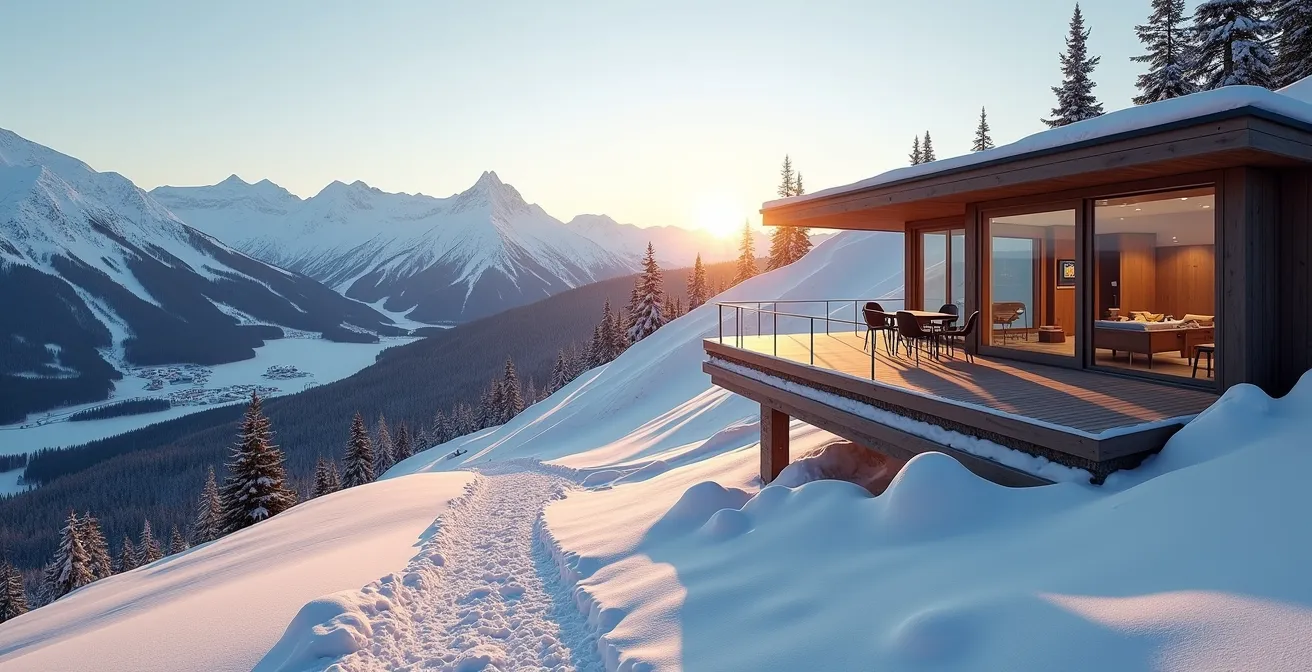
The premium for a ski-in/ski-out property is only justified if you operate it as a year-round business, not just a winter luxury.
- Winter rental income alone rarely covers annual costs; a robust four-season strategy targeting summer and shoulder-season guests is essential for profitability.
- Market choice is critical: international destinations like Tremblant or Whistler offer higher appreciation potential, while regional hubs like Saint-Sauveur provide stability.
Recommendation: Focus your due diligence on a property’s off-season revenue potential and local rental regulations before ever considering the quality of the snow.
For the affluent investor targeting Canada’s premier ski destinations, the allure of a ski-in/ski-out property is undeniable. The convenience of clicking into your bindings at your doorstep commands a significant price premium. But beyond the lifestyle fantasy lies a critical investment question: is that premium truly justified by the returns? Many analyses stop at the obvious—high winter demand. They champion the “location, location,location” mantra without dissecting the financial reality of a high-cost asset that is in peak demand for only four months of the year.
This approach is flawed. Viewing a slopeside chalet or condo purely as a piece of real estate misses the point entirely. The secret to a successful investment in this segment isn’t found in property appreciation alone. It lies in a paradigm shift: you are not buying a home, you are acquiring a seasonal leisure business. Its success hinges on transforming a potential 8-month liability into a 12-month, cash-flowing asset.
This guide moves beyond the basics of rental income. We will analyze the operational leverage required to make a ski property profitable, dissect the strategic differences between key Canadian markets, and reveal the tactical decisions that separate a high-performing four-season asset from a “summer cottage in disguise” that bleeds cash nine months a year. We’ll explore how to turn off-season vacancies into revenue streams and why the smartest move might be to buy when everyone else has hung up their skis.
This article provides a comprehensive framework for evaluating a ski-in/ski-out investment, treating it with the financial rigor it deserves. Explore the key financial and strategic considerations that will determine your property’s long-term value and profitability.
Table of Contents: A Strategic Investor’s Guide to Slopeside Real Estate
- Can You Cover Your Annual Costs with Just 4 Months of Ski Rentals?
- Tremblant vs. Saint-Sauveur: Which Ski Town Offers Better Long-Term Value?
- How to Attract Tenants to a Ski Chalet When the Snow Melts?
- The Owner’s Locker: How to Manage Gear Storage When Renting Your Chalet?
- Why Buying a Ski Chalet in April Can Save You 10% on the Price?
- The “Park Effect”: How National Parks Guarantee Occupancy for Airbnbs?
- Ski, Bike, Hike: Location Strategy for Adventure-Focused Accommodations
- Four-Season Chalets: How to Avoid Buying a Summer Cottage in Disguise
Can You Cover Your Annual Costs with Just 4 Months of Ski Rentals?
The core question for any investor is whether the high-season revenue can carry the property through the entire year. Relying solely on the four-month ski season to cover 12 months of mortgage, taxes, and fees is a high-risk strategy. The math often doesn’t add up. Successful ownership requires a realistic view of your property’s operating leverage, where the high fixed costs necessitate a year-round revenue strategy to achieve profitability. The winter income should be seen as the foundation, not the entire structure.
In premier markets, the numbers can be compelling, but they tell a story of year-round performance. For example, market data from top-tier destinations shows strong potential beyond winter. Analysis of the Whistler market reveals that a typical Airbnb can achieve around CA$79,000 in annual revenue with a 64% occupancy rate. This figure is not generated in winter alone; it reflects a business that also captures the lucrative summer and shoulder season demand. An occupancy rate over 60% is a clear indicator of a four-season asset, not just a winter cabin.
A closer look at a real-world example reinforces this. A profit and loss breakdown for a 2-bedroom ski-in/ski-out condo in Whistler showed it generated $60,643 in net income after accounting for a standard 25% management fee. While its winter performance was strong, the analysis highlighted the critical need to manage year-round carrying costs. Without significant off-season revenue, the high mortgage and strata fees would quickly erode winter profits. The premium is therefore not for the snow, but for the potential to run a full-year hospitality business.
Tremblant vs. Saint-Sauveur: Which Ski Town Offers Better Long-Term Value?
For investors focused on the Quebec market, the choice between Mont-Tremblant and a regional hub like Saint-Sauveur is a crucial strategic decision. It’s a classic case of international appeal versus regional stability. Tremblant, as an Ikon Pass destination, attracts a global clientele, which drives higher property values and rental rates. However, this comes with a highly regulated environment, including mandatory rental pools in many of the newer developments (Phase 2 properties) and strict enforcement of CITQ permits, with fines up to $50,000.
Saint-Sauveur, by contrast, primarily serves the Montreal and regional market. Its property market is less volatile and more reliant on local economic health. The rental model is predominantly freehold, offering owners greater flexibility in management and usage. While its international draw is limited, its proximity to a major metropolitan area provides a consistent stream of weekend and holiday visitors. The decision hinges on your investment thesis: are you seeking high-growth potential and appreciation driven by global tourism, or stable, predictable returns from a domestic market?
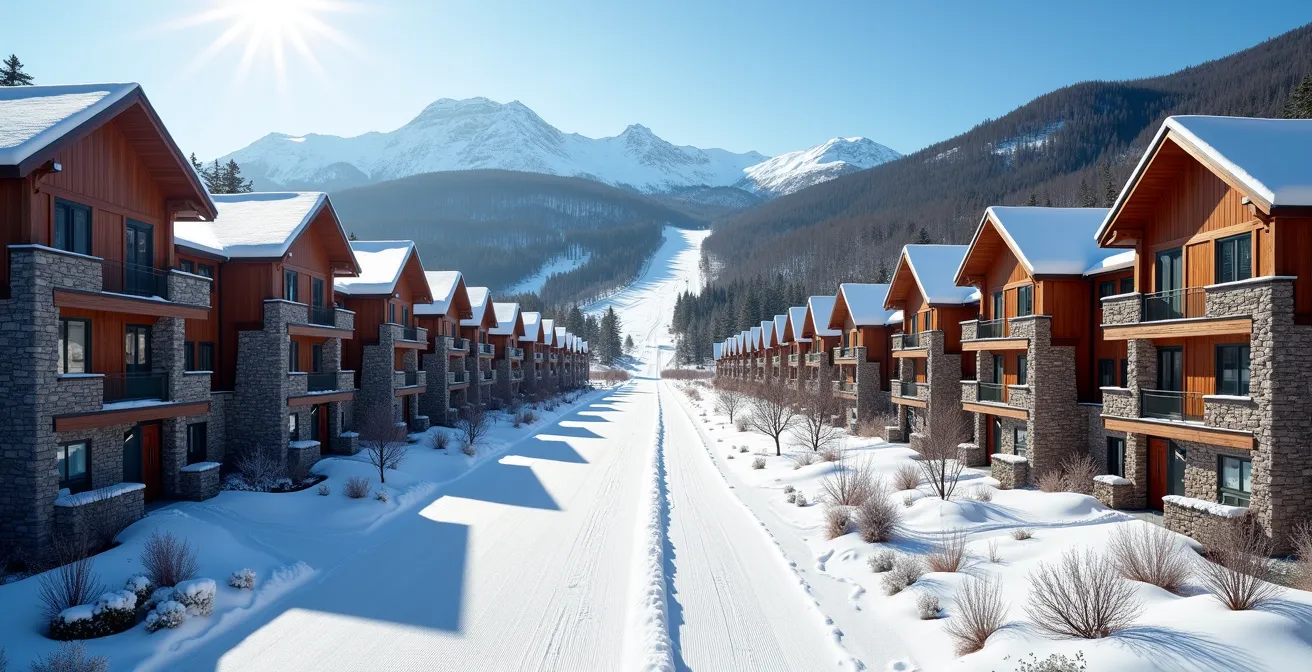
The aerial view of Tremblant highlights the structural differences in its real estate. The uniform, hotel-style condos often fall under restrictive rental covenants, while the more diverse freehold chalets offer greater autonomy. An investor must understand these zones, as they dictate not only the rental model but also the long-term value proposition. Furthermore, climate resilience is a growing factor. Tremblant’s higher elevation and significant investment in snowmaking provide a buffer against milder winters, a key consideration for long-term value.
This comparative table, based on an analysis of the Mont-Tremblant condo market, breaks down the key investment factors.
| Factor | Mont-Tremblant | Saint-Sauveur |
|---|---|---|
| Average Property Price | $950,000+ (new developments) | Data not available |
| Rental Model | Mandatory rental pool (Phase 2) or flexible (freehold) | Primarily freehold/flexible |
| International Appeal | High – Ikon Pass destination | Regional – Montreal market focus |
| CITQ Permit Required | Yes – strict enforcement up to $50,000 fines | Yes – provincial requirement |
| Climate Resilience | Higher elevation, significant snowmaking investment | Lower elevation, local market dependent |
How to Attract Tenants to a Ski Chalet When the Snow Melts?
The defining characteristic of a profitable ski property is its ability to generate income when there is no snow. Treating the off-season as a write-off is a recipe for financial failure. A savvy investor applies a proactive Yield Management strategy, transforming the property into a desirable destination for hiking, mountain biking, festivals, and even remote work. The goal is to create a compelling offer for every month of the year, not just December through March.
Whistler serves as a masterclass in this strategy. According to hospitality experts Lifty Life, “Whistler’s high season is actually during the summer months, with occupancy reaching 90%+.” This isn’t an accident; it’s the result of a concerted effort to build world-class summer attractions like the Crankworx mountain bike festival and extensive trail networks. Your property must be marketed to tap into these pre-existing demand drivers. This includes targeting summer mountain biking enthusiasts, creating “Fall Colors & Remote Work” packages for professionals from Toronto and Montreal, and partnering with organizers of major events like the Tremblant International Blues Festival.
The strategy extends beyond major festivals. Developing unique experience packages is key. This could involve partnerships with local businesses for fly-fishing guides, wine tours in the Eastern Townships, or access to regional food trails. Even shoulder seasons hold potential. Marketing your property to international visitors for Northern Lights viewing can fill rooms when domestic demand is low. The property itself must support this strategy with amenities like high-speed internet, secure bike storage, and a comfortable workspace. You are no longer just selling a bed; you are selling a year-round adventure basecamp.
The Owner’s Locker: How to Manage Gear Storage When Renting Your Chalet?
A frequently overlooked aspect of renting a ski chalet is the logistical challenge of personal belongings. This is “The Owner’s Burden”: how do you maintain a personal connection to your property while operating it as a hotel-like rental? Leaving personal ski gear, clothing, and valuables in open closets is not an option. A dedicated, secure owner’s locker is not a luxury; it’s an operational necessity for any serious investor.
This solution provides a secure space for your gear between visits, but it also elevates the guest experience by creating a clean, uncluttered, and impersonal environment, which is what premium renters expect. Furthermore, smart storage solutions address specific challenges of Canadian climates and building regulations. As noted in an analysis of ski properties, Canadian strata (condo) bylaws often have strict rules prohibiting the storage of items like propane tanks on balconies or in common areas. Your storage solution must be compliant.
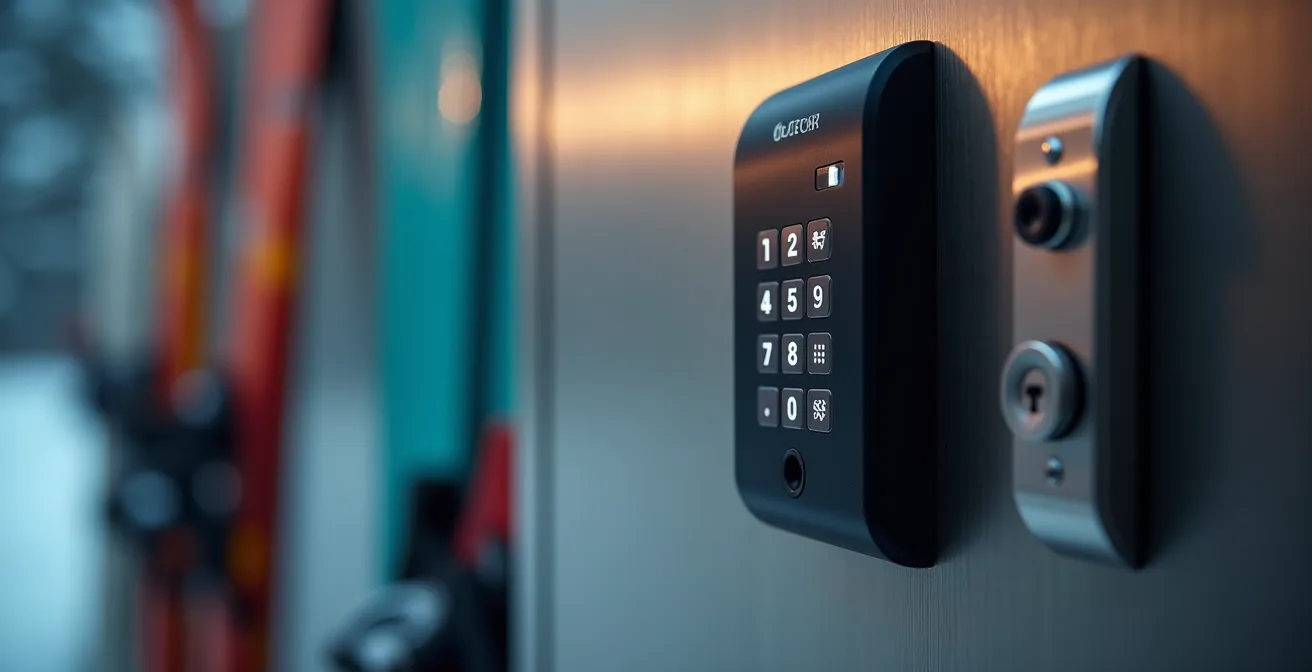
The best solutions involve installing keyless-entry, climate-controlled lockers inside the property. This prevents mold and mildew on expensive gear during the damp shoulder seasons of spring and fall. Some sophisticated owners even monetize these spaces. They offer to rent the lockers to repeat guests who prefer not to travel with their ski equipment, creating an additional, hassle-free revenue stream and fostering guest loyalty. This small operational detail demonstrates a professional approach that distinguishes a high-performing rental from an amateur one. It’s a tangible part of turning your property into a seamless, guest-focused business.
Why Buying a Ski Chalet in April Can Save You 10% on the Price?
In real estate, timing is everything, and this is especially true in a highly seasonal market like ski properties. The peak buying frenzy occurs between October and January, when aspiring owners are caught up in the romance of the upcoming ski season. This high demand inflates prices. The astute investor, however, operates with a counter-cyclical mindset. The best time to buy is often when the snow is melting and other buyers’ attention has drifted elsewhere: the spring shoulder season.
Data consistently supports this strategy. For instance, a Whistler luxury real estate market analysis reveals that Q2 (April-June) consistently shows price dips compared to the peak Q4 buying season. This dip is driven by several factors. Sellers who failed to close a deal during the winter may be more motivated. The “lifestyle” buyers have disappeared, reducing competition. This creates a window of opportunity for the investor focused on fundamentals, not emotion. A potential 10% saving on the purchase price can dramatically improve your ROI from day one.
Buying in the off-season provides more than just a financial advantage. As vacation rental company Evolve notes, “The off-season months of June through August are the best time to buy a ski property.” This timing eases the pressure of wintertime competition and, more importantly, “gives you the chance to see what every season will offer in the area.” Visiting a property in May or June allows you to assess its summer appeal. Are the hiking and biking trails easily accessible? What is the condition of the landscaping? Is there an issue with black flies? These are critical due-diligence questions for a four-season asset that are impossible to answer in January.
The “Park Effect”: How National Parks Guarantee Occupancy for Airbnbs?
One of the most powerful, yet often misunderstood, drivers of value in resort real estate is the “Regulatory Moat.” This is a concept borrowed from finance, describing a barrier to entry that protects a business from competition. In the context of Canadian ski towns, nothing creates a more powerful moat than proximity to a National Park with strict development and residency rules. The prime example is the relationship between Banff National Park and the town of Canmore, Alberta.
Case Study: Banff’s ‘Need to Reside’ Clause and the Rise of Canmore
Banff National Park has a strict ‘need to reside’ clause, which mandates that to own property, one must work or own a business within the park. This regulation effectively blocks outside investment in short-term rentals. This creates a permanent, artificial scarcity of visitor accommodation inside one of Canada’s most iconic destinations. The result? The nearby town of Canmore, located just outside the park gates, has become the de-facto investment hub. It captures the massive tourist overflow, leading to extremely high occupancy rates and property value appreciation. This “Park Effect” is a government-enforced guarantee of demand.
The numbers from Canmore quantify the power of this regulatory moat. With limited new supply and constant demand from park visitors, market data shows Canmore’s year-round appeal generates a 60% average occupancy rate with a strong Average Daily Rate (ADR) of $277. During the peak summer months, occupancy can push well over 90%. For an investor, this is the holy grail: a market where external regulations severely limit competition and funnel customers directly to your door.
When evaluating a property, look for similar dynamics. Is it near a provincial or national park with development restrictions? Are local short-term rental laws becoming more stringent, thus grandfathering in existing legal rentals and limiting future supply? Finding a property protected by a strong regulatory moat can be a more reliable indicator of long-term success than the amount of annual snowfall.
Ski, Bike, Hike: Location Strategy for Adventure-Focused Accommodations
A successful four-season strategy requires more than just being “near a mountain.” It demands a granular location strategy focused on the infrastructure of adventure. Today’s high-value guest is often a multi-sport enthusiast. They ski in the winter, but they expect world-class mountain biking in the summer and accessible hiking trails in the fall. Your property’s value is directly tied to its proximity and access to this year-round adventure ecosystem.
This means your due diligence must go beyond the ski trail map. Verify direct access to major mountain biking networks, such as the legendary trails in Cumberland on Vancouver Island or the expanding network in Bromont, Quebec. A property with “bike-in/bike-out” potential in the summer can be as valuable as its ski-in/ski-out access in the winter. Another critical factor is the resort’s mega-pass affiliation. Is it an Epic Pass resort like Whistler, or an Ikon Pass destination like Tremblant and Revelstoke? This dictates your target demographic and marketing strategy, as pass holders plan their vacations around these networks.
Furthermore, the property itself must have the right infrastructure. A bike wash station and secure, ground-level gear storage are non-negotiable for the mountain bike crowd. High-speed internet is essential for guests planning their routes or for the growing “work from the cabin” clientele. Finally, while condos are popular, data shows a clear seasonal preference. A Vacasa report reveals that while 55% of winter bookings were for condos, this represented a 15% increase from summer bookings, suggesting a different preference in the warmer months. This highlights the need to match your property type to your target season and activity.
Your Action Plan: Infrastructure Checklist for an Adventure Property
- Verify direct access to major mountain biking networks (e.g., Cumberland, Bromont).
- Check the resort’s mega-pass affiliation (Epic Pass vs. Ikon Pass) to understand the target demographic.
- Ensure the property has or can accommodate a bike wash station and secure gear storage.
- Confirm high-speed internet availability for trail research and remote work.
- Evaluate proximity to other year-round attractions like national parks, golf courses, or major hiking trails.
Key Takeaways
- The premium for ski-in/ski-out is justified only through a year-round business model, not winter income alone.
- Off-season revenue from activities like mountain biking and festivals is critical to covering high fixed costs and achieving profitability.
- Market-specific factors, such as rental regulations (CITQ) and international pass affiliations (Ikon/Epic), are primary drivers of long-term value.
Four-Season Chalets: How to Avoid Buying a Summer Cottage in Disguise
The biggest mistake an investor can make is buying a property that excels in July but fails in January. Many rural Canadian properties are, at their core, summer cottages that have been cosmetically adapted for winter. These “summer cottages in disguise” often have fundamental infrastructure weaknesses that can lead to catastrophic failures and lost rental income during the most critical season.
A primary area of concern is water and septic systems. As the property experts at SnowOnly warn, this is a common pitfall for unsuspecting buyers. Their advice is a stark reminder of the realities of a Canadian winter:
Many Canadian rural properties are on wells and septic systems. A shallow dug well that’s fine in summer may run dry or freeze in harsh winter.
– SnowOnly Property Portal, Guide to Wise Investments in Ski Properties
A frozen well or a failed septic field in the middle of a guest’s Christmas vacation is not just an inconvenience; it’s a financial disaster that can destroy your rental reputation. Due diligence must include a thorough inspection of the well’s depth and recovery rate, the age and capacity of the septic system, and the quality of the insulation protecting pipes. Another critical element is road access. Is the private road leading to the chalet regularly and reliably plowed? Municipal plowing standards do not apply to private lanes, and being “snowed in” is not a charming experience for paying guests.
Finally, assess the building’s envelope. Look for signs of a true four-season build: high-quality, double or triple-pane windows; significant insulation in the attic and walls; and a robust heating system (ideally with a backup, like a wood stove or generator). A property that relies on electric baseboard heaters as its primary source will incur astronomical heating costs and may struggle to maintain a comfortable temperature in -30°C weather. Don’t be fooled by a rustic fireplace and a fresh coat of paint. A true four-season chalet is built from the foundation up to withstand the worst of a Canadian winter.
Ultimately, the premium for a ski-in/ski-out property is a calculated bet on your ability to operate it as a sophisticated, year-round business. The justification isn’t in the powder days, but in the profit and loss statement. To turn this luxury into a lucrative investment, you must move beyond the mindset of a homeowner and adopt the discipline of an entrepreneur. If you are prepared to master the art of the four-season asset, then the answer is yes—the premium is more than justified.