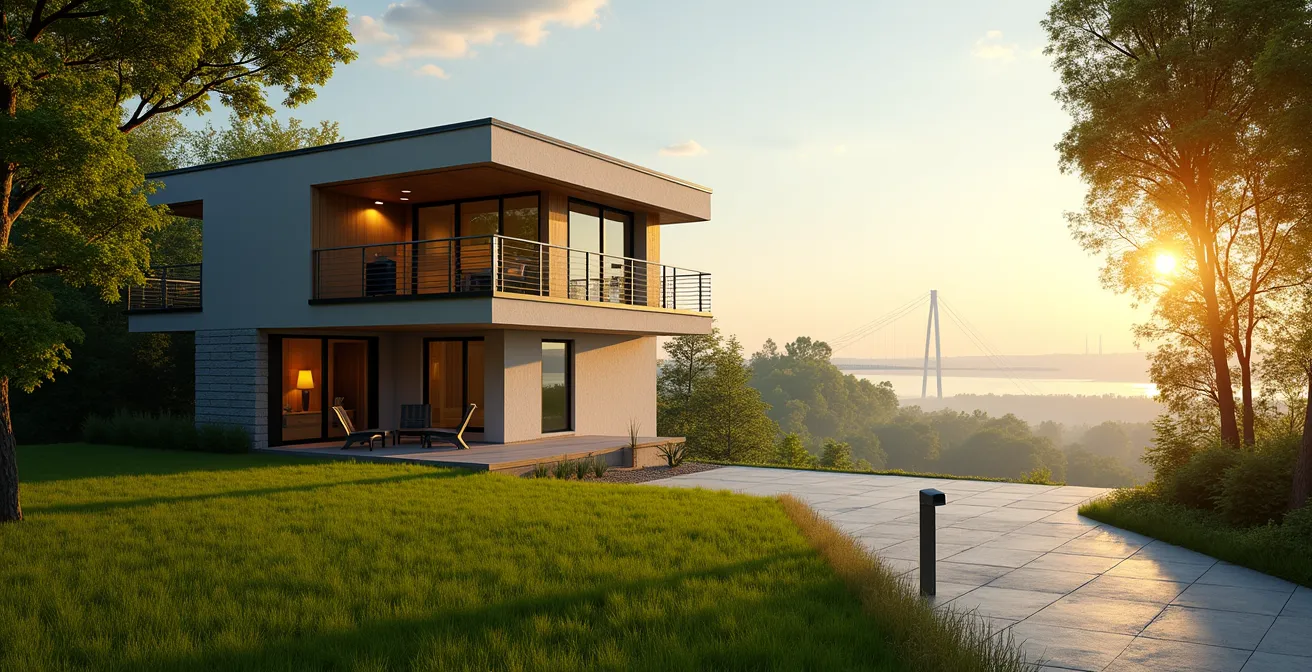
The decision to leave Montreal for the suburbs is less about emotion and more about a complex financial calculation of trade-offs.
- The true cost of commuting goes far beyond gas, including vehicle depreciation, “last mile” fees, and significant winter penalties.
- Property value is directly tied to quantifiable factors like school district performance and proximity to new transit like the REM.
Recommendation: Instead of just dreaming of a bigger backyard, build a spreadsheet. Quantify the hidden costs and investment potential of each potential suburb to see if the financial reality matches the lifestyle dream.
The Montreal condo is starting to feel tight. Every parent in the city knows the feeling: the need for a backyard, a quiet street for the kids to ride their bikes, and maybe, just maybe, an extra bedroom that isn’t also a home office. The call of the suburbs, particularly the South Shore towns like Brossard and Longueuil, seems like the obvious answer. You trade the bridge traffic for more square footage and a perceived upgrade in quality of life. It’s a classic Montreal story.
But the common wisdom—”you get more for your money”—is a dangerous oversimplification. Families often focus on the lower mortgage payment and overlook the complex web of new expenses and logistical challenges. The conversation rarely goes beyond the sticker price of the house or the generalized complaints about the Champlain Bridge. This superficial analysis can lead to costly surprises and the realization that the suburban dream comes with a detailed, and often expensive, instruction manual.
What if the key wasn’t just comparing house prices, but calculating the total, all-in cost of a suburban life? The real decision lies in a granular analysis of trade-offs. It’s about understanding that your daily commute has hidden financial costs, that a school’s reputation has a direct impact on your property’s appreciation, and that a “lifestyle” is an asset that can be measured. This guide moves beyond the platitudes to provide a framework for making a calculated decision, not just an emotional leap.
We will dissect the true financial and lifestyle implications of moving to Montreal’s suburbs. By exploring commute costs, school districts, the evolution of suburban communities, the impact of new infrastructure, and even the return on investment of your backyard, you will gain a clear, data-driven perspective to answer the ultimate question: is it truly worth it for your family?
Table of Contents: Suburban Shift: Is Moving to the South Shore Worth the Bridge Traffic?
- How Much Does Commuting From Laval Really Cost You in Time and Gas?
- Public vs. Private Schools: How District Reputation Affects Home Prices?
- Why New “Dix30” Style Neighborhoods Are Attracting Millennial Families?
- How Will the REM Expansion Change Property Values in the North Shore?
- Pool or No Pool: Which Feature Actually Adds Value to a Family Home?
- Why Are Young Families Fleeing Montreal for Towns Like Trois-Rivières?
- Hardiness Zone 5b: Which Plants Actually Survive a Montreal Winter?
- Quebec Landscaping: Designing a Backyard That Survives Winter and Shines in Summer
How Much Does Commuting From Laval Really Cost You in Time and Gas?
The first number every prospective suburbanite crunches is the commute. But focusing only on gas money and time spent in traffic is a rookie mistake. The Total Cost of Commute is a far more complex and revealing metric. Whether you’re looking at the North Shore (Laval) or the South Shore (Brossard), the financial equation involves hidden variables that can significantly alter your monthly budget. It’s not just the 407 or the 10; it’s the slow financial drain from factors you haven’t considered.
Beyond the obvious fuel and insurance hikes, you must factor in accelerated vehicle depreciation. Each year, you’re adding 15,000-20,000 km to your car, drastically reducing its resale value. Then there are the “last mile” costs associated with transit like the REM. Parking at the station isn’t always free, and feeder bus passes add up. Winter is another major variable in Quebec; you’re not just paying for snow tires, but for the extra fuel burned in slower traffic and the cost of a longer, more stressful commute for 4-5 months of the year.
Thinking through these hidden costs provides a much more realistic picture of your new financial reality. A “cheaper” house can quickly become more expensive on a monthly basis once the full, unvarnished cost of getting to and from it is calculated. This detailed audit is the first and most critical step in evaluating any suburban move.
Your Action Plan: Calculate the Hidden Commute Costs
- Vehicle Depreciation: Calculate the annual loss of value on your vehicle based on the projected increase in mileage. Online calculators can provide a rough estimate.
- “Last Mile” Costs: Investigate the costs associated with your transit plan. Check parking fees at REM stations or the price of monthly feeder bus passes from the RTL or STL.
- Toll Planning: If your route involves potential tolls, like on the A25 or A30 bridges, calculate this daily cost into your budget, even if you plan to avoid it.
- Hybrid Work ROI: Adjust your calculations based on your actual hybrid work schedule. A 2-day-a-week commute has a fundamentally different financial impact than a 5-day one.
- Winter Penalty Fund: Add a 15-20% buffer to your monthly fuel and time estimate for the months of December through March to account for winter-specific delays and costs.
Public vs. Private Schools: How District Reputation Affects Home Prices?
After calculating the daily pain of the commute, the next major financial lever in your suburban decision is education. For families, the choice between public and private schooling isn’t just a pedagogical one; it’s a powerful driver of real estate value. The reputation of a school district can be one of the single most significant, non-physical attributes affecting a home’s price and its potential for appreciation. This is the concept of Property Value Arbitrage through education.
Parents will pay a premium for access to top-rated public schools, effectively capitalizing the cost of private school tuition into their mortgage. This creates a clear and measurable impact on the market. In fact, an analysis of market trends shows that homes located within the catchment areas of highly-sought-after public schools often command a significant price premium. One report revealed that properties in top catchments saw prices rise up to 10 times more than neighbouring areas. This premium acts as an investment, as these homes tend to hold their value better during market downturns and appreciate faster in growth periods.
For families moving to Quebec, resources like the Fraser Institute’s rankings are invaluable. They provide objective data to help assess the academic performance of different schools.
Case Study: Using the Fraser Institute Report Card
The Report Card on Quebec’s Secondary Schools 2024 from the Fraser Institute offers a clear example of this principle in action. It ranks 465 public and private secondary schools across the province based on standardized test results. A family considering a move can use this report to compare the performance of schools in Brossard versus, say, Pointe-Claire. By cross-referencing top-ranked public schools with real estate listings, they can identify neighbourhoods where the “school premium” is still reasonable, offering a path to excellent education without the full cost of private tuition, effectively building value into their home purchase.
Therefore, researching school zones with the same diligence you research property taxes is not just good parenting; it’s a savvy financial strategy for maximizing your real estate investment.
Why New “Dix30” Style Neighborhoods Are Attracting Millennial Families?
The old stereotype of the suburb as a sea of cookie-cutter houses with no soul is being challenged by a new model of development: the “lifestyle center.” In the Montreal area, the blueprint for this is Brossard’s Quartier DIX30. These communities are attracting millennial families not just with the promise of a backyard, but with the creation of a “15-Minute Suburb,” where urban conveniences are integrated into a suburban landscape. This hybrid model addresses the biggest fear of many urbanites: isolation.
These developments are designed to be destinations in themselves. With a mix of retail, dining, entertainment, green spaces, and residential units, they create a vibrant, walkable core. The success of this model is staggering; Quartier DIX30 welcomes more than 24 million visitors annually, proving its appeal as a central hub for the entire South Shore. For a family living nearby, this means coffee shops, grocery stores, parks, and daycare are often just a short walk or bike ride away, drastically reducing the reliance on a car for every single errand.
This urban-suburban fusion offers a “best of both worlds” scenario: the space and safety of the suburbs combined with the accessibility and energy of a city neighbourhood. The developers of DIX30 are explicitly aiming to transform it into a Pedestrian Oriented Development (POD), making it the true heart of the South Shore, especially with its proximity to the new REM station. This focus on walkability and integrated amenities is a powerful magnet for families fleeing the compromises of city living but unwilling to sacrifice convenience entirely.
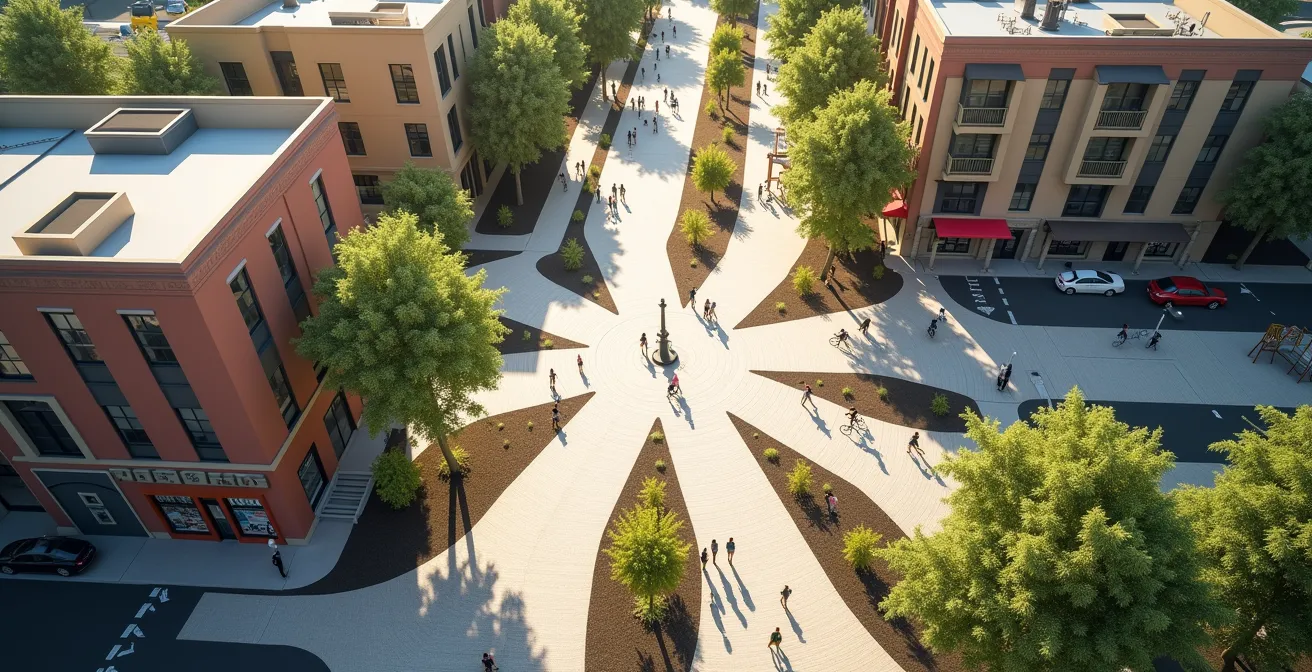
As you can see in this kind of layout, the design prioritizes human scale over vehicle dependence. The central plazas, tree-lined paths, and mixed-use buildings create a sense of community and activity that is often missing in traditional suburban planning, making it a key selling point for a new generation of homebuyers.
How Will the REM Expansion Change Property Values in the North Shore?
For decades, Montreal real estate has followed a simple rule: proximity to a metro station equals higher value. The Réseau express métropolitain (REM) is writing the next chapter of that rule, and savvy buyers are paying close attention. While much of the initial excitement surrounded the South Shore link, the planned expansion to the North Shore, as well as other areas, presents a massive opportunity for property value arbitrage. Buying a home in an area slated for a future REM station is one of the clearest paths to securing built-in equity appreciation.
The impact of new transit is not speculative; it’s a well-documented phenomenon. Properties within a short walking distance (typically under 1km) of a new station can see a significant value uplift compared to similar properties further away. This “transit premium” materializes as the project moves from blueprint to reality, rewarding those who invested early. As noted by CBC News when the first line opened, the southern branch was just the beginning. The article mentioned, “The southern branch, which links downtown Montreal’s Gare Centrale station to the city of Brossard, is opening today,” setting the stage for future growth elsewhere.
For a family considering the North Shore, this means pulling out the REM expansion maps and overlaying them with real estate listings. The key is to identify zones that are currently undervalued but are designated for future stations. A property in Laval or Deux-Montagnes that seems inconvenient today could become a prime location in five to seven years. Evaluating the proximity to a future station, the efficiency of the local bus network to feed that station, and the availability of parking are all crucial due to-diligence steps for any forward-thinking buyer.
Pool or No Pool: Which Feature Actually Adds Value to a Family Home?
Once you’ve secured your suburban home, the next question is how to maximize its value and your enjoyment of it. The classic Canadian dream often includes a backyard pool for those hot summer days. However, in the specific climate of Quebec, a pool is a high-cost, low-usage luxury. It’s a significant investment for a season that can feel frustratingly short. This is where the concept of Four-Season Lifestyle ROI comes into play, shifting the focus from a 3-month amenity to an 8-month (or longer) living space.
A financial breakdown reveals the stark reality. An in-ground pool comes with a hefty price tag and significant annual maintenance costs, all for what amounts to about 12 weeks of use. Alternative investments, such as a covered and heated patio, an outdoor sauna, or professional landscaping focused on winter interest, offer a much higher utility for a similar or lower cost. These features extend the usability of your backyard from early spring well into late autumn, and in some cases, year-round.
This table clearly illustrates the trade-offs. While a pool might offer a slightly higher bump in resale value on paper, its high initial and recurring costs, combined with its very limited season of use in Quebec, make it a questionable investment from an ROI perspective.
| Investment Type | Initial Cost Range | Annual Maintenance | Season of Use | Resale Value Impact |
|---|---|---|---|---|
| In-ground Pool | $50,000-$80,000 | $3,000-$5,000 | 3 months (June-August) | 5-7% increase |
| Covered Heated Patio | $25,000-$40,000 | $500-$1,000 | 8-9 months | 4-6% increase |
| Outdoor Sauna | $15,000-$30,000 | $300-$600 | 12 months | 3-5% increase |
| Professional Landscaping | $10,000-$25,000 | $1,000-$2,000 | 12 months visual appeal | 3-5% increase |
Investing in a four-season outdoor space like a heated patio or even a sauna not only adds comparable resale value but more importantly, provides triple the amount of time for your family to actually use and enjoy your property—a far more practical return on investment for the realities of Canadian life.
Why Are Young Families Fleeing Montreal for Towns Like Trois-Rivières?
While many Montreal families are weighing the pros and cons of the North and South Shores, a growing contingent is making an even bolder leap. The search for affordability and a different pace of life is pushing them beyond the commuter belt entirely, to cities like Trois-Rivières. This isn’t a suburban shift; it’s a fundamental lifestyle reset, made possible by the rise of remote and flexible work arrangements. For these families, the ultimate luxury isn’t a 45-minute commute to downtown; it’s no commute at all.
The primary driver is, without a doubt, housing affordability. The South Shore real estate market analysis shows that while prices are generally more affordable than on the island of Montreal, they are still significantly higher than in regions further afield. By moving to a city like Trois-Rivières, a family can often afford a larger home with more land for the price of a starter home in a close-in suburb. This financial freedom is a powerful incentive.
However, this move represents a clear set of trade-offs. What you gain in affordability, you lose in proximity to specialized services and cultural amenities. Access to Montreal’s world-class hospitals, universities, and vibrant arts scene moves from a short drive to a major day trip. This lifestyle is only viable for those whose work is fully remote or requires only occasional travel to the city. It’s a calculated decision to trade urban access for financial breathing room and a quieter community life.
| Factor | Montreal (Urban Core) | South Shore (Hybrid) | Trois-Rivières (Remote) |
|---|---|---|---|
| Commute to Montreal CBD | 0-30 minutes | 30-75 minutes | 90+ minutes |
| Housing Affordability | Lowest | Moderate | Highest |
| Access to Specialized Healthcare | Immediate | 30-45 minutes | 90+ minutes |
| Cultural Amenities | Maximum | Good (via transit) | Limited |
| Hybrid Work Compatibility | Not needed | Ideal (2-3 days) | Remote only |
Hardiness Zone 5b: Which Plants Actually Survive a Montreal Winter?
No matter where you land—Brossard, Laval, or even Trois-Rivières—you’ll face a common and formidable challenge: the Quebec winter. This reality extends directly into your new backyard, where choosing the right plants is not a mere aesthetic choice, but a crucial financial and practical one. The concept of Hardiness Zone Economics means understanding that a beautiful garden that dies every winter is a recurring expense, while a garden designed for your specific climate is a one-time investment that adds lasting value.
The entire Greater Montreal area falls into Canadian Hardiness Zone 5b. This designation is a scientific shorthand for the region’s minimum winter temperatures, and it’s the single most important piece of information for any gardener. Ignoring it means throwing money away on plants that are not genetically equipped to survive the deep freeze. The key to a successful and cost-effective landscape is to embrace native and zone-appropriate species that will thrive with minimal intervention.

Focusing on plants like Serviceberry (Amelanchier), which offers beauty in all four seasons, or Purple Coneflower (Echinacea), which supports local pollinators and returns reliably each year, is a smart strategy. These plants are adapted to the local soil and climate, requiring less water, fertilizer, and replacement. A landscape built with these hardy perennials and shrubs becomes a resilient, low-maintenance asset that enhances curb appeal and personal enjoyment year after year, rather than a frustrating and costly annual project.
- Plant Serviceberry (Amelanchier) for its beautiful spring flowers, summer berries, and brilliant fall colour.
- Establish masses of Purple Coneflower (Echinacea) and Black-Eyed Susan (Rudbeckia) for vibrant, long-lasting summer blooms that attract pollinators.
- Create structure and winter interest with native shrubs like Red Osier Dogwood, whose bright red stems provide a stunning contrast against the snow.
- If planning a vegetable garden, use cold frames and raised beds with southern exposure to extend the short growing season and get a head start in the spring.
Key Takeaways
- The true cost of a suburban commute must include vehicle depreciation, transit fees, and a “winter penalty.”
- A home’s value is directly influenced by its school district’s reputation, making school research a critical investment strategy.
- Investing in a four-season outdoor space like a heated patio offers a better return on investment in Quebec’s climate than a traditional swimming pool.
Quebec Landscaping: Designing a Backyard That Survives Winter and Shines in Summer
Embracing Zone 5b plants is the first step, but creating a truly valuable and enjoyable backyard in Quebec requires a holistic design approach. It’s about more than just surviving the winter; it’s about designing a space that offers visual interest and utility year-round. This means thinking like a four-season designer, planning sightlines from your indoor windows, and using a mix of plants and hardscaping to create a landscape that feels alive even under a blanket of snow.
The strategy involves creating a strong “winter skeleton” for your garden. This framework is built with elements that look good without their leaves. Start with an evergreen backbone of native trees like White Pine or Balsam Fir for year-round structure. Then, layer in elements that provide texture, colour, and movement. Ornamental grasses like ‘Karl Foerster’ stand tall through the snow, catching the low winter light. Shrubs with colourful bark, like Red Twig Dogwood, become living sculptures. A well-placed stone patio or a cedar pergola provides a focal point and a sense of place, regardless of the season.
You must also contend with local soil conditions. Many areas on the South Shore, for example, have heavy clay soil, which poses challenges for drainage. A smart landscape design anticipates this by incorporating raised beds for vegetables and selecting clay-tolerant species, turning a potential problem into a feature of a resilient garden. This thoughtful planning ensures your outdoor space is not a source of frustration but a genuine extension of your home across all seasons.
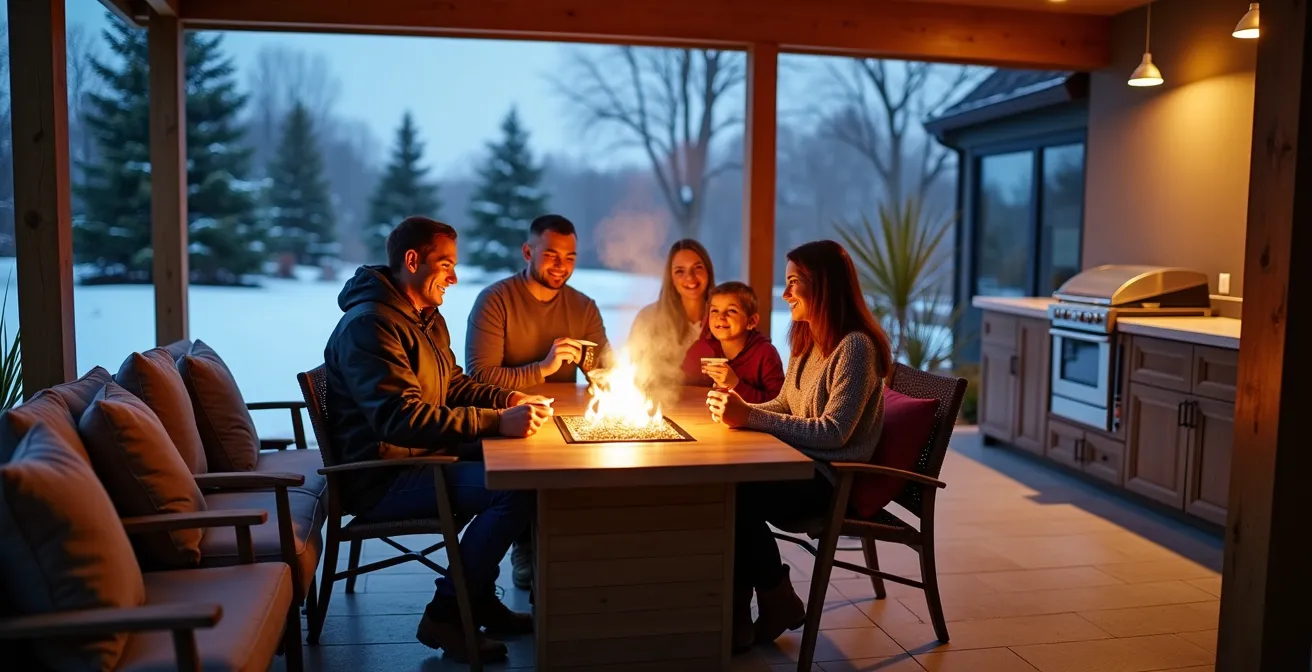
Ultimately, a successful Quebec backyard is a partnership with nature, not a battle against it. By choosing the right plants and designing for all four seasons, you create an outdoor space that adds tangible value to your property and immeasurable value to your family’s quality of life.
To turn your suburban property into a true sanctuary, the next logical step is to consult with a landscape designer who specializes in Quebec’s climate and native plants, ensuring your investment thrives for years to come.