Contrary to popular belief, a three-season cottage in Quebec is not just a cheaper house; it’s an entirely different asset class governed by the province’s unique environmental and financial rules.
- The true cost isn’t the purchase price, but the potential six-figure sum required for a full winterization that respects Quebec’s building code.
- Financing is fundamentally different, with major banks often refusing mortgages and requiring a minimum 35% down payment due to higher perceived risk.
Recommendation: Treat the purchase like a technical investment. Your due diligence must extend beyond the four walls to include the foundation’s battle with frost, the lake’s health report, and the property’s official seasonal designation.
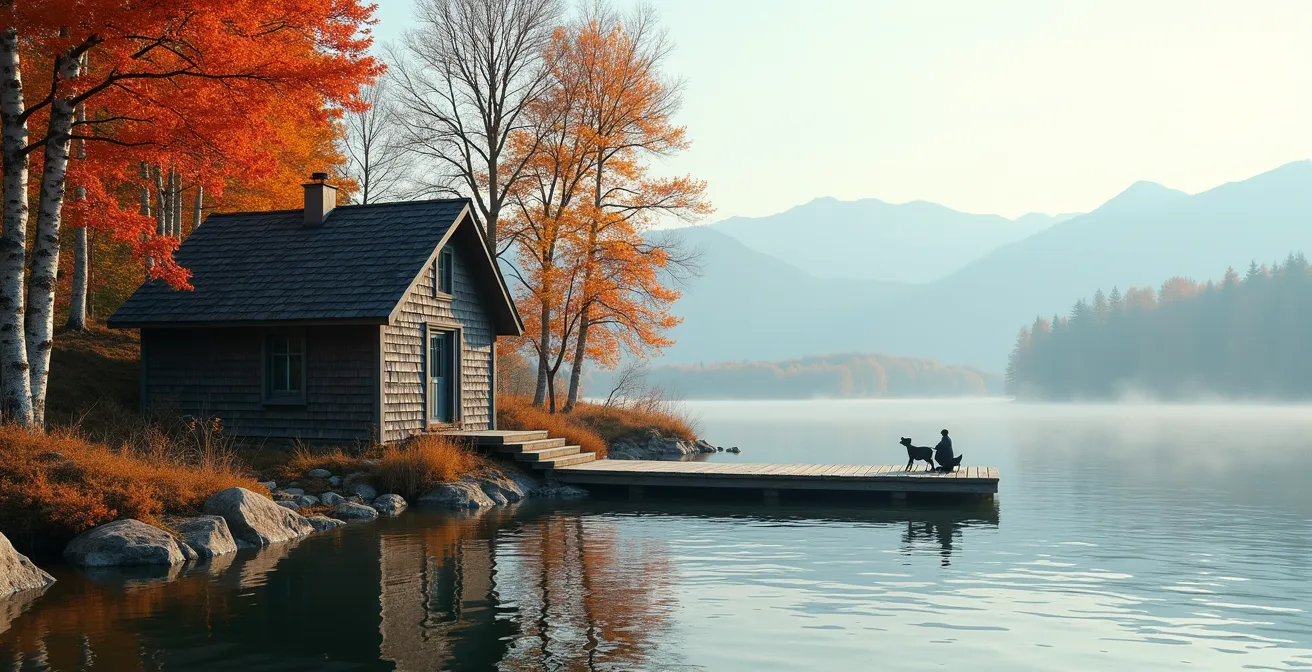
The image is a powerful one, deeply ingrained in the Quebecois psyche: a rustic cottage nestled by a pristine lake, the gentle lapping of water against the dock, and the promise of long, sun-drenched summer days. For many, the three-season cottage represents an accessible entry into this dream, a nostalgic escape without the hefty price tag of a fully winterized chalet. The common assumption is that the main compromise is simply a shorter period of use. You save on the purchase, and the only “cost” is packing up before the first snowfall.
But as a vacation property agent navigating the specific realities of the Quebec market, I can tell you this view is dangerously incomplete. The difference between a three-season and four-season property isn’t just a furnace and some insulation. It’s a fundamental distinction that touches everything from structural integrity to financial viability. What if the real deciding factor isn’t the charm of the wooden walls, but the engineering of the foundation against frost heave? What if the bank’s stringent lending requirements are a direct reflection of a real “winter liability”?
This article moves beyond the romantic ideal to provide a pragmatic buyer’s guide. We will dissect the true cottage ecosystem—a complex interplay between construction, finance, and Quebec’s specific environmental regulations. We’ll explore the real costs of conversion, the critical steps for winterization, the logic behind the demanding financing, and the essential verifications needed to ensure your dream getaway doesn’t become a hidden nightmare. This is about making an informed decision, where nostalgia is balanced by a clear-eyed understanding of the investment.
text
To help you navigate this complex decision, this guide breaks down the essential factors you must consider. Below, the summary outlines each critical area of due diligence, from structural costs to environmental checks, ensuring you’re fully equipped to evaluate a three-season cottage in Quebec.
Summary: The Classic Cottage: Is a Three-Season Property a Smart Buy in Quebec?
- How Much Does It Cost to Convert a 3-Season Cottage into a 4-Season Home?
- How to Properly “Close” Your Cottage to Prevent Pipes from Bursting?
- Why Do Banks Ask for a 35% Down Payment on Non-Winterized Cottages?
- Piles vs. Concrete Foundation: What Holds Up Best in Shifts of Frost?
- Blue-Green Algae: How to Check Lake Health Before Making an Offer?
- Composite vs. Pressure Treated Wood: Is the Maintenance Savings Worth the Cost?
- Coastal Erosion: How to Check if Your Dream Cottage Will Fall into the River?
- Four-Season Chalets: How to Avoid Buying a Summer Cottage in Disguise
How Much Does It Cost to Convert a 3-Season Cottage into a 4-Season Home?
The most common misconception about three-season cottages is that a “winterization” project is a simple upgrade. In reality, converting a property to be legally and safely habitable year-round in Quebec is a major renovation, often costing anywhere from $50,000 to over $200,000. This isn’t just about adding a heater; it’s a comprehensive structural overhaul that must comply with the province’s strict building code, especially regarding insulation (R-values) and foundations. While Quebec has recently seen a relatively low 0.4% quarterly increase in Quebec renovation costs, the scope of a full conversion remains a significant financial undertaking.
A true conversion involves much more than surface-level changes. It requires what we can call “frost engineering”—a systematic approach to protect the entire structure from Quebec’s harsh freeze-thaw cycles. This includes excavating and insulating the foundation, upgrading the entire plumbing system to prevent freezing, installing a sufficiently powerful and compliant heating system, and often requires a complete overhaul of the electrical panel. Furthermore, the septic system must be verified or upgraded to handle year-round use, a detail many buyers overlook. Professional design and permit fees alone can add another 10-15% to the total budget, making it crucial to factor these hidden expenses into your calculation from the very beginning.
The costs can be broken down into several key areas. Insulating and finishing a basement or crawlspace to modern standards can run from $70 to $100 per square foot. A full plumbing replacement, often necessary to move pipes from vulnerable exterior walls, costs between $50 and $250 per linear foot. If the cottage requires a lateral extension for utilities, expect to pay $200 to $500 per square foot. The heating system and its necessary electrical upgrades will often consume 15-25% of the total renovation budget. When you add it all up, the “bargain” price of a three-season cottage can quickly evaporate, sometimes exceeding the cost of buying a true four-season property from the start.
How to Properly “Close” Your Cottage to Prevent Pipes from Bursting?
For a three-season cottage owner, “closing” for the winter is the most critical annual ritual. This process goes far beyond simply locking the door; it’s a meticulous procedure to mitigate your “winter liability”—the significant risk of catastrophic damage from freezing temperatures. The primary enemy is water. When water freezes in a pipe, it expands with enough force to split copper, PVC, and even iron, leading to devastating floods when the spring thaw arrives. A proper winterization is your only defence against returning to a water-logged disaster that insurance may not fully cover on a seasonally occupied property.
The core of the process involves completely draining the entire plumbing system. This means shutting off the main water supply and then systematically opening every single faucet, valve, and fixture—from the highest point in the cottage to the lowest—to let gravity do its work. It’s not enough to just open the taps; you must also drain the water heater, the toilet tanks and bowls, and any appliances connected to the water line, like dishwashers or washing machines. For low spots where water can remain trapped, using a compressor to blow out the lines is a professional-grade step that ensures no water is left behind.
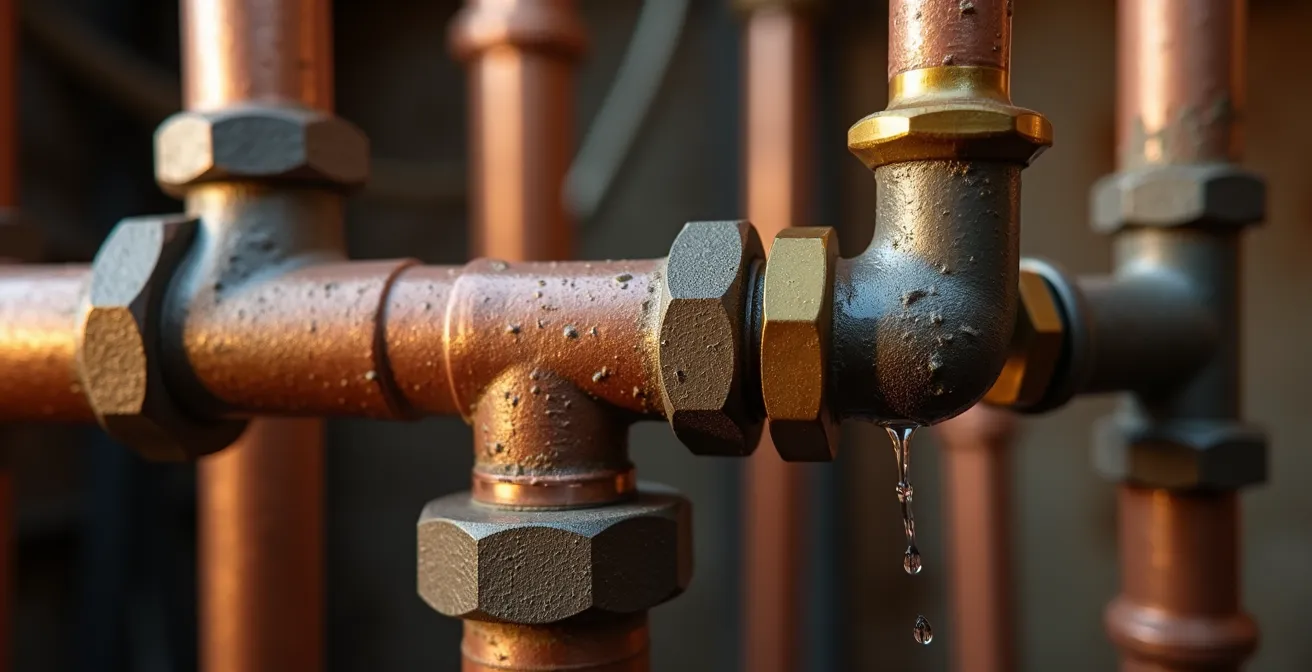
As this image of a cottage’s plumbing illustrates, the system is a network of potential failure points. Once the lines are empty, the final protective measure is to pour a non-toxic propylene glycol antifreeze into every P-trap, including sinks, showers, and toilets. This prevents the small amount of water designed to remain in the traps (to block sewer gases) from freezing and cracking the fixture. For added peace of mind, installing smart water sensors with freeze alerts can provide an early warning if temperatures inside the cottage drop to dangerous levels, and scheduling periodic visits from a local caretaker is a wise investment.
Why Do Banks Ask for a 35% Down Payment on Non-Winterized Cottages?
Many aspiring cottage buyers get a rude awakening when they approach a bank for financing. While you might secure a mortgage for a primary residence with as little as 5% down, lenders typically demand a minimum down payment of 35% to 50% for a three-season property. This isn’t an arbitrary rule; it’s a calculated risk management strategy. Lenders classify three-season cottages as “Type B” properties—recreational homes with seasonal access or use—which are considered a higher risk than standard “Type A” homes. The primary reason is the limited resale market. In a financial downturn, a vacation property is one of the first assets people sell, and a cottage that can’t be used or even accessed for several months of the year has a much smaller pool of potential buyers, making it harder for the bank to recoup its investment in case of default.
This higher risk profile means that these properties are often ineligible for mortgage default insurance from the Canada Mortgage and Housing Corporation (CMHC). Without this insurance, the lender bears 100% of the risk, prompting them to demand a larger down payment to secure their position. As the RE/MAX Quebec market analysis notes, this is a standard industry practice. In their report, they state:
Type B properties with seasonal access represent higher default risk due to limited buyer pools and challenging resale conditions
– RE/MAX Quebec Market Analysis, Quebec Cottage Market Report 2024
This table clearly illustrates the stark difference in financing requirements. Major Canadian banks are often hesitant to lend on these properties at all, pushing buyers toward credit unions like Desjardins, which has a deeper understanding of the Quebec market, or even more expensive specialty and private lenders, especially for remote or water-access-only cottages where a 50%+ down payment is common.
| Property Type | Minimum Down Payment | CMHC Insurance | Typical Lender |
|---|---|---|---|
| 4-Season Cottage | 5-20% | Available | Major banks + Desjardins |
| 3-Season Cottage | 35-50% | Not available | Specialty lenders + Desjardins |
| Remote/Water Access | 50%+ | Not available | Private lenders only |
Piles vs. Concrete Foundation: What Holds Up Best in Shifts of Frost?
In Quebec, a cottage’s longevity is determined from the ground up. The province’s dramatic freeze-thaw cycles exert immense pressure on foundations, a phenomenon known as “frost heave.” When water in the soil freezes, it can expand and lift a poorly-built foundation, and when it thaws, the structure can settle unevenly, causing cracked walls, warped floors, and doors that no longer close. For a three-season cottage, which often sits on simple posts or blocks, this is a major long-term risk. Choosing the right foundation is the most critical element of frost engineering and ensuring the structural integrity of your investment.
The gold standard for a four-season home is a poured concrete foundation with footings that extend below Quebec’s typical 1.5-meter (5-foot) frost line. This ensures the base of the structure rests on stable ground that never freezes. However, this is also the most expensive and time-consuming option. For many cottage settings, especially on the rocky and sloped terrain of the Canadian Shield, a more modern and cost-effective solution has become the standard: helical piles. These are large, screw-like steel piles that are drilled deep into the ground, well past the frost line, providing an exceptionally stable base.
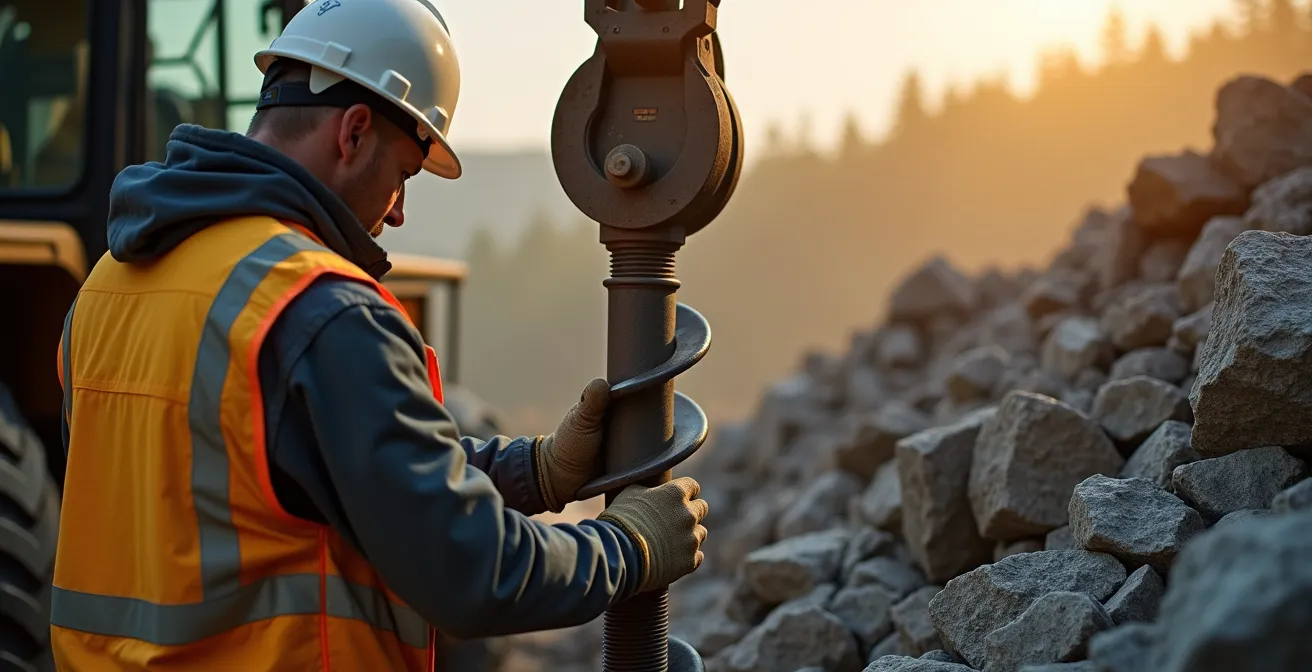
The installation of helical piles, as shown here, is a fast and minimally invasive process that is perfectly suited for remote or difficult-to-access cottage lots. The following table provides a clear comparison of the most common foundation types for cottages in Quebec, highlighting the trade-offs between cost, installation time, and frost resistance.
| Foundation Type | Frost Resistance | Cost Range | Installation Time | Best For |
|---|---|---|---|---|
| Concrete (below frost line) | Excellent | $15,000-30,000 | 2-3 weeks | Permanent structures |
| Helical Piles | Very Good | $8,000-15,000 | 2-3 days | Rocky terrain/slopes |
| Traditional Posts | Fair | $3,000-8,000 | 1-2 days | 3-season only |
Blue-Green Algae: How to Check Lake Health Before Making an Offer?
The idyllic image of a lakeside cottage hinges entirely on the quality of the lake itself. In Quebec, a growing concern for waterfront property owners is the proliferation of cyanobacteria, commonly known as blue-green algae. These blooms, which can look like pea soup or spilled paint on the water’s surface, can produce toxins harmful to humans and pets, leading to beach closures and rendering the water unsafe for swimming, fishing, or even boating. Buying a cottage on a lake prone to these blooms can severely impact your enjoyment and the property’s long-term value. Therefore, a key part of your purchase process must be environmental due diligence.
Fortunately, Quebec has robust monitoring programs that buyers can leverage. The Ministère de l’Environnement, de la Lutte contre les changements climatiques, de la Faune et des Parcs (MELCC) maintains public records and maps of lakes affected by cyanobacteria blooms. The guidelines are clear: the MELCC specifies that a concentration of 20,000 cells/mL threshold triggers beach closures in Quebec, an official action that can be a major red flag for a potential buyer. Before making an offer, it is crucial to consult this data and contact the local lake association, which often conducts its own regular water testing and can provide invaluable historical context on the lake’s health.
Beyond official data, your own eyes are a powerful tool. When visiting a property, look for warning signs: murky or unusually colored water, excessive growth of aquatic plants near the shore, or the presence of scum or foam along the waterline. These can all be indicators of high nutrient levels in the water, which is the primary driver of algae blooms. For the most comprehensive assessment, you can hire an environmental consultant to perform a professional water quality analysis. This due diligence ensures that your dream of a lakeside retreat is built on the foundation of a healthy, stable lake ecosystem.
Your Lake Health Verification Checklist
- Check the Réseau de surveillance volontaire des lacs (RSVL) historical data online for past water quality reports.
- Contact the local lake association to request their private water testing records and inquire about any history of blooms.
- During your visit, look for visual warning signs like murky water, excessive aquatic plants, or foam on the shore.
- Consult the official MELCC website for any current or past cyanobacteria bloom advisories for your specific lake.
- For high-value properties or if concerns arise, hire an environmental consultant for a professional water quality assessment.
Key Takeaways
- A 3-season cottage is a distinct asset class, not just a “cheaper” house, with unique risks in Quebec.
- True winterization is a major renovation project often costing $50,000-$200,000, not a simple upgrade.
- Financing requires a high down payment (35%+) as these properties are seen as higher risk by lenders and are ineligible for CMHC insurance.
- Environmental due diligence, such as checking for blue-green algae and erosion risk, is as critical as a building inspection.
Composite vs. Pressure Treated Wood: Is the Maintenance Savings Worth the Cost?
The deck is often the heart of cottage life, but in Quebec’s climate, it’s also a major source of maintenance. The choice of decking material is a classic cottage debate, pitting the traditional aesthetic of wood against the low-maintenance promise of modern composites. For a three-season property, where your time is precious, minimizing annual chores like staining and sealing can be a huge advantage. However, this convenience comes at a significant upfront cost. A composite deck can initially cost more than double a standard pressure-treated pine deck, forcing owners to weigh the long-term savings against the immediate investment.
Pressure-treated wood remains popular for its low initial cost and classic “chalet” look. However, it requires annual or biennial staining or sealing to protect it from moisture, UV damage, and the freeze-thaw cycle, which can cause it to warp and splinter. Cedar offers better natural resistance and stability but still needs regular oiling to maintain its colour and prevent greying. Composite decking, made from a mix of recycled wood fibers and plastic, requires only occasional cleaning. This 10-year cost comparison for a standard 300 sq. ft. deck in Quebec highlights the financial trade-off:
| Material | Initial Cost (300 sq ft) | Annual Maintenance | 10-Year Total | Cold Weather Performance |
|---|---|---|---|---|
| Pressure Treated Pine | $2,100 | $300 (stain/seal) | $5,100 | Warping possible |
| Cedar | $3,600 | $200 (oil) | $5,600 | Good stability |
| Composite | $5,400 | $50 (cleaning) | $5,900 | Can be brittle at -20°C |
While the 10-year total costs appear surprisingly close, the decision isn’t purely financial. As a case study of Laurentian cottage owners reveals, many find the elimination of annual staining in harsh conditions makes the higher initial cost of composite worthwhile. However, they also caution that in heritage cottage areas, the authentic aesthetic of real wood can be a crucial factor for resale value. Furthermore, it’s important to consider cold-weather performance; some composite materials can become brittle and more susceptible to impact damage in the extreme cold of a Quebec winter, a risk to consider even if the cottage is closed.
Coastal Erosion: How to Check if Your Dream Cottage Will Fall into the River?
For a waterfront property in Quebec, the proximity to water is its greatest asset and potentially its greatest threat. Coastal and riverbank erosion is a slow-moving but powerful force that can literally undermine your investment. Changes in water levels, spring ice breakup, and heavy rainfall can gradually wear away the shoreline, bringing it closer and closer to your cottage’s foundation. This risk is so significant that the provincial government has established strict regulations and designated erosion risk zones to protect both homeowners and the environment. Before you fall in love with a view, you must verify that it’s a stable one.
Your first step is to consult the MELCC’s official online mapping tools, such as the “Cartographie des zones inondables,” which identifies areas with a history of flooding and high risk of erosion. Municipalities also incorporate these risk zones into their zoning bylaws, which you must review. These bylaws dictate a mandatory setback of 10 to 15 meters from the high-water mark, a line that defines the highest point the water level typically reaches. A cottage built too close to this line may be non-compliant, making it difficult to get permits for renovations or even to rebuild after a fire. As the MELCC’s official guidelines warn, the consequences are severe:
Properties in designated flood zones face strict renovation restrictions and insurance challenges under Quebec’s shoreline protection regulations
– MELCC Environmental Guidelines, Quebec Shoreline Protection Policy 2024
This statement underscores the financial and legal gravity of the issue. To conduct a thorough assessment, you should request all historical flood and erosion records from the local municipality for the specific property. For properties on a steep bank or where erosion is visibly apparent, it is highly recommended to hire a geomorphologist or geotechnical engineer. They can perform a professional slope stability assessment and provide a definitive report on the long-term risk. This expert analysis is a small investment to protect you from the catastrophic risk of losing your land and your cottage to the water.
Four-Season Chalets: How to Avoid Buying a Summer Cottage in Disguise
In the competitive Quebec cottage market, one of the biggest risks for a buyer is purchasing a property advertised as “four-season” that is, in reality, a hastily upgraded three-season cottage in disguise. This is more than just a misrepresentation; it can constitute a “vice caché” (hidden defect) under Quebec’s Civil Code. A seller who knowingly misrepresents a property’s seasonal nature can be held liable for the costs you incur to fix the issues. To protect yourself, you must learn to identify the true “seasonal signature” of a property by looking past the fresh coat of paint and focusing on the non-negotiable elements of a true year-round home.
A true four-season chalet is engineered from the ground up to withstand Quebec winters. This starts with the foundation, which must extend below the 1.5-meter frost line. The walls and attic must have insulation certificates proving they meet modern R-value requirements (e.g., R-24.5 for walls). The water system is another key indicator: a submersible well pump is a strong sign of a year-round system, whereas a jet pump with exposed lines is typically for seasonal use only. The septic system permit is also a crucial document; it will explicitly state whether the system is designed for seasonal or year-round use. Finally, don’t be shy about asking for proof: request to see utility bills from the winter months. High heating costs are concrete evidence of year-round occupancy.
Your best ally in this verification process is a qualified and experienced home inspector who specializes in rural and cottage properties. They know exactly what to look for. This checklist, based on what Quebec inspectors focus on, should be your guide during a viewing.
Inspector’s Checklist for 4-Season Verification
- Foundation Depth: Verify that the foundation extends below the 1.5-meter frost line, the standard in Quebec.
- Insulation Certificates: Check for certificates or documentation confirming wall and ceiling R-values (minimum R-24.5 for walls).
- Water System Type: Inspect the water source. A submersible pump typically indicates year-round capability, unlike a seasonal jet pump.
- Septic Permit Status: Review the official septic system permit to confirm if it is designated for “year-round” or “seasonal” use.
- Proof of Use: Request copies of winter utility bills (Hydro-Québec) as concrete evidence of heating costs and occupancy during cold months.
Ultimately, buying a three-season cottage can be a wonderful and smart investment, provided you enter the transaction with your eyes wide open. It is not a lesser version of a house; it’s a unique property type with its own set of rules, risks, and rewards. By understanding the true costs of conversion, the critical nature of winterization, the logic of the financial markets, and the key structural and environmental checks, you transform yourself from a nostalgic dreamer into an informed investor.
To navigate this complex ecosystem successfully, your most important step is to surround yourself with the right expertise. Partner with a specialized real estate broker and a certified building inspector who truly understand the nuances of Quebec’s seasonal properties. They are your best insurance against turning a cottage dream into a financial liability.
Frequently Asked Questions About The Classic Cottage: Is a Three-Season Property a Smart Buy in Quebec?
What constitutes a ‘vice caché’ in Quebec cottage sales?
Under Quebec’s Civil Code, if a seller knowingly misrepresents a 3-season cottage as 4-season, buyers can seek compensation for hidden defects discovered after purchase.
What documents reveal the true seasonal nature?
The ‘Déclaration du vendeur sur l’immeuble’ must disclose seasonal limitations, past freezing incidents, and any non-compliant renovations.
Can insurance claims history reveal seasonal issues?
Yes, requesting the property’s insurance claim history can reveal past freeze damage or seasonal closure claims.