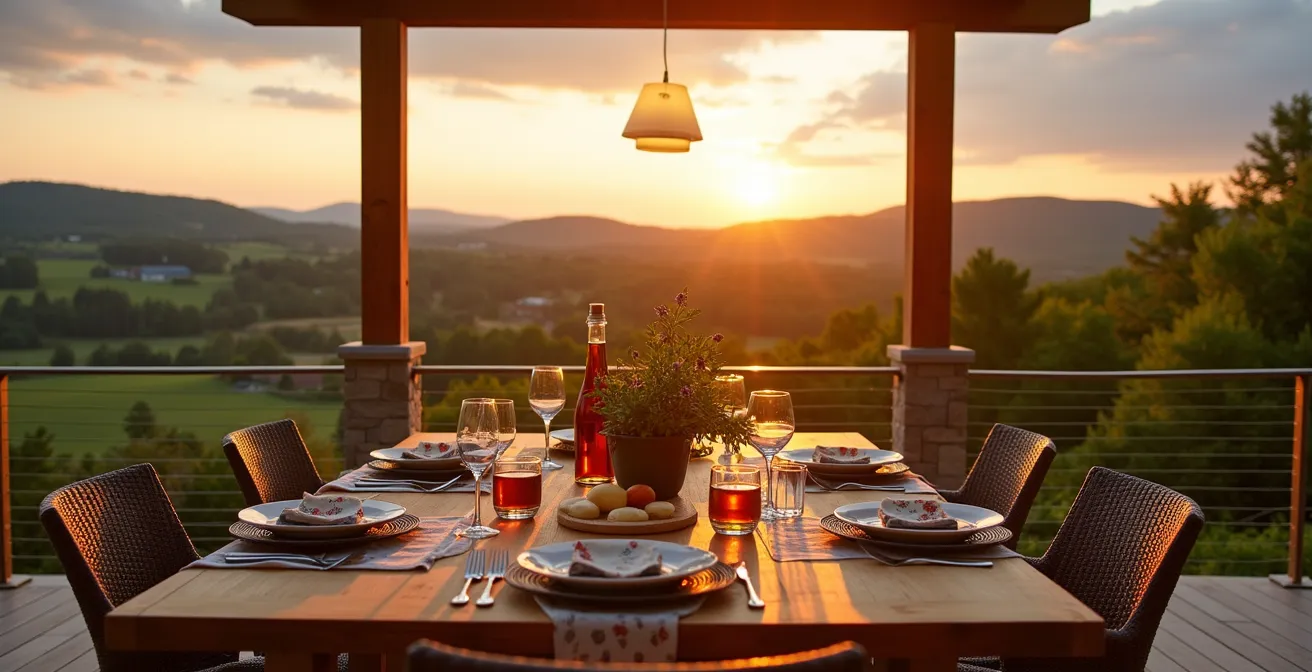
Contrary to popular belief, the biggest driver of rental yield in Quebec’s tourism hotspots isn’t just a scenic view—it’s the proximity to a vibrant culinary ecosystem.
- Artisanal networks like cheese trails create a defensible “economic moat” for your property.
- Seasonal rushes, such as the ‘temps des sucres’, allow for strategic price surging and maximized occupancy.
Recommendation: Stop evaluating properties based on location alone. Start analyzing their integration potential within the local ‘culinary terroir’ for maximum ROI.
For the discerning real estate investor, the value of a property in a tourism region like Quebec seems straightforward: it’s about the view, the proximity to ski hills, or the charm of a historic village. The common wisdom is that a good location guarantees good returns. While these factors are important, they are merely the appetizer. The main course, and the true secret to unlocking premium rental yields and sustained property appreciation, lies in a region’s gastronomy.
We’re not just talking about having a few good restaurants nearby. The real opportunity lies in what can be called a region’s culinary terroir: the unique, interconnected ecosystem of artisans, farmers, seasonal traditions, and signature products. This terroir creates a powerful economic moat, attracting a high-value demographic of “foodie travelers” who are willing to pay a premium for authentic experiences. They don’t just want a place to sleep; they want a base from which to explore the local flavour.
But if the key is not just location, but deep integration into this culinary narrative, how does an investor capitalize on it? This goes beyond simply listing “near the cheese route” in your property description. It involves transforming your property into an experience-first asset, strategically aligning your amenities with seasonal demand, and navigating the specific legal landscape of Quebec’s hospitality sector. This guide will deconstruct the “Foodie Factor,” providing a framework to identify and leverage a region’s culinary identity for superior real estate returns.
This article explores the specific strategies and economic principles that connect Quebec’s rich food culture to tangible real estate profits. Below is a summary of the key areas we will cover to help you build a more resilient and profitable property portfolio.
Summary: Unlocking Property Value Through Quebec’s Gastronomy
- The “Cheese Trail” Effect: How Proximity to Artisans Boosts Short-Term Rental Rates?
- Chef’s Kitchen: What Appliances Do Foodie Travelers Expect in a Luxury Rental?
- Maple Syrup Season: How to Capitalize on the “Temps des Sucres” Rush?
- Offering Wine to Guests: The Legal Pitfalls of “Welcome Baskets” in Quebec
- Converting a Heritage Home into a Bed & Breakfast: Is It Still Profitable?
- Agrotourism: How to Monetize Your Farm with Overnight Guest Stays?
- Pick-Your-Own: Is Opening an Orchard a Viable Business for a Hobby Farmer?
- Quebec Tourism Trends: Betting on the Rise of Ecotourism and “Slow Travel”
The “Cheese Trail” Effect: How Proximity to Artisans Boosts Short-Term Rental Rates?
The concept of “location, location, location” requires a critical update for the modern investor. In regions like Quebec’s Charlevoix or the Eastern Townships, the most valuable location is not necessarily the one with the best mountain view, but the one offering the greatest artisanal proximity. This proximity to a network of producers—cheesemakers, cideries, microbreweries, and organic farms—forms a powerful attraction for culinary tourists. These travelers are not just looking for a meal; they are seeking an immersive experience, and your property becomes their home base for this exploration.
This “Cheese Trail” effect has a direct and quantifiable impact on short-term rental (STR) performance. Properties situated along these established routes or near renowned artisans can command higher nightly rates and achieve better occupancy, especially outside of traditional peak seasons. The reason is simple: you are offering more than lodging; you are offering convenient access to the very soul of the region. As an example, the Charlevoix region, with its famous Route des Saveurs and proximity to agricultural hubs like Île d’Orléans, sees properties benefit directly from this dynamic, commanding premium rates from visitors drawn to its food scene.
While general market data provides a baseline, it’s this niche positioning that creates a competitive advantage. A detailed Quebec City short-term rental market analysis confirms that rates vary significantly based on proximity to attractions, and for a growing segment of travelers, artisanal producers are the main attraction. An investor who understands this can identify undervalued properties that, despite lacking a panoramic view, are sitting on a goldmine of culinary terroir.
Chef’s Kitchen: What Appliances Do Foodie Travelers Expect in a Luxury Rental?
Once you’ve secured a property with strong artisanal proximity, the focus shifts inward. To attract and satisfy the foodie traveler, the kitchen cannot be an afterthought; it must be the centerpiece of the rental. This demographic sees cooking with local ingredients as a core part of their vacation experience. A poorly equipped kitchen is not a minor inconvenience—it’s a deal-breaker. Investing in a true “chef’s kitchen” is not a cost; it’s a strategic move to justify a premium price point and generate rave reviews.
So, what defines a kitchen that meets these high expectations? It’s about functionality, quality, and thoughtful touches. This means moving beyond the standard electric stove and a mismatched set of pots. High-end appliances like a gas range, a convection oven, and an espresso machine are increasingly expected. A spacious island for food prep, quality cookware including sharp knives and a Dutch oven, and extras like a well-stocked spice rack signal that you understand and cater to their passion. This investment is validated by broader market trends, with the Canada household kitchen appliances market valued at USD 4.92 billion in 2024 and projected to grow, reflecting a deep consumer appreciation for quality culinary tools.
An open-concept layout that seamlessly connects the kitchen to dining and living areas is also crucial. It transforms cooking from a chore into a social event, which is exactly what these guests are looking for. Providing these amenities turns your property from a simple rental into an experience-first asset, a place where memories are made around the table.

As you can see, the focus is on quality and an invitation to create. Here is a list of essential elements to consider when designing or upgrading your rental kitchen to attract a premium clientele:
- High-end appliances: Gas ranges, convection ovens, wine fridges, and espresso machines.
- Ample workspace: Spacious islands perfect for prepping meals or serving snacks.
- Quality tools: A full set of sharp knives, heavy-bottomed baking sheets, a high-performance blender, and a classic Dutch oven.
- Thoughtful extras: Curated spice racks, multiple cutting boards, and quality barware for crafting cocktails.
- Social layout: Open-plan designs that integrate the kitchen with living areas for effortless entertaining.
Maple Syrup Season: How to Capitalize on the “Temps des Sucres” Rush?
A region’s culinary terroir is not static; it ebbs and flows with the seasons. For an investor in Quebec, the most significant of these is the “temps des sucres,” or maple syrup season. This period, typically from late February to April, sees a massive influx of tourists eager to visit a “cabane à sucre” (sugar shack) and experience this quintessential tradition. This seasonal rush presents a prime opportunity for yield stacking—strategically maximizing revenue during peak demand.
Properties located in the heart of maple country, such as the regions of Beauce, Montérégie, or the Eastern Townships, can implement dynamic pricing strategies, significantly increasing their nightly rates during this short but intense window. The key is to market the property not just as a place to stay, but as the perfect gateway to the sugar shack experience. This includes providing guests with curated lists of the best local shacks, offering maple-themed welcome baskets, and highlighting the cozy, “après-sugar-shack” comfort of your property.
The economic scale of this single seasonal event is immense. The maple syrup industry is a cornerstone of Quebec’s economy, and savvy investors can ride this wave. It’s a powerful example of how a unique, culturally ingrained culinary ritual creates a predictable and highly profitable tourism market. Many maple producers are now diversifying into agritourism with tours and tastings, further enhancing the appeal of nearby accommodations. The industry’s impact is staggering, with a report from the Quebec Maple Syrup Producers confirming a contribution of over $1.1 billion to the province’s GDP, supporting thousands of jobs and creating a robust tourism ecosystem.
Offering Wine to Guests: The Legal Pitfalls of “Welcome Baskets” in Quebec
In the quest to create a premium experience, offering a welcome basket with local delicacies is a fantastic touch. For foodie travelers, arriving to find a selection of artisanal cheese, fresh bread, and perhaps a bottle of local wine can set a perfect tone. However, in Quebec, the simple act of including alcohol in that basket can lead you into a complex legal gray area. An investor must balance the desire for hospitality with a firm understanding of provincial regulations to avoid significant penalties.
The core issue lies with the laws governed by the Régie des alcools, des courses et des jeux (RACJ) and the sale of alcohol. Even if you consider the wine a “free gift,” it can be interpreted as being included in the price of the stay, which would require a liquor license. This is a hurdle most individual STR owners cannot and do not want to overcome. The risk of fines and legal complications far outweighs the benefit of including a bottle of wine. Fortunately, there are creative and fully compliant ways to provide a similar high-end experience.
Instead of providing alcohol directly, you can offer a curated experience. This could involve providing a gift card for the local SAQ (Société des alcools du Québec), or partnering with a nearby winery to offer guests a voucher for a tasting. This not only avoids legal issues but also encourages guests to explore the local area and supports other local businesses. Your role as a host is to be a knowledgeable and trustworthy guide to the local terroir. This includes navigating the rules so your guests can have a seamless experience.
Your action plan: Creating compliant and high-value welcome experiences in Quebec
- Register and Collect Taxes: Ensure you are registered with Revenu Québec to collect and remit the 3.5% Lodging Tax on all stays under 31 nights. This is a non-negotiable first step.
- Obtain CITQ Certification: Secure your classification certificate from the Corporation de l’industrie touristique du Québec (CITQ). Operating without it risks heavy fines.
- Understand the Alcohol Distinction: Clearly differentiate between a ‘free gift’ and an ‘included sale’. To be safe, never include alcohol directly in your rental package price.
- Offer Compliant Alternatives: Provide guests with tasting vouchers for nearby wineries or cideries. This promotes local partners and stays within legal bounds.
- Curate with Gift Cards: Curate a list of recommended local beverages and include an SAQ gift card in your welcome basket, empowering guests to make their own purchases legally.
Converting a Heritage Home into a Bed & Breakfast: Is It Still Profitable?
For investors captivated by Quebec’s charming historic towns, acquiring a heritage home seems like a natural fit for a hospitality venture. The immediate question then becomes: what is the best business model? The traditional Bed & Breakfast (B&B) or the more modern Short-Term Rental (STR)? While both cater to tourists, they operate under different regulatory frameworks in Quebec, and the choice has significant implications for profitability, operations, and legal compliance.
A B&B often implies a higher level of service, including providing breakfast, and typically involves the owner residing on the property. An STR offers more flexibility for both guest and owner. Crucially, Quebec’s regulations treat them differently. Both require a CITQ classification certificate, a process that can take several weeks and is strictly enforced, with fines for non-compliance starting at a hefty $2,500. However, zoning laws can be a major differentiator; many municipalities have stricter zoning requirements for B&Bs, often restricting them to commercial or mixed-use areas, whereas STR regulations can vary widely by borough or city.
The profitability question hinges on your investment strategy and operational capacity. A B&B can foster deep guest loyalty and command high rates due to its personalized service, but it is also more labour-intensive. An STR, managed remotely via platforms like Airbnb or Vrbo, offers scalability but can feel more transactional. The key is to analyze the local market and regulations before committing.
This table summarizes some of the key operational and regulatory differences an investor must consider when deciding between a traditional B&B and an STR model for a heritage property in Quebec.
| Aspect | Traditional B&B | Short-Term Rental |
|---|---|---|
| CITQ Certificate | Required | Required (unless rented for personal vacation under 31 days/year) |
| Tax Collection | 3.5% Lodging Tax + GST/QST | 3.5% Lodging Tax |
| Inspection | Full property review, including owner’s presence | Primarily focused on safety and conformity standards |
| Zoning | Commercial or specific mixed-use zoning often required | Highly variable by municipality; some areas have significant restrictions |
Agrotourism: How to Monetize Your Farm with Overnight Guest Stays?
For investors with larger rural properties or functioning farms, the opportunity extends beyond simply being *near* the culinary terroir—you can become a central part of it. Agrotourism, which invites guests to stay on a farm and experience agricultural life firsthand, is a rapidly growing segment of the travel industry. It allows you to monetize your land in a new way, creating a powerful revenue stream that complements your primary agricultural activities.
The model can take many forms: converting a barn into rustic-chic lofts, setting up luxury tents for a “glamping” experience, or renovating a farmhouse for guest stays. The key is to offer authenticity. Guests are not just looking for a rural hotel; they want a connection to the land and its produce. This can involve offering them tours of the farm, workshops on cheesemaking or preserving, or simply the chance to pick their own breakfast from your garden. In Canada, the economic potential is significant, with sectors like maple syrup being a major contributor.
As Brian Langis, a Chartered Business Valuator, noted in a report on Canada’s maple syrup industry, the sector’s impact is vast.
Maple syrup production would represent 12,582 full-time equivalent jobs and contribute $1.1 billion to Canada’s GDP.
– Brian Langis, CBV, CBV Institute – Canada’s Maple Syrup Industry Report
This economic weight is increasingly supported by government initiatives. For instance, a recent joint federal and provincial investment in Ontario’s maple sector helped dozens of producers upgrade their equipment, demonstrating a commitment to strengthening the industry’s agritourism potential. By offering overnight stays, you are tapping into this powerful trend and creating a destination in your own right.
Pick-Your-Own: Is Opening an Orchard a Viable Business for a Hobby Farmer?
You don’t need a massive commercial farm to tap into the agrotourism trend. For the “hobby farmer” or an investor with a few acres of land, a pick-your-own (or “U-pick”) operation can be a surprisingly viable and profitable business model. This approach transforms a simple orchard or berry patch into an experiential destination, attracting families and foodies who are willing to pay for the experience of harvesting their own food.
The success of a U-pick business hinges on creating an experience, not just selling produce. This means thinking like a retailer and a marketer. Designing “Instagram-worthy” spots on your property, providing branded baskets, and maintaining a strong social media presence are just as important as the quality of your fruit. This business model is gaining traction, as it taps directly into consumer desires for transparency, connection to their food source, and outdoor family activities. The growth is backed by data, with a Statistics Canada report showing that 20.9% of Quebec farms reported direct-to-consumer sales in 2020, a notable increase from previous years.
Furthermore, a U-pick operation offers excellent opportunities for revenue diversification. The season for fresh fruit is short, but you can extend your income throughout the year by transforming surplus crops into value-added products like jams, pies, or ciders. Offering workshops on canning or baking can create another revenue stream while building a loyal community around your brand. Partnering with local tourism boards can also amplify your reach, placing your hobby farm firmly on the region’s culinary map.
Key Takeaways
- A property’s value is directly linked to its integration within a local “culinary terroir,” not just its location.
- High-end kitchen amenities are a non-negotiable investment to attract the premium “foodie traveler” demographic.
- Navigating Quebec-specific regulations (CITQ, alcohol) is crucial to de-risk your investment and operate legally.
Quebec Tourism Trends: Betting on the Rise of Ecotourism and “Slow Travel”
The strategies discussed—leveraging artisanal proximity, creating chef-worthy kitchens, and tapping into agrotourism—are not isolated tactics. They are all components of a larger, powerful shift in tourism: the rise of ecotourism and “slow travel.” Today’s travelers, particularly in the post-pandemic era, are increasingly seeking meaningful, sustainable, and authentic experiences. They want to slow down, connect with nature, and understand the culture of the places they visit. Quebec, with its vast natural landscapes and rich culinary heritage, is perfectly positioned to capture this growing market.
Investing in a property that aligns with this ethos is not just a trend; it’s a long-term strategy. A rental that facilitates a deeper connection to the local food ecosystem is inherently a “slow travel” destination. It encourages guests to visit the farmers’ market instead of the supermarket, to spend an afternoon at a local cidery, or to simply enjoy a home-cooked meal made with ingredients sourced within a few kilometers. This approach builds a sustainable business model that is less reliant on fleeting trends and more on timeless values.
Quebec’s unique position in the global food landscape, particularly with maple syrup, gives it an undeniable “economic moat” in this space. This single product is a global phenomenon rooted in the province’s forests.
Quebec produces an average 72% of the entire world’s maple syrup, accounting for an average 90% of Canadian production.
– Quebec Maple Syrup Producers, PPAQ Economic Statistics
This incredible natural and cultural asset is the anchor for a much broader story of ecotourism and culinary discovery that you, as an investor, can become a part of.

To capitalize on these trends, your next step is to analyze potential properties not just by their features, but by their strategic position within the region’s culinary narrative. This framework provides a new lens through which to evaluate opportunities, unlocking value that other investors may overlook.