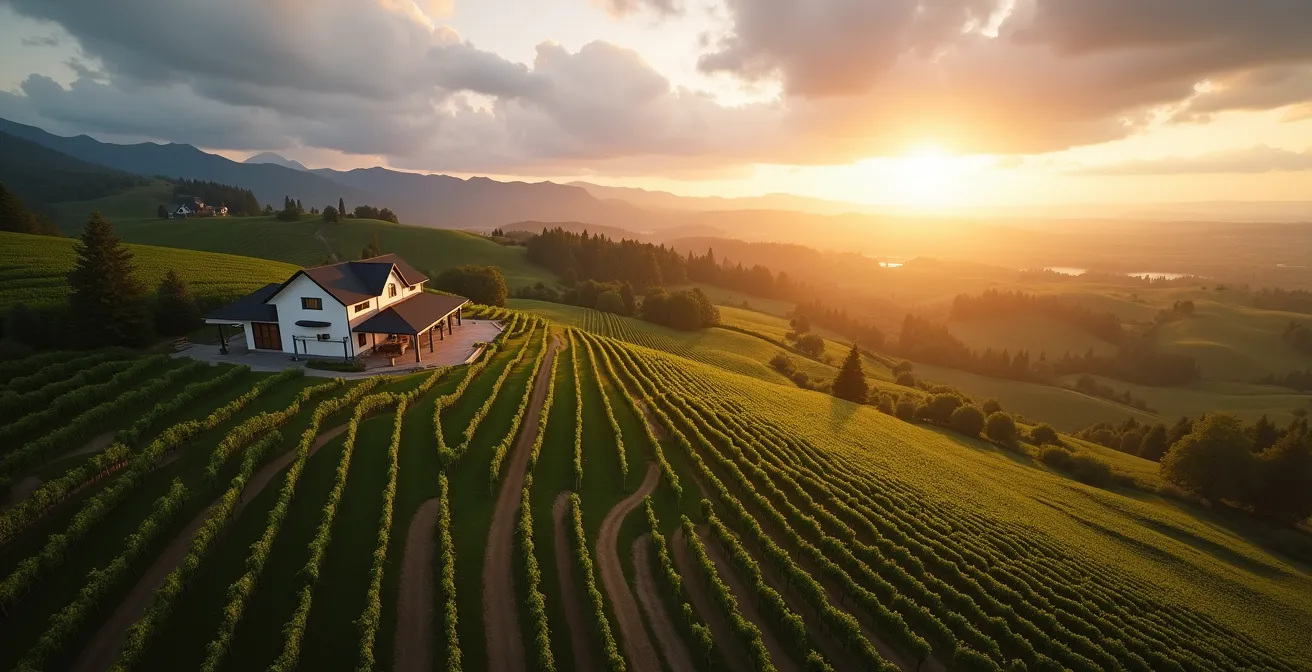
The value of a country home near a vineyard isn’t just in the view; it’s a measurable economic asset called “Terroir Value,” driven by the symbiosis between protected agricultural land and a vibrant local artisan economy.
- Protected “Green Zones” create scarcity, guaranteeing unobstructed views and boosting the value of adjacent residential properties.
- Proximity to artisan producers (wineries, cheese makers) creates an “agritourism flywheel” that increases demand and short-term rental potential.
Recommendation: For buyers in regions like Quebec’s Eastern Townships, shift your focus from simple aesthetics to analyzing the economic and legal frameworks that underpin long-term property appreciation.
For many, the dream of owning a country home is painted with broad, romantic strokes: rolling hills, a slower pace of life, and perhaps a glass of wine on the porch overlooking a neighbouring vineyard. This idyllic picture is a powerful draw, especially in breathtaking regions like Quebec’s Eastern Townships. But for the savvy buyer, the real value isn’t just in the pastoral scenery. It’s a tangible, economic principle we can call “Terroir Value”—a concept that goes far beyond aesthetics to encompass the legal, cultural, and agricultural forces that actively enhance a property’s worth.
Most advice on rural property focuses on the obvious: the charm of the lifestyle or the potential nuisances of farm life. While these are valid points, they miss the bigger picture. They fail to explain the powerful economic engine at work when protected agricultural land meets a thriving local food culture. This isn’t just about buying a house; it’s about investing in an ecosystem. The true financial benefit comes from understanding the symbiosis between a working landscape and the residential properties nestled within it.
This guide moves beyond the surface-level appeal to dissect the mechanics of Terroir Value. We will explore how legal frameworks like agricultural zoning are not limitations but value drivers, and how the proximity to a “Cheese Trail” can be a more reliable indicator of investment potential than a simple property appraisal. By understanding this, you can learn to see a field of vines not just as a beautiful view, but as a key component of your real estate portfolio’s long-term health.
To fully grasp how these interconnected elements create value, this article breaks down the key considerations for any prospective buyer in a premier agricultural region. From the realities of living beside a working farm to the economic impact of local gastronomy, you will gain a specialist’s view on investing in rural charm.
Summary: Understanding the Full Scope of Terroir-Driven Real Estate
- Living Next to a Farm: Dealing with Smells, Flies, and Early Morning Tractor Noise
- The “Green Zone”: Why You Can’t Build a House on that Cheap Agricultural Land?
- Pick-Your-Own: Is Opening an Orchard a Viable Business for a Hobby Farmer?
- Heritage Views: How Conservation Easements Protect Your Property Value?
- The Micro-Climates of Monteregie: Why Some Valleys Are Better for Gardening?
- The “Cheese Trail” Effect: How Proximity to Artisans Boosts Short-Term Rental Rates?
- Is It Legal? How to Convince a Municipality to Allow Tiny Home Developments
- The Foodie Factor: How Gastronomy Drives Real Estate Demand in Regions like Charlevoix
Living Next to a Farm: Dealing with Smells, Flies, and Early Morning Tractor Noise
The romantic image of a country home often omits the sensory details of a working landscape. The reality includes the earthy smell of fertilizer in the spring, the buzz of insects during the summer, and the unmistakable sound of a tractor at dawn. For an unprepared buyer, these can be jarring. For the informed investor, they are signs of a healthy, productive agricultural environment—the very thing that underpins your property’s unique value. Rather than viewing them as nuisances, it’s crucial to understand them as normal, and legally protected, aspects of farm operations.
Across Canada, provinces have enacted “Right to Farm” legislation. These laws are designed to protect farmers from nuisance complaints arising from normal agricultural practices. An excellent example is Ontario’s Farming and Food Production Protection Act, which shields farmers from complaints about odour, noise, dust, and flies, provided they are following established standards. Quebec has similar robust protections under its `Loi sur la protection du territoire et des activités agricoles`. This means that legally, the tractor’s early start and the smells of the season are part of the deal. Complaining about them is not only futile but misses the point: these activities signify a vibrant agricultural economy that stabilizes the entire region’s real estate market.
Therefore, a standard home inspection is insufficient. A buyer must conduct what can be called a Sensory Due Diligence. This proactive approach involves experiencing the property at different times and seasons to fully appreciate the rhythm of the surrounding agricultural life. This isn’t about finding problems; it’s about confirming your tolerance and alignment with the realities of the countryside.
Your Sensory Due Diligence Checklist
- Seasonal Visits: Visit the property during peak farming seasons, such as spring for fertilization and late summer or early fall for harvest, to experience the most intense periods of activity.
- Time-of-Day Documentation: Document noise levels at various times, paying special attention to early morning (5-7 a.m.) and evening hours when farm work might still be underway.
- Proximity Assessment: Check for proximity to livestock operations (dairies, piggeries) and understand that their associated odours are a normal and constant part of the environment.
- Legal Research: Research the specifics of Quebec’s “Right to Farm” legislation to understand the protections afforded to your neighbours and the limitations on any potential future complaints.
- Neighbourly Introduction: Meet with the farmers next door. Inquire about their typical operations, their schedule, and any plans for expansion. This builds goodwill and provides invaluable firsthand information.
The “Green Zone”: Why You Can’t Build a House on that Cheap Agricultural Land?
In Quebec, you’ll often encounter vast, beautiful tracts of land for sale at what seems like a bargain price, only to learn they are in a `zone agricole`, or “Green Zone.” The immediate reaction for many is disappointment, seeing it as a restriction. This is a fundamental misunderstanding of one of the most powerful drivers of Terroir Value. Established by the `Commission de protection du territoire agricole du Québec` (CPTAQ), these zones are designed to preserve farmland for agricultural use, severely restricting residential construction. But this “restriction” is actually a gift to adjacent homeowners.
This strict protection creates what economists call scarcity. By preventing endless suburban-style sprawl, the Green Zone guarantees that your view of the rolling vineyard or verdant orchard will not be replaced by a new housing development. It preserves the very pastoral character you’re paying a premium for. This creates a “Zoning Premium” for residential properties that border or overlook this protected land. Your home becomes more valuable precisely because the land next door can *never* be developed in the same way.
This isn’t theoretical. Studies on agricultural land reserves across the country demonstrate this effect. For instance, in British Columbia, its Agricultural Land Reserve (ALR) has proven to stabilize and enhance adjacent property values by ensuring the long-term integrity of the agricultural landscape. The clear boundary between development and protected nature becomes a permanent asset.
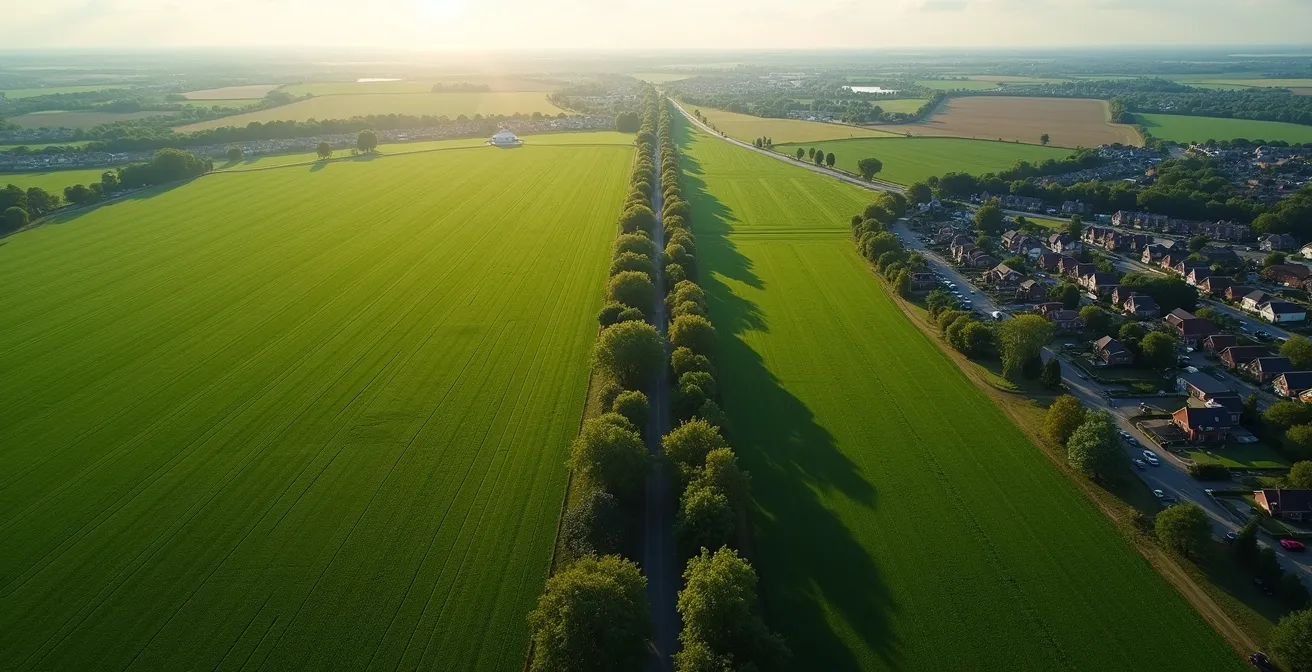
As this image illustrates, the line between residential and agricultural zones is often stark and definitive. On one side, the ordered patterns of housing; on the other, the open, productive expanse of farmland. The value of the homes on the edge is directly supported by the guaranteed permanence of the green space on the other side. You are not just buying a home; you are buying a perpetual, unblockable view, courtesy of provincial law.
Pick-Your-Own: Is Opening an Orchard a Viable Business for a Hobby Farmer?
The dream of country living often evolves into a more active fantasy: transforming a few acres into a small, productive business, like a U-pick orchard or a boutique vineyard. For the “hobby farmer,” this can be a rewarding lifestyle, but it’s crucial to approach it with a clear-eyed business perspective. The viability of such a venture depends heavily on market dynamics, land costs, and the specific agricultural potential of your property. The romantic vision must be grounded in the economic reality of Canadian agriculture.
The value of farmland itself is a key indicator of the health of the agricultural sector. In Canada, the market is robust. A report from Farm Credit Canada (FCC) provides a detailed look at how these values are changing across the country, which can help an aspiring hobby farmer understand the investment landscape. Quebec, for instance, shows strong, steady growth, suggesting a healthy and diversified agricultural economy conducive to niche products.
The following table, based on FCC data, breaks down recent trends in farmland values across several Canadian provinces. For a prospective buyer in the Eastern Townships, the 7.7% growth in Quebec is particularly relevant. It reflects a dynamic market driven by diversified agriculture, including the very wineries, cideries, and orchards that a hobby farmer might aspire to create. This data shows you’re not just buying into a lifestyle, but a thriving economic sector.
| Province | 2024 Growth Rate | Key Driver |
|---|---|---|
| Saskatchewan | 13.1% | Strong agricultural activity |
| British Columbia | 11.3% | Favorable growing conditions |
| New Brunswick | 9.0% | Limited supply |
| Quebec | 7.7% | Diversified agriculture |
| Alberta | 7.1% | Irrigation demand |
| Ontario | 3.1% | Market stabilization |
| Prince Edward Island | 1.4% | Stable market |
While the dream is appealing, success requires more than just passion. It demands a significant capital investment, a deep understanding of horticulture, and a solid business plan that accounts for marketing, labour, and the unforgiving nature of weather. For most, the more realistic path is to enjoy the fruits of their neighbours’ labour while their own property value appreciates alongside the thriving agricultural landscape.
Heritage Views: How Conservation Easements Protect Your Property Value?
Beyond broad governmental zoning like the “Green Zone,” there is a more precise and personal tool for preserving the character of a landscape: the conservation easement. For a property owner who values their “Heritage View”—that iconic vista of a historic barn, an old-growth forest, or a rolling pasture—an easement is the most powerful way to ensure it remains unchanged for generations. This legal agreement, made between a landowner and a conservation body (like a land trust), voluntarily restricts the type and amount of development on a piece of land, permanently.
How does this protect your property value? It operates on the same principle as the Green Zone, but on a micro-level. If your neighbour places their scenic farmland under a conservation easement, they have legally forfeited the right to subdivide it or build new structures. For you, this means your cherished view is not just protected by goodwill, but by a legally binding contract. This certainty adds a direct and often significant premium to your own property, as future buyers will pay more for a guaranteed, unspoiled landscape.
This tool is becoming increasingly popular in culturally and ecologically significant areas like the Eastern Townships. It’s a way for landowners to leave a legacy, often with tax benefits, while simultaneously bolstering the property values of the entire community. When you buy a property next to land under an easement, you are acquiring a level of certainty and stability that is rare in real estate. You are buying a view that has been legally secured against the pressures of future development. It transforms a beautiful but transient view into a permanent, bankable asset.
Therefore, when evaluating a property, it’s wise to inquire not only about the local zoning but also about any existing conservation easements in the immediate vicinity. The presence of such agreements is a strong positive signal about the community’s commitment to preserving its rural character and, by extension, its long-term real estate values.
The Micro-Climates of Monteregie: Why Some Valleys Are Better for Gardening?
Not all land is created equal, even within the same region. A discerning buyer, particularly one with a green thumb or aspirations of a small vineyard, must look beyond the macro-level map and understand the power of micro-climates. The Monteregie region, which includes the Eastern Townships, is a prime example. Its varied topography of hills and valleys creates countless distinct micro-climates, where conditions like temperature, sunlight exposure, and wind patterns can differ dramatically from one property to the next.
A south-facing slope might be several degrees warmer, allowing for the cultivation of more sensitive grape varietals. A valley floor might be protected from harsh winds but more susceptible to late spring frosts. These subtle differences determine the land’s true agricultural potential. This is a core component of “terroir”—the unique environmental context that gives agricultural products their character. A property with a favourable micro-climate is not just better for gardening; it possesses a higher intrinsic value because it has greater productive potential.
The long-term value of such land is significant. The appreciation of agricultural land is not a short-term trend; it’s a steady, reliable pattern. For example, over the last decade, Canadian agricultural land showed an impressive average appreciation of about 11% annually. Investing in a property with a superior micro-climate means you are buying land at the premium end of this appreciating asset class.

The effect of a micro-climate can be seen in the smallest details, like the morning dew on a grape leaf. This condensation is a direct result of specific temperature and humidity conditions in that exact spot. An experienced vintner or farmer learns to read these subtle signs. As a buyer, recognizing that one side of a hill is better suited for an orchard than the other is a mark of a sophisticated investor who understands the deep connection between land, climate, and value.
The “Cheese Trail” Effect: How Proximity to Artisans Boosts Short-Term Rental Rates?
The value of a rural property is not determined in a vacuum. It is deeply intertwined with the economic vitality of its surroundings. In regions famous for their artisan food culture, like the Eastern Townships with its `Route des Vins` and numerous fromageries, a powerful economic phenomenon emerges: the “Cheese Trail” Effect. This is an artisan economy flywheel where high-quality local producers attract tourists, who in turn drive up demand for accommodation, directly benefiting local property owners.
This is a classic example of agricultural symbiosis. The vineyards, cideries, and cheese makers create a destination. They become the “anchor tenants” of the region, drawing a steady stream of visitors eager for authentic gastronomic experiences. For a homeowner, this transforms your property from a simple residence into a potential income-generating asset through short-term rentals on platforms like Airbnb and Vrbo. Your proximity to these popular artisans becomes a key selling point, allowing you to command higher nightly rates and achieve better occupancy, especially during peak tourist season.
A clear case study of this effect can be seen in other parts of the province. For instance, Quebec’s Mauricie-Portneuf region saw significant farmland value growth driven by this exact feedback loop. The development of agritourism routes and the reputation of artisan food producers accelerated both the demand for agricultural land and the rates for nearby short-term rentals. This demonstrates that investing near an established or emerging “food trail” is a strategic move to capitalize on the tourism economy. To identify these high-value regions, a savvy investor should research provincial investments in regional food trails, map the density of anchor producers, and analyze accessibility from major urban centers.
When you buy a home in Dunham, you aren’t just buying property; you’re buying a foothold in a premier tourist destination. The success of the local cheesemaker or vintner directly contributes to your potential rental income and, ultimately, your property’s overall market value.
Is It Legal? How to Convince a Municipality to Allow Tiny Home Developments
As property values in desirable rural areas rise, investors and landowners increasingly look for innovative ways to maximize their land’s potential. One such idea is the development of tiny homes, either as a small community or as unique short-term rental units. However, this modern trend often runs into a wall of traditional municipal zoning bylaws. In most of rural Quebec, convincing a municipality to allow tiny home developments is a significant, though not impossible, challenge.
The primary obstacle is that most zoning regulations were written long before the tiny home movement began and do not have a category for such dwellings. They are often not classified as permanent homes, nor are they typically permitted as accessory dwelling units on agricultural land. To succeed, a proponent must frame the project not as a residential subdivision, but as a boon to the local economy, particularly agritourism. The argument must be that these small, low-impact structures can provide much-needed accommodation for tourists visiting the region’s wineries and farms, without paving over valuable farmland.
Success often hinges on presenting a professional, well-researched proposal that addresses the municipality’s concerns head-on. This includes detailed plans for servicing (water, septic), aesthetics that complement the rural character, and economic projections showing the positive impact on local tourism revenue. Some progress can be seen in markets where land values are stable and tourism is a key economic driver. For example, the relative stability of farmland values in a mature market like Prince Edward Island has led to more openness toward alternative agricultural developments, such as agri-tourism cabins, which share a similar profile to tiny homes.
Ultimately, pioneering a tiny home project in a rural municipality is an uphill battle that requires patience, significant investment in planning, and strong negotiation skills. It is not a straightforward path to profit, but for the right investor with a compelling vision that aligns with the region’s agritourism goals, it can be a way to unlock unique value from a property.
Key Takeaways
- True rural property value (“Terroir Value”) is an economic equation based on land protection, agricultural health, and local artisan culture.
- Legal frameworks like Quebec’s “Green Zone” are not restrictions but powerful assets that create scarcity and protect views, boosting adjacent property values.
- The success of local wineries, farms, and artisans creates an “agritourism flywheel” that directly increases a property’s short-term rental income potential and overall demand.
The Foodie Factor: How Gastronomy Drives Real Estate Demand in Regions like Charlevoix
The ultimate expression of Terroir Value is when all the elements—protected land, skilled farming, artisan production, and tourism—coalesce to create a world-class gastronomic destination. Regions like Charlevoix or the Eastern Townships become magnets for “foodies,” a discerning demographic that travels for culinary experiences. This “Foodie Factor” acts as a powerful accelerant for the local real estate market, driving demand in a way that transcends typical market cycles.
Gastronomy creates a narrative for a region. It’s not just about a single good restaurant or winery; it’s about an entire ecosystem of quality. When a region gains a reputation for its food, it attracts a wealthier, more invested type of visitor and potential resident. These are buyers who appreciate the story behind their food, the quality of the local ingredients, and the culture of craftsmanship. They are willing to pay a premium for property that places them at the heart of this vibrant scene. This demand is built on something more durable than fleeting trends: the authentic character of a place.
This entire system is underpinned by a simple, powerful economic principle: the finite nature of the land itself. As FCC Chief Economist J.P. Gervais noted, “The limited supply of farmland available for sale combined with lower borrowing costs resulted in an increase in the average price of farmland across the country.” This scarcity is even more pronounced for land that contributes to a renowned gastronomic region. Furthermore, according to Statistics Canada, the total amount of available farmland is shrinking. One report highlights that total farmland has shrunk by over 3 million acres since the early 2000s. This decreasing supply, met with rising demand from both agriculture and lifestyle buyers, is the fundamental equation that ensures the long-term appreciation of your investment.
When you invest in a property in a region known for its terroir, you are buying more than land and a house. You are buying a piece of a story, a stake in a protected landscape, and a share in a thriving artisan economy. This is the essence of Terroir Value—a robust and enduring asset that pays dividends in both lifestyle and financial returns.
To truly capitalize on the unique opportunities presented by Terroir Value, the next logical step is to analyze specific properties through this new lens, evaluating not just the home itself but its strategic position within the local agricultural and artisan ecosystem.