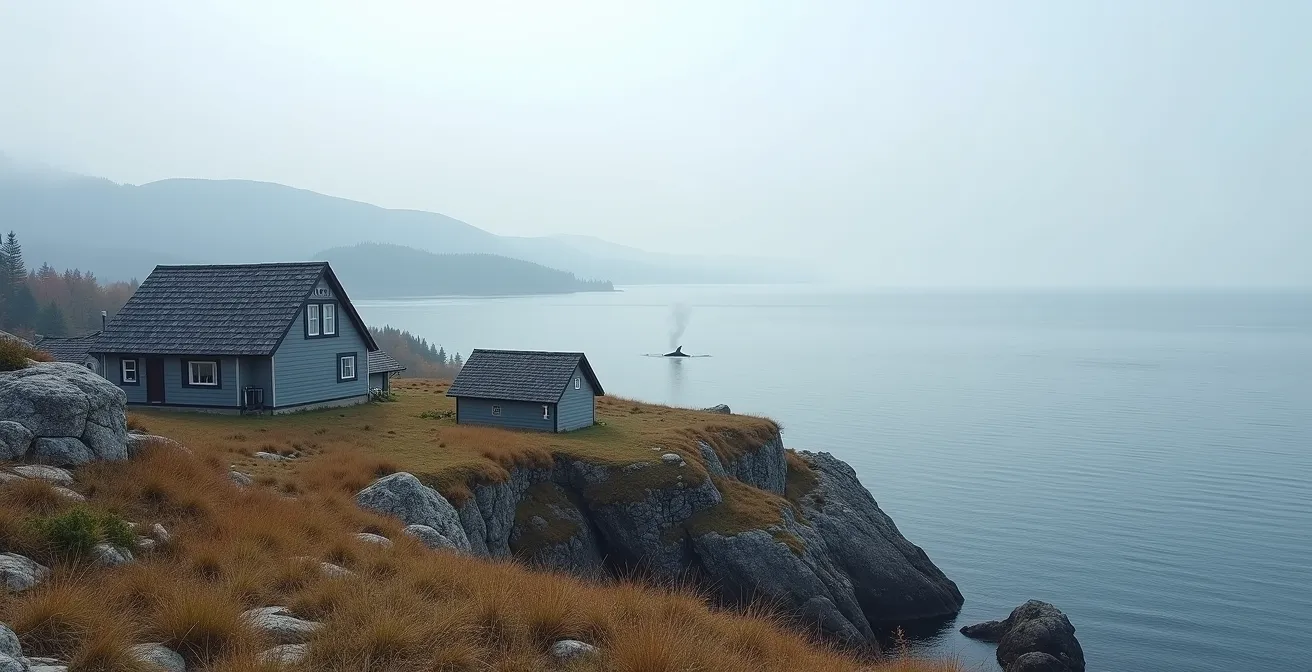
Contrary to idyllic brochures, the true value of St. Lawrence real estate lies in mastering its unique environmental and economic challenges, not just admiring the view.
- Physical risks like coastal erosion and salt air corrosion are manageable but require specific materials and proactive maintenance.
- The region’s economy is driven by seasonal tourism, creating lucrative rental opportunities for savvy investors who can address housing shortages.
Recommendation: Your due diligence must extend beyond standard inspections to include flood zone mapping, marine park regulations, and a realistic budget for the ‘salt and rust’ premium of coastal living.
The dream is powerful: waking to the sound of a whale’s blow, watching the tides transform the landscape from your deck, and owning a piece of one of Canada’s most iconic coastlines. The St. Lawrence Estuary, particularly along the Charlevoix and Côte-Nord shores, offers a lifestyle that feels a world away from the city. This promise of natural grandeur and authentic Quebecois maritime culture attracts many potential buyers.
Most discussions about real estate here understandably focus on the spectacular views, the proximity to national parks like Bic, and the investment potential driven by a booming whale-watching industry. But the seasoned coastal property expert knows that the conversation can’t end there. The very forces that create this stunning environment—the powerful river, the salt-laden air, the seasonal influx of people—present a unique set of operational realities for homeowners. Ignoring them is not just naive; it’s a financial risk.
This guide takes a different approach. We’re moving beyond the postcard to give you the strategic insights needed to make a sound investment. We’ll explore the symbiotic relationship between the region’s environment and its economy, revealing that the key to success isn’t just finding a house with a view, but understanding the ecosystem it belongs to. It’s about resilience planning, both for your property and your finances.
By examining the critical factors—from coastal erosion and material corrosion to the nuances of a seasonal rental market and conservation regulations—you will gain the knowledge to not only protect your investment but to thrive within the unique economic landscape of the Whale Route. This is your guide to mastering the operational realities of coastal living.
Summary: Navigating Real Estate on the St. Lawrence Estuary
- Coastal Erosion: How to Check if Your Dream Cottage Will Fall into the River?
- Salt Air Corrosion: Why Your Metal Roof and Car Rust Faster by the Sea?
- Living on an Island: The Reality of Depending on Ferry Schedules (L’Isle-aux-Coudres)?
- Staffing the Whale Boats: The Critical Shortage of Housing for Seasonal Pilots
- Marine Parks: How Conservation Zones Limit Dock and Waterfront Construction?
- Can You Compete with Employer-Provided Housing in Remote Areas?
- Shoreline Protection: Managing Camping Sites Near Lakes and Rivers
- Northern Living: Can You Really Buy a House for Under $200k in Abitibi?
Coastal Erosion: How to Check if Your Dream Cottage Will Fall into the River?
The dynamic shoreline of the St. Lawrence is a core part of its appeal, but it’s also a significant risk factor for any waterfront property owner. Coastal erosion is a slow, persistent process that can undermine foundations and lead to catastrophic property loss. Unfortunately, this is a peril that is often misunderstood by buyers mesmerized by a cliff-top view. The reality is that coastal erosion affects 20% of Quebec waterfront properties, yet it’s typically excluded from standard home insurance policies because it’s classified as a gradual “earth movement” rather than a sudden event.
This insurance gap means that due diligence before you buy is not just important; it’s your primary line of defense. A prospective buyer must become a student of the local geography and regulations. The process begins with verifying the property’s status within designated risk zones. Quebec’s government provides powerful tools for this, but you must know where to look and what to ask. Your investigation should involve checking official flood and erosion maps and cross-referencing that data with the municipal land use plan (schéma d’aménagement), which details specific local risks.
Understanding these risks also allows you to budget for potential mitigation. Shoreline stabilization is possible, but costs vary dramatically. Soft engineering solutions like revegetation can cost between $10,000 and $30,000, while hard engineering like a stone riprap wall can easily reach $50,000 to $150,000. Factoring these potential future expenses into your purchase price is a crucial part of smart resilience planning.
Your Checklist for Verifying Erosion Risk in Quebec
- Access Official Maps: Begin by using Quebec’s official Géo-Inondations mapping tool to confirm if the property lies within a designated flood or erosion zone.
- Consult Municipal Plans: Contact the local municipality to review the schéma d’aménagement et de développement (land use and development plan) for specific coastal risk assessments tied to the property’s address.
- Investigate Stabilization Permits: If considering shoreline work, inquire about the process for obtaining a Certificate of Authorization from the MELCCFP and budget accordingly for soft vs. hard engineering solutions.
- Review Insurance Options: Confirm with your broker that gradual erosion is excluded from your policy and ask about specific riders for “sudden earth movement,” referencing guidelines from the Insurance Bureau of Canada.
- Check Financial Assistance Eligibility: Determine if the property could qualify for Quebec’s disaster financial assistance program, which may apply to properties deemed at imminent risk of erosion.
Salt Air Corrosion: Why Your Metal Roof and Car Rust Faster by the Sea?
Life on the St. Lawrence Estuary means constant exposure to a corrosive cocktail of salt and humidity. This salty air, while invigorating, is relentless in its attack on metal. Homeowners often underestimate this “salt and rust premium,” discovering too late that their new metal roof, deck hardware, and even their vehicle are aging prematurely. The airborne salt particles settle on surfaces, attract moisture, and dramatically accelerate the oxidation process, turning a 5-year screw into a rust stain in a single season.

This is not a matter of poor quality but of a harsh environment demanding specific solutions. Standard building materials are simply not designed to withstand this constant chemical assault. Choosing coastal-grade materials from the outset is a critical investment. For example, a standard galvanized steel roof might last a decade, whereas a roof made from Galvalume Plus, designed for marine environments, can last 25 years or more. The same principle applies to everything from window frames, where fiberglass outperforms aluminum, to the small but crucial deck screws, where 316-grade stainless steel is non-negotiable.
The following table, based on data from Quebec government recommendations and CSA standards, illustrates the stark difference in lifespan and the importance of selecting the right materials for any new build or renovation project on the coast. It’s a clear demonstration of how a higher upfront cost translates into long-term savings and structural integrity.
Proactive maintenance is the other half of the equation. A disciplined seasonal routine is essential to combat the effects of salt. This isn’t a suggestion; it’s a non-negotiable part of coastal homeownership. A simple freshwater rinse can do wonders, and a structured maintenance calendar ensures no detail is overlooked.
This comparative data, derived from analyses of materials suitable for Quebec’s coastal climate, highlights the importance of investing in resilience.
| Material Type | Standard Option | Coastal-Grade Option | Expected Lifespan Difference | CSA Rating |
|---|---|---|---|---|
| Roofing | Galvanized Steel | Galvalume Plus | 10 years vs. 25 years | CSA A123.21 |
| Window Frames | Aluminum | Fiberglass/Vinyl | 15 years vs. 30 years | CSA A440 |
| Deck Hardware | Zinc-plated | 316 Stainless Steel | 5 years vs. 20 years | CSA G164 |
Living on an Island: The Reality of Depending on Ferry Schedules (L’Isle-aux-Coudres)?
The allure of island living, epitomized by places like L’Isle-aux-Coudres in the Charlevoix region, is undeniable. It offers a sense of community, seclusion, and a profound connection to the rhythm of the river. However, this idyllic lifestyle comes with a unique set of operational realities tied directly to the umbilical cord of the ferry service. For a potential homeowner, this is a logistical factor that must be evaluated with the same seriousness as a property inspection.
Life on the island moves to the beat of the ferry schedule. While the service is generally reliable, it dictates everything. A missed ferry can mean a significant delay, impacting everything from grocery shopping and medical appointments on the mainland to commuting for work. During peak tourist season, wait times can be long, and during the winter or in rough weather, service can be reduced or even cancelled. This dependency requires a fundamental shift in mindset, demanding advanced planning and a level of self-sufficiency that mainland living does not.
From a real estate perspective, this has several implications. Access for contractors and building materials can be more complicated and expensive, as everything must be transported by boat. Emergency services, while available, have an inherent delay compared to the mainland. Furthermore, the “island premium” can apply to the cost of goods and services. Prospective buyers must ask practical questions: What is the contingency plan if the ferry isn’t running? How does this impact home insurance or access to specialized healthcare? For those planning to work from home, is the internet connectivity robust enough to handle disruptions in physical travel?
Ultimately, buying on an island like L’Isle-aux-Coudres is a lifestyle choice that trades convenience for charm. A successful owner is one who embraces this trade-off, building buffer time into their schedules, keeping a well-stocked pantry, and developing a deep appreciation for the quiet moments when the last ferry has departed for the night.
Staffing the Whale Boats: The Critical Shortage of Housing for Seasonal Pilots
The engine of the St. Lawrence Estuary’s economy is tourism, and its fuel is the seasonal workforce. From May to October, towns like Tadoussac, Les Escoumins, and Baie-Sainte-Catherine swell with whale boat pilots, naturalist guides, and hospitality staff. This influx creates a vibrant atmosphere but also exposes a critical vulnerability in the local real estate market: a severe shortage of suitable housing for these essential workers. This challenge, however, represents a significant opportunity for the savvy property investor.

Many large tour operators provide dorm-style housing, but there is a growing demand for better quality, private accommodations that employers struggle to meet. An investor who can offer clean, furnished, and well-maintained rental units can tap into a steady stream of income. The key is understanding this specific niche. Seasonal leases are permitted for tourism workers under Quebec’s Tribunal administratif du logement (TAL), allowing for premium rates during the high season with near-guaranteed occupancy. This model of “ecosystem economics” directly links your property investment to the health of the whale-watching industry.
A successful seasonal rental business model in this context requires more than just a spare room. It means providing a turn-key solution for a worker arriving for a five-month season. This includes providing a furnished space with a private bedroom, reliable high-speed internet (a crucial amenity now more accessible with services like Starlink in remote Côte-Nord areas), and functional kitchen facilities. By meeting these needs, you create a property that is far more attractive than basic employer-provided options.
Case Study: The Tadoussac Seasonal Rental Model
With whale watching packages in the Charlevoix region starting at $139 per person per night for tourist accommodations, property owners have a clear benchmark for value. By catering to the seasonal workforce, an investor can create a profitable niche. Landlords offering furnished rentals compliant with TAL regulations for seasonal workers can charge premium monthly rates during the May-October peak season. This provides a stable, high-demand revenue stream, effectively turning the region’s biggest logistical challenge—seasonal staffing—into a lucrative real estate opportunity.
Marine Parks: How Conservation Zones Limit Dock and Waterfront Construction?
Owning waterfront property within the perimeter of a world-renowned conservation area like the Saguenay-St. Lawrence Marine Park is a double-edged sword. On one hand, the park’s strict conservation measures protect the very ecosystem—especially the whales—that makes your property so valuable and unique. On the other hand, these same regulations impose significant limitations on what you can do with your shoreline.
The park is not just a designation on a map; it’s a complex legal and administrative entity co-managed by Parks Canada and Quebec’s Sépaq. This joint governance creates a multi-layered permitting process for any waterfront construction, including docks, boathouses, or shoreline stabilization. Property owners in areas designated as Comprehensive Conservation Zones face the strictest rules. These can include restrictions on the size and materials of docks, prohibitions on certain types of motorized watercraft (jet skis are banned throughout the park), and even regulations on nighttime lighting to prevent disorientation of marine life.
These rules are in place for a good reason. The park is a critical habitat for several whale species, including the endangered St. Lawrence beluga. Regulations are designed to minimize human impact on these animals. For instance, the park welcomes 400,000 visitors annually via boats, but rules prohibit approaching belugas closer than 400 metres. For a property owner, this translates into a responsibility to be a steward of the environment. Your dream of building a large private dock might not be feasible if it interferes with a sensitive area.
Before purchasing any waterfront property in or near the park, it’s essential to conduct thorough due diligence on its specific zoning. This involves contacting both Parks Canada and Sépaq to understand the limitations that apply to the property. This is a prime example of “symbiotic real estate”: the regulations that limit your personal use are the same ones that preserve the long-term value of your investment by protecting the natural attraction of the region.
Can You Compete with Employer-Provided Housing in Remote Areas?
For investors looking to capitalize on the seasonal housing shortage, the main competition often comes from the large tour operators themselves. Many provide basic, dorm-style accommodations for their staff. To succeed, a private landlord must offer a superior value proposition. This doesn’t necessarily mean competing on price, but rather on quality of life, offering features that institutional housing lacks. This strategy is particularly effective when targeting not just seasonal workers, but also the growing demographic of remote professionals seeking a “workation” escape from the city.
The key to competing is differentiation. While an employer might offer a bed, you can offer a home. Highlighting premium features is crucial. For instance, the availability of reliable, high-speed internet via Starlink in previously underserved Côte-Nord areas is a massive selling point for remote workers. Other key differentiators include offering pet-friendly policies, which are almost never available in employer housing, and emphasizing private outdoor spaces with inspiring views of the St. Lawrence. A well-equipped home office setup can seal the deal for a professional looking to blend work and leisure.
The financial model also requires strategic thinking. A hybrid approach can often yield the highest return on investment. This involves leveraging the high-demand, high-rate tourism season from May to September, and then offering a medium-term lease (e.g., 7 months) at a standard rate for the rest of the year to a local resident or a remote worker. This balances high seasonal income with stable year-round occupancy, outperforming both a standard 12-month lease and a purely seasonal strategy.
The following analysis illustrates the potential returns of different rental strategies in the region. A hybrid model, while requiring more active management and compliance with both residential and commercial tourism regulations, can generate significantly higher annual gross revenue.
| Rental Strategy | Monthly Revenue | Occupancy Rate | Annual Gross | TAL Compliance |
|---|---|---|---|---|
| 12-Month Local Lease | $1,200 | 100% | $14,400 | Standard protections |
| 5-Month Tourism (May-Sept) | $3,500 | 80% | $14,000 | Commercial license required |
| Hybrid: 7-Month + 5-Month Tourism | $1,200/$2,500 | 90% | $16,900 | Mixed compliance |
Shoreline Protection: Managing Camping Sites Near Lakes and Rivers
The desire for unfettered access to the water is a primary driver for buying a coastal property. However, the province of Quebec has established strict regulations to protect the fragile ecosystems that border its lakes and rivers, including the St. Lawrence. The most significant of these is the Policy for the Protection of Shores, Littoral Zones, and Floodplains (PPRLPI). This policy is not a mere suggestion; it is a legal framework that dictates land use within a specific distance of the high-water mark.
For any waterfront owner, the most critical element of the PPRLPI is the mandatory riparian buffer zone. This is a strip of land, typically 10 to 15 meters wide measured from the high-water line, where most forms of development are strictly forbidden. This means you cannot build structures, clear vegetation, or even extensively landscape within this protected band. The purpose of this buffer is to prevent erosion, filter runoff from your property before it enters the river, and provide a critical habitat for wildlife.
For property owners, especially those with smaller lots or who envision creating amenities like private campsites or manicured lawns down to the water’s edge, this can be a major constraint. Failure to comply can result in significant fines and orders to restore the shoreline to its natural state at your own expense. Therefore, any plan for your waterfront must begin with a clear understanding of where this buffer zone lies and what activities are permitted within it.
Instead of viewing this as a limitation, the savvy owner sees it as a framework for responsible stewardship. The focus shifts from “clearing” the shoreline to enhancing it with native plants that thrive in St. Lawrence conditions, such as wild rose and red osier dogwood. It involves a commitment to practices that protect the water quality that defines the region, from maintaining your septic system to using phosphate-free cleaners. This approach not only ensures compliance but also enhances the ecological health and long-term appeal of your property.
Your Waterfront Eco-Stewardship Action Plan
- Re-vegetate the Riparian Buffer: Plant native species like wild rose, red osier dogwood, and willows within the 10-15 meter buffer zone to stabilize the soil and create a natural filter.
- Install Dark Sky Compliant Lighting: Use shielded light fixtures that direct light downward and have a maximum color temperature of 3000K to minimize light pollution and protect nocturnal wildlife.
- Maintain Your Septic System: Schedule an annual inspection with a certified professional to ensure your septic system complies with Quebec’s Q-2, r.22 regulation and is not leaching into the groundwater.
- Use Eco-Friendly Products: Exclusively use phosphate-free and biodegradable cleaning products to prevent harmful chemicals from entering the estuary’s delicate ecosystem.
- Create Permeable Pathways: If creating a path to the water, use permeable materials like wood chips or gravel instead of pavement to allow rainwater to soak into the ground and reduce erosive runoff.
Key Takeaways
- The Environment is an Active Partner: Your property’s physical integrity depends on actively managing environmental forces like erosion and salt corrosion through smart material choices and consistent maintenance.
- The Economy is Seasonal and Specific: The region’s tourism-driven economy creates unique and profitable rental niches for investors who can solve the seasonal housing shortage with quality accommodations.
- Regulations are a Framework for Value: Strict rules, from riparian buffer zones to marine park construction limits, are not just constraints; they are mechanisms that protect the natural beauty and long-term value of your real estate investment.
Northern Living: Can You Really Buy a House for Under $200k in Abitibi?
The search for affordable real estate often leads buyers to cast a wide net, with inland regions like Abitibi-Témiscamingue appearing attractive for their sub-$200,000 price points. However, for those captivated by the maritime lifestyle, the question remains: is coastal living on the Whale Route completely out of reach? While hotspots like Baie-Saint-Paul and Tadoussac command premium prices, the answer is no. Affordable properties still exist, provided you know where to look and what hidden costs to budget for.
The key to finding value is to look beyond the primary tourist hubs. Further up the Côte-Nord, in communities like Les Escoumins and Forestville, or across the river on the South Shore near Trois-Pistoles, properties under $300,000 are still a reality. These areas offer the same access to the pure marine air and stunning sunsets over the St. Lawrence, but without the intense market pressure of their more famous neighbours. You are still on the doorstep of the Saguenay-Saint-Laurent Marine Park, with premier whale-watching opportunities just a short drive away.
However, an attractive sticker price is only the beginning of the story. The “salt and rust premium” applies here as well, and older homes in these remote areas often come with a list of necessary, and costly, upgrades. A truly affordable purchase is one where these “hidden” costs are factored in from day one. A mandatory septic system upgrade to meet Quebec’s stringent Q-2, r.22 regulations can easily cost $25,000 or more. If the property isn’t on municipal water, drilling a well can add another $15,000-$30,000. These are not optional renovations; they are fundamental requirements for a safe and legal dwelling.
Furthermore, buyers, particularly Anglophones, must consider access to services. In many of the more affordable and remote Côte-Nord communities, healthcare, education, and government services are offered primarily in French. This is a practical, day-to-day reality that must be part of the decision-making process. A successful investment in these areas is about balancing the allure of a lower purchase price with a realistic, comprehensive budget for upgrades and a clear-eyed assessment of the lifestyle fit.
To make a truly informed decision on the Whale Route, your next step is to apply this framework of operational realities and hidden costs to every property you evaluate, ensuring your investment is as resilient as it is beautiful.